Follow Us on Google
From Ndubuisi Orji, Abuja
Barely two weeks after assumption of office, President Bola Tinubu assented to the Student Loan (Access to Higher Education) Act. The Act, which was sponsored by former speaker of the House of Representatives, Femi Gbajabiamila, and passed by the ninth National Assembly, is intended to give a lifeline to indigent students in government-owned tertiary institutions.

The bill provides that the student loan, which shall be funded majorly from 1% of all taxes, levies and duties accruing to the government of the federation from Federal Inland Revenue Service (FIRS), Nigerian Immigration Service and Nigerian Customs Service; and 1% of all profits accruing to the government of the federation arising from oil and other minerals, shall be only for the payment of tuition fees.
Specifically, a section of the Act stipulates that “the loans referred to in this Act shall be granted to students only for the payment of tuition fees.” While Section 14 states thus: “(a) applicant must have secured admission into any of the Nigerian universities, polytechnics, colleges of education or any vocational school established by the Federal Government or the government of any state of the federation.
“(b) applicant income or family income must be less that N500,000 per anum. (c) applicant must provide at least two guarantors, and each of the guarantors shall be a- (i) civil servant of at least level 12 in the service, (i) lawyer with at least 10 years post-call experience, (i) judicial officer, or (iv) justice of peace.
However, the Act, which is intended to give a lifeline to indigent students have been trailed by controversy. Not a few have picked holes in some of the provisions of the law, which they considered unfriendly.
Recently, Tinubu announced that all the encumbrance of the legislation has been put aside. He went ahead to set up a presidential committee, with Gbajabiamila, who is also his chief of staff, to work out modalities for the takeoff of the scheme.
Also, in July, the House of Representatives set up an ad hoc committee to interface with the Federal Ministry of Education on the issues surrounding the implementation of the Student Loan Scheme.
Permanent secretary, Ministry of Education, David Adejoh, who appeared before the panel recently, had said the scheme was implementable, noting that the presidential committee was already fine tuning modalities, including proposed amendments to the Act.
According to him, “we have been meeting as a committee and we have looked at specific areas that we think should be further refined to be able to answer all the questions that Nigerians needed answered. Most importantly, especially to make the act very responsive to the need to increase access to higher education, especially for those people that could not afford it.”
The stance of the Permanent Secretary, notwithstanding, stakeholders, including members of the House of Representatives, have continued to raise concerns about some of the ambiguities of the Act.
Some of the concerns, Daily Sun gathered, included whether the loan is going to be a one-off affair, which would take a student from the first year to final year. A school of thought has also wondered how students under the scheme would be able to cope with other living expenses on campus, like accommodation, books, etc, as tuition is actually the least of the challenges of indigent students.
However, the major concern is seemingly Section 3 of the Act, which stipulates the loan is solely for tuition. Incidentally, the permanent secretary says, none of the Federal Government-owned tertiary institutions collect tuition.
While the government is optimistic that the scheme will kick off any time from September, members of the House of Representatives believe that there are many issues yet to be addressed for the effective take-off of the scheme. These, according to them, include the procurement for the take-off of the scheme and the welfare of students among other issues.
Chairman, House ad hoc committee on the Student Loan, Terseer Ugbor, says there are still a lot of unanswered questions about the the scheme.
Ugbor said: “There are a lot of questions to be asked that need answers. There are a lot of gaps, so to say. The secretariat that is being formed to manage this student loans, the platform that is being created, are there plans to ensure recovery of these loans? How will these loans be done? I heard that the commercial banks will be involved in the disbursement and in the recovery of these loans. Are commercial banks equipped to play these roles?
“We have had discussion with students and one of the issues they raised was the issue of their upkeep. Are we giving student loan to the students and excluding the issue of upkeep? Can these issues be included in these loan? Can a percentage of this loan be given as upkeep for students’ welfare while in school? Of course, you know a student with a hungry stomach or a student who cannot transport himself from Point A to Point B cannot achieve the full benefits of being in the university.”
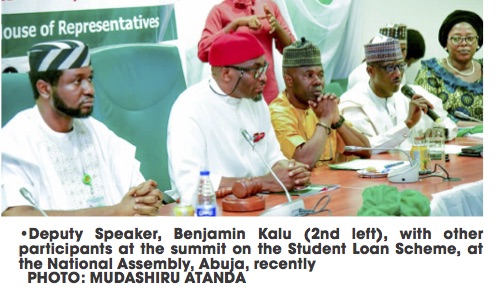
Last Thursday, the House of Representatives also held a summit on the Students Loan Scheme. The Speaker, Tajudeen Abbas, who was represented by his deputy, Benjamin Kalu, in his speech at the event, noted that the summit to harness opinion of stakeholders to guide the House in the review of the Student Loan Act, so that it can serve the intended purpose
According to him, “the Student Loan Act is a legislative framework designed to address the financial challenges faced by young Nigerians to accessing higher-quality education. By accessing credit facilities, the Act aims to ensure that deserving students are not denied educational opportunities due to financial constraints.”
Nevertheless, a parent, whose wards are in a public university, Osigbeme Yakubu, told Daily Sun that no student in Federal Government owned tertiary institutions can benefit from the scheme, except the Act is amended, especially as the loan is tied solely to tuition fees, which they do not pay.
According to him, “like the government has said there is no federal university that collects tuition. It has been like that for a long time. That is why they are hiding under those charges. Indirectly they collect it under those charges. They need to be very specific. If you are going to tie it to tuition, if means that no student will be able to collect the loan, especially students from federal universities, because federal universities don’t pay tuition.
“They need to remove that word tuition and call it fees. You can call it anything that you want to call it, tying it to tuition means no student will be able to benefit from it because federal institutions don’t pay tuition, not just the universities. All federal higher institutions – polytechnics, colleges of education, research institutes, it is tuition free. But they pay charges.”
He added that “there is need to be certain caveat to it, because if it is a loan, there should be a ceiling to which any student can take. If there is no ceiling, then they will be an abuse to the process. And then there should also be a limit. Is it going to a one-off thing? Or students can apply twice or thrice? But then how do you apply for the loan; you have not paid one and you are applying for another. How much can you apply for and at what level can you apply?”
Similarly, the Senate President, National Association of Nigerian Students (NANS) Nnalue Felix, said the students body is concerned about certain aspects of the Act.
He stated: “We have seen this as an avenue to facilitate and also empower Nigerian students who have financial challenges with regards to the completion of their academic pursuits. But we also want to state that there are some worrisome challenge concerning some of the provisions of the Act itself.
“There is need for a review of the criteria for securing this loan. We have suggestions that there is need to involve district heads, chief executive officers of businesses worth N2million. And businesses that are certified by CAC should also be made to be guarantors.
“We also spoke about the need for the NANS leadership to be represented in the board. This will actually give a grassroots representation of the people who are targeted to benefit from this loan. Nigerian students are pleading that in the implementation of this loan, there’s need for those who will be saddled with the responsibility of working on the Board to be transparent and to make the loan available to the poor masses and the common man because the loan, ordinarily, is targeted at those facing hardship. Those who do not have people to stand in for them in the pursuit of the academic programme.’
Nevertheless, Adejoh told members of the House of Representatives that all the grey issues will be sorted out. According to him, “the issue we are looking at are because of the reactiond of Nigerians to the bill. I stand to be corrected, not up to five people have signed the Act. So, people are talking about what they don’t really know about. That is why I will be circumspect to go into specific issues because we are already discussing them.
“It is implementable. On the understanding that a vehicle is a vehicle, whether you buy a Volkswagen or a Mercedes, the two can take you to your destination. But it is the speed with which you can get there that is the difference. As it is now, it is implementable to the extent that we are coming back to the National Assembly to make sure we increase the speed of getting to our destination.”