Follow Us on Google
From Kenneth Udeh, Abuja
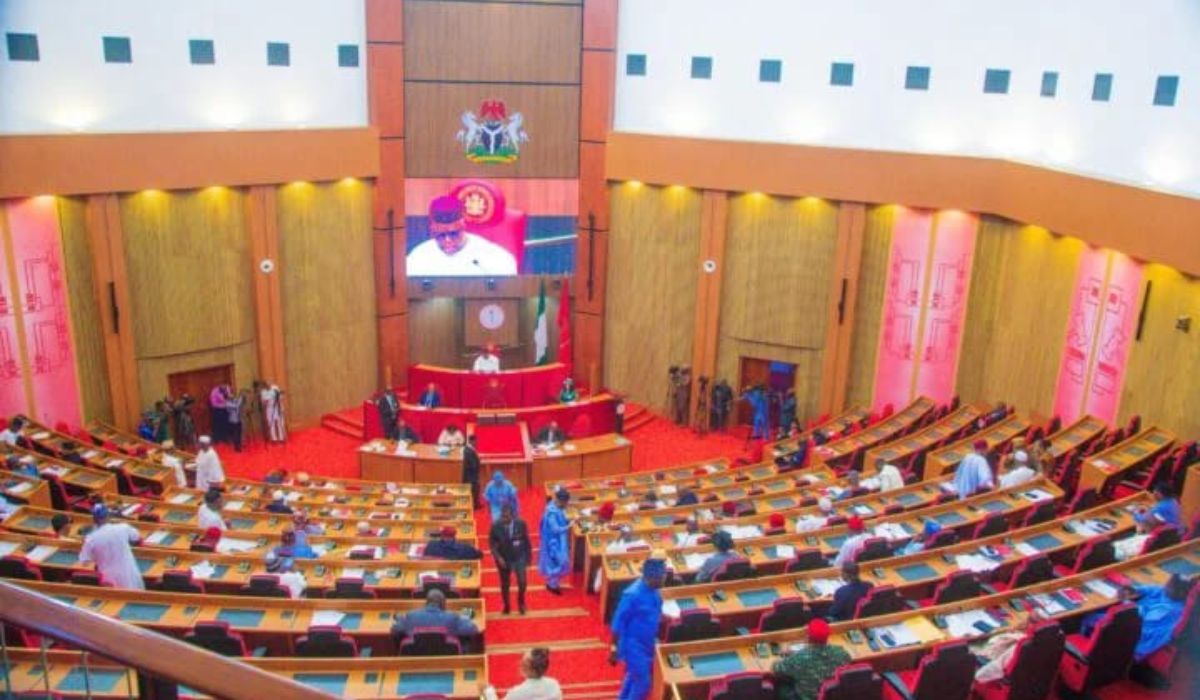
In a watershed moment for Nigeria’s democratic and security evolution, the Senate on Wednesday approved the Constitution of the Federal Republic of Nigeria (Alteration) (State Police) Bill, 2026, bringing the country closer than ever to the establishment of state-controlled police services after decades of national debate.
The landmark constitutional amendment, transmitted to the National Assembly as an Executive Bill by President Bola Ahmed Tinubu and sponsored on the floor of the Senate by Senate Leader Opeyemi Bamidele, secured overwhelming support after a rigorous clause-by-clause consideration in which all 26 provisions attracted not less than 80 affirmative votes.
The historic vote unfolded under the watchful eyes of senior officials of the Tinubu administration, state governors and Attorneys-General who were granted rare access into the Senate Chamber to observe proceedings, underscoring the significance attached to the legislation by both the executive and legislative arms of government.
On the same day, the Senate also passed the Police Trust Fund Act (Repeal and Re-enactment) Bill, 2026 (SB.1030), following consideration of the report of the Senate Committee on Police Affairs chaired by Senator Abdulhamid Ahmed Mallam-Madori (Jigawa East), further strengthening the legal and financial framework for policing in Nigeria.
Executive Presence Signals Significance of Reform
Proceedings began with the swearing-in of four newly elected senators by Senate President Godswill Akpabio following their victories in recent by-elections conducted by the Independent National Electoral Commission (INEC).
The lawmakers sworn in were Senator Olaka Nwogu of the Peoples Democratic Party representing Rivers South-East Senatorial District, Senator Envulu Anza of the All Progressives Congress representing Nasarawa North, Senator Ikeje Asogwu of the APC representing Enugu North and Senator Dayo Faduyile of the APC representing Ondo South.
Shortly thereafter, the Senate suspended Order 12 of its Standing Rules following a motion moved by Senate Leader Opeyemi Bamidele to permit distinguished visitors into the chamber.
Among those admitted were Chief of Staff to the President, Femi Gbajabiamila; Kaduna State Governor Uba Sani; Ogun State Governor Dapo Abiodun; Ondo State Governor Lucky Orimisan Aiyedatiwa; and several state Attorneys-General, including representatives from Anambra and Akwa Ibom States.
Their presence immediately drew attention within the Red Chamber, as attendance by non-members during sensitive legislative proceedings is traditionally uncommon.
The Sun gathered that some lawmakers initially expressed reservations over the admission of the visitors. However, they were eventually allowed to witness what many senators described as one of the most consequential constitutional exercises in Nigeria’s democratic history.
Privately, several lawmakers interpreted the heavy executive presence as a reflection of the Presidency’s keen interest in the outcome of the State Police Bill, with some describing it as a subtle effort to observe lawmakers’ positions on one of President Tinubu’s flagship constitutional reforms.
Closed-Door Session Delays Proceedings
Although the Senate had scheduled consideration of the constitutional amendment package immediately after the swearing-in ceremony, proceedings were temporarily delayed when lawmakers moved into a closed-door executive session following a motion by Senate Leader Bamidele.
The meeting lasted for over an hour before senators returned to the chamber to begin deliberations on the highly anticipated legislation.
Akpabio Sets Tone for Historic Vote
Before the Senate entered the executive session, Senate President Godswill Akpabio described the constitutional amendment process as a defining moment for both the National Assembly and Nigeria’s democratic development.
He urged senators to rise above partisan interests and approach the exercise with patriotism and a commitment to national interest.
According to him, the proposals before the Senate were not ordinary legislative measures but reforms capable of fundamentally reshaping Nigeria’s security architecture and strengthening the federal system.
“The decisions we take will have the potential to shape the future of policing, public safety and intergovernmental relations in Nigeria for generations to come,” Akpabio stated.
Governors to Appoint State Police Commissioners
One of the major highlights of the bill was the constitutional empowerment of state governors to appoint Commissioners of Police for their respective states, subject to confirmation by the State Houses of Assembly.
Under Clause 17 of the proposed amendment, while the Federal Police Service should continue to be headed by an Inspector-General of Police, every State Police Service should be headed by a Commissioner of Police appointed by the governor and confirmed by the state legislature.
The bill also defined the operational relationship between governors and state police commands.
Section 17(6) provided that a governor might issue lawful written directives of a general policy nature to the Commissioner of Police on matters relating to public safety and public order within the state.
To address concerns over potential abuse, lawmakers inserted safeguards prohibiting political persecution through the state police structure.
Section 17(7) specifically provided that a State Commissioner of Police should not arrest, detain, investigate or deploy force against any person, political party or group merely for criticising the government except in accordance with the law.
The provision was designed to prevent the weaponisation of state police against political opponents, activists, journalists and dissenting voices.
Senate Abandons Electronic Voting
One of the dramatic moments of the day came when the Senate abandoned plans to deploy electronic voting for the constitutional amendment exercise.
Akpabio had earlier announced that senators would vote electronically, with each vote digitally recorded, displayed and printed to guarantee transparency and accountability.
Test runs of the electronic voting devices were subsequently conducted, marking what would have been the first deployment of such technology for constitutional voting under the 10th Senate.
Other News
However, the arrangement was later discarded after Senate Leader Opeyemi Bamidele raised concerns that technical faults affecting some devices could disenfranchise lawmakers.
He consequently proposed a manual voting process that would allow every senator to publicly declare his or her position.
“Rather than go by way of electronic voting, which obviously now will disenfranchise a few or some of our colleagues whose machines are not working, I am moving that we give every distinguished senator the opportunity to answer his or her father’s name by doing manual voting,” Bamidele said.
Akpabio endorsed the proposal, arguing that public voting would enable constituents to know exactly where their representatives stood on every constitutional amendment.
The Senate subsequently suspended relevant provisions of its Standing Rules and adopted the manual voting process.
Bamidele Leads Debate on Landmark Reform
Opening debate on the bill, Bamidele described the proposal as one of the most significant constitutional reforms since the advent of the Fourth Republic.
He argued that the centralised policing system established by the 1999 Constitution had become increasingly inadequate in addressing modern security threats including terrorism, banditry, kidnapping, communal conflicts, cybercrime and organised criminal activities.
According to him, the bill sought to establish a constitutional framework for State Police Services while preserving a strong Federal Police Service with clearly defined national responsibilities.
He explained that the legislation provided constitutional safeguards against abuse, established independent State Police Service Commissions and empowered the National Assembly to prescribe minimum standards for recruitment, training, discipline, accountability and professional conduct.
Clause-by-Clause Voting and Abaribe’s Intervention
Following adoption of the bill’s general principles, the Senate dissolved into the Committee of the Whole and commenced clause-by-clause consideration.
All 26 clauses received overwhelming support from senators.
The only significant observation came during consideration of Clause 16.
Senator Enyinnaya Abaribe questioned subsection 12, which provided that any federal intervention in the affairs of a State Police Service should be authorised in writing by the President and communicated to relevant authorities within 48 hours.
Abaribe argued that presidential notification alone was insufficient without legislative approval.
Responding immediately, Senate Leader Bamidele drew attention to subsection 13, which provided that no intervention should continue beyond the period prescribed by law unless approved by a resolution of the Senate.
Satisfied with the clarification, lawmakers proceeded to vote on the remaining provisions.
Key Safeguards Approved
Among the critical provisions approved were constitutional safeguards preventing governors from deploying state police for partisan, ethnic, religious, sectional or personal purposes.
The bill also mandated cooperation between Federal and State Police Services and provided that no state police formation could commence operations unless it was established by state legislation and certified as meeting national standards prescribed by the National Assembly.
Another provision preserved the right of states to establish unarmed traffic management agencies, emergency response services, environmental safety agencies and neighbourhood safety organisations that did not exercise police powers.
The legislation further subjected federal interventions to Senate oversight and judicial review.
Final Passage and Next Constitutional Hurdle
After concluding consideration of all 26 clauses, the Committee of the Whole reported back to plenary.
The Senate subsequently adopted the committee’s report and proceeded to the third reading, where the bill was overwhelmingly passed.
Commending senators and members of the executive arm who witnessed the proceedings, Senate President Akpabio expressed confidence that the new policing framework would significantly improve security across the country.
“I pray also that Nigeria will be safer with this bill, as the banditry and terrorism we are witnessing will not only be minimized but totally reduced to the barest minimum.”
“I am of the opinion that Nigeria shall conquer terrorism and banditry. And so shall it be,” Akpabio declared.
With Senate approval secured, the bill would now proceed to harmonisation with the version passed by the House of Representatives. Thereafter, it would be transmitted to the 36 State Houses of Assembly, where it must secure approval from not less than two-thirds of the state legislatures before returning to the President for assent, as required under the constitutional amendment process.
Should it scale those hurdles, Nigeria would, for the first time in its history, formally adopt a dual federal-state policing system, marking one of the most far-reaching constitutional and security reforms since the return to democratic governance in 1999.