Follow Us on Google
From Fred Ezeh, Abuja
Stakeholders including Ministers, renowned entrepreneurs, educationist and others, have advocated for more opportunities for women in Nigeria’s governance system, insisting that greatness will continue to elude Nigeria untill women are given their rightful place in governance system and other leadership positions.
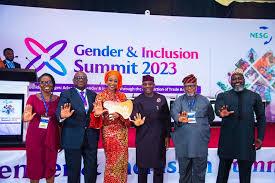
The campaign was amplified by the stakeholders at the two-day Gender and Inclusion Summit, themed “Reimagining Gender-Inclusive Pathways and Partnerships for Poverty Reduction,” organised by the Policy Innovation Centre (PIC), in Abuja.
Executive Director of PIC, Dr. Osasuyi Dirisu, in his welcome remarks, explained that PIC is the brain child of the Nigeria Economic Summit Group (NESG) established in 2017 through the support of Bill and Melinda Gate Foundation, to provide a platform for social interaction in the country, championing the cause gender related issues and youth empowerment.
He said: “In Nigeria, for instance, the link between poverty and child mortality is particularly stark. Unarguably, children from the poorest families are nearly 11 times more likely to die than those from the wealthiest families.
“The global multidimensional poverty index offers a comprehensive understanding of poverty, going beyond monetary measures to capture its multidimensional aspects, providing a clearer picture of who is poor and why.
“It is against this backdrop that PIC has dedicated this year’s Gender and Inclusion Summit to discussing policy imperatives and actions necessary to realize a more inclusive Nigeria.
“The PIC community is committed to translating every idea and recommendation from this Summit into a clear roadmap for actions towards improving Nigeria’s performance in gender index rankings.
Chairman of PIC, Mr. Udeme Ufot, in his remarks, further explained that the Summit is a platform conceived to foster dialogue among critical stakeholders from diverse sectors.
He said the summit serves as a space where stakeholders reflect on new evidence and explore contextually relevant solutions to the disparities in inclusivity in Nigeria.
“By uniting the collective power of the government, development partners, civil societies, academia, the private sectors and citizens, we aim to inspire a collective commitment and focused action towards building a gender inclusive society.
Similarly, the Chairman of NESG, Niyi Yussuf, also highlighted the importance of such annual summit for stakeholders to discuss social issues that would improve the society, making it better for all.
He stated that since 2022, the summit has been institutionalised as an annual gathering for multi-stakeholders to discuss and co-create contextually relevant solutions for gender and inclusion in Nigeria.
He appreciated the fact that there was discussion on Artificial Intelligence (AI) and other technological tools that are changing life and living in the world.
Director General, National Institute for Legislative and Democratic Studies, Prof. Abubakar Sulaiman, in his remarks, appealed to the participants to proffer solutions to several issues holding back the growth and development of Nigeria, including human capital development.
He appreciated the topic of the conference which tends to promote the issue of gender inclusion, assuring that the outcome of the conference will be presented to the National Assembly with appropriate actions.
Country Director, PLAN International, Charles Usie, in his remarks, said that lately, he has taken the responsibilities of pushing for more opportunities for women within and outside his organization, challenging other conference participants to emulate his footsteps.
“In doing this, we must speak less and act more. We must consciously commit to promoting the cause of breaking any obstacles that could hinder the growth and development of women and children,” he said.
UNICEF’s Gender and Development Manager, Ms. Takudzwa Kanyangarara, in her submissions, lamented that women and children are most affected by growing poverty in Nigeria, adding that the situation has grossly affected the rights of children to education, nutrition among others.
She admitted that while significant progress has been made in trying to eradicate deep poverty in Nigeria, some basic challenges facing women and children remain, thus emphasizing the importance of listening to girls’ needs and aspirations.
She said: “In a changing world, UNICEF is committed to understanding and meeting the evolving needs of adolescents and young people. Our Gender Action Plan highlights our commitment to working with and for adolescents.
“Girls have told us how crucial it is to provide them with the information and services they need to make informed decisions about their health and everyday lives.”