Follow Us on Google
By Merit Ibe
The Standards Organisation of Nigeria (SON) and the Mycotoxicology Society of Nigeria (MSN) have called for deeper collaboration among stakeholders to tackle the growing threat of mycotoxins in food and agricultural products to enhance Nigeria’s export competitiveness.
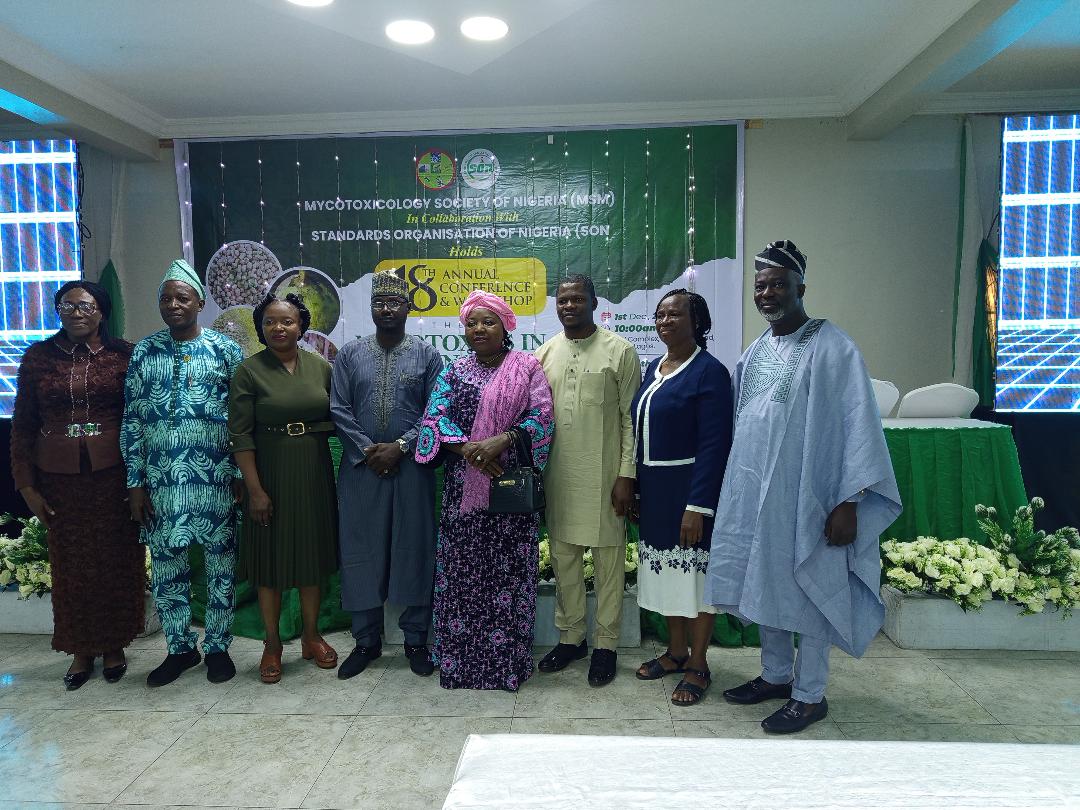
The appeal was made at the 18th Annual Conference and Workshop held recently with the theme: “Mycotoxins in a Changing World: Risks, Management and Innovations,” organised by the SON and the MSN, where scientists, regulators, researchers, and agricultural industry players stressed the need to apply scientific research, modern testing methods, and coordinated policies to protect public health, strengthen consumer confidence, and enhance Nigeria’s export competitiveness.
Reaffirming SON’s mandate to build a robust national quality infrastructure, the Director General, Dr. Ifeanyi Okeke, represented by Mrs. Talatu Ethan, Director, Corporate Affairs, SON and Chairperson of the Local Organising Committee (SON 2025), highlighted that strong standards and quality assurance systems are essential as Nigeria works to expand productivity and market access.
Okeke noted that the theme of the conference reflects the realities of a fast-evolving agricultural and industrial landscape and reinforces the need for effective mycotoxin management and innovation.
Mycotoxins, naturally occurring contaminants that affect various agricultural commodities present technical and trade-related challenges that require strong analytical capacity, clear scientific benchmarks, and harmonized standards to support national competitiveness.
The DG’s representative, Ethan who is also the Vice President, South, MSN, noted that the theme is particularly relevant in the rapidly evolving agricultural and industrial environment.
“It emphasizes the growing need to understand and address mycotoxin hazards, apply effective management strategies, and embrace innovative solutions that enhance food safety, protect public health, and support trade competitiveness. This theme aligns closely with SON’s mandate of promoting compliance with standards, encouraging technological advancement, and safeguarding consumers.”
The programme, the DG said, afforded the organisation the opportunity to raise awareness among farmers, processors, exporters, researchers, and regulators on the importance of compliance with established standards, food safety, and good agricultural practices. Participants also took part in a hands-on laboratory workshop at SON’s National Mycotoxins Laboratory, where they explored advanced methods for detecting and quantifying mycotoxins. SON noted recent investments in modernizing its laboratories and improving regional testing capacity to enhance certification, traceability, and food safety nationwide.
“These investments also align with the Federal Government’s Nigeria First policy, demonstrating SON’s commitment to supporting local production, quality assurance, and industrial competitiveness.”
A major highlight of the event was the conferment of Honorary Fellowship of the Mycotoxicology Society of Nigeria on the SON DG in recognition of his contributions to standardization and food safety.
Accepting the honour, Dr. Okeke reaffirmed SON’s commitment to research, capacity building, and national efforts to strengthen food safety systems.
In her address National President of the MSN, Prof. Yemisi Jeff-Agboola, commended the leadership of the SON DG, noting that it has positioned SON as a central force in addressing mycotoxin challenges through science-based standardization, conformity assessment and strong research partnerships.
Jeff-Agboola said MSN’s voice is now more clearly heard in national conversations on food safety, One Health, and standards, including strengthened collaboration with SON towards science-based mycotoxin standards and quality infrastructure that protect Nigerian consumers and support trade.
The MSN boss noted that the theme of the workshop was apt as we live in a world where climate patterns are shifting, food systems are under pressure, and health systems are stretched; in that context, mycotoxins are a silent but powerful threat.
She said “We do not work in isolation. We work at the intersection of multiple global crises like the climate change which is fundamentally altering the ecology of agricultural systems worldwide.
“Changing temperatures, unpredictable rainfall patterns, and extreme weather events are creating ideal conditions for the proliferation of mycotoxin-producing fungi. Our research in “Climate Change and Emerging Mycotoxin Risks in Food and Feed” is not merely academic, it is existential. We are the watchmen standing watch over the safety of our food systems in an increasingly unstable world.”
She noted that food security remains a critical challenge for Nigeria and the African continent.
“Mycotoxin contamination represents a silent threat to the nutritional security of millions of Nigerians. We have a moral obligation to ensure that the food reaching our tables is safe, not just adequate.
“One Health is no longer a buzzword, it is a reality we must embrace. The same fungi that contaminate animal feed compromise the health of our livestock. The same mycotoxins that affect animals migrate through the food chain to humans. The environmental degradation that creates conditions for mycotoxin proliferation threatens the very ecosystem services upon which we all depend. Our research, therefore, cannot be compartmentalized. It must be integrated, holistic, and rooted in the understanding that human health, animal health, and environmental health are indistinctly linked.”
In her keynote, Dr Bosede Oluwabamiwo, a trustee of the MSN, underscored the importance of regulatory alignment, effective risk communication, and innovation. She emphasized the place of collaboration across industry leaders, noting that true progress will come when stakeholders work together.
Other News
“Through collaboration we create better food systems.”
She pointed out that innovation is a game-changer that should be integrated in the food processes.
“Innovation is changing the way the world deals with mycotoxins. Instead of waiting until contamination happens, new technologies now help us predict, prevent, detect, and manage mycotoxins much more effectively.”
She further added that addressing mycotoxins in a changing world is not solely a scientific challenge ‘it is a multidimensional problem that requires collaboration across disciplines and sectors.
“We need partnerships that unite agronomists, food technologists, toxicologists, policymakers, and economists in a shared mission, to safeguard food systems and public health, investment in capacity building interdisciplinary research, and regional early-warming systems will be pivotal.
The scientific community must also ensure that our innovations translate into scalable context appropriate solutions – especially for resource-limited settings..
Farmers should take early action to stop the Inception of mycotoxins.”
Prof. Stephen Fapounda, Chairman of the Board of Trustees and one of the founding fathers of the MSN stressed that food safety is core to human health and international trade.
He said at least two strategic contaminants of international interest that have attracted international attention are mycotoxins and pesticides.
“The issue of food safety is an issue for everybody because it concerns your health.
As a matter of fact some countries have gone ahead to place sanctions to ban exports if found wanting in compliance to standards because these two categories of contaminants are very critical. So, nations have put in place regulations that will dictate limits that humans and animals can take. “This means everybody is invited to make sure that whatever we are taking in is wholesome and safe.
“If we are able to play our part, then Nigeria will no longer be one of the countries to be accused of food fraud. Food fraud is a criminal offense by the United Nations, it can destroy international trade.”
He called on the government to do more.
The president of All Farmers Association of Nigeria (AFAN), Dr Farouk Rabi’u Mudi, represented by the Deputy Chairman, AFAN, Lagos chapter, Mr Sakin Agbayewa, noted that the issue of mycotoxins cannot be overemphasized, as it’s topical.
“The logic cannot be emphasized.
“Because we need to be alive to enjoy the fruit of our labour and we need to eat healthy to stay right or we eat right to stay healthy. What will it profit us after all the farming, I will now spend the bulk of the money on health issues.”
He advised that the farm products should be our medicine and not chemicals.
He urged the farmers to be cautious while processing their farm products for better quality.
Farmers also called for improved funding to help them upgrade their machines for better and quality produce.
Other speakers included Dr Daniel Apeh, Dr Margret Eshiet, Prof. Toba Sam Anjorin, a professor of plant pathology/ mycopathology, Dept of crop science, University of Abuja, Prof E.O. Ewuola, Dr Titilayo Falade among other presenters.
The speakers elucidated on the practices to prevent mycotoxins, the role of farmers in prevention, post harvest prevention strategies.They also highlighted key barriers to adoption of good agricultural and post-harvest practices, including limited awareness, poor access to clean seeds, inadequate extension services, insufficient equipment, cultural drying methods, and financial constraints. They emphasized that simple measures, especially proper drying, remain among the most effective controls against mycotoxin growth.
The conference concluded that mycotoxins remain a major food safety challenge in Nigeria, undermining public health, agricultural productivity, and international trade. Strengthening food safety requires coordinated policies, improved monitoring, enhanced awareness, strong institutional capacity, and sustained investment in research, technology, and standards enforcement.