Follow Us on Google

“The realisation hits like a cold bucket of water on a harmattan morning. The world is gathering for football’s greatest carnival, the stadiums across the United States, Mexico, and Canada are lit, the pitches are manicured to perfection, and the global audience is tuning in. But the Green and White will be conspicuously absent. We are reduced to mere spectators, forced to choose surrogate teams to support, debating the tactical prowess of Mbappe or Vinícius Jr while our own multimillion-euro superstars watch from the comfort of their holiday resorts. How did we get here?“
See where our hubris has landed us. Now, Nigeria, the Giant of Africa won’t be paraded in the World Cup kicking off in America. What a pain! What a shame!
The realisation hits like a cold bucket of water on a harmattan morning. The world is gathering for football’s greatest carnival, the stadiums across the United States, Mexico, and Canada are lit, the pitches are manicured to perfection, and the global audience is tuning in. But the Green and White will be conspicuously absent. We are reduced to mere spectators, forced to choose surrogate teams to support, debating the tactical prowess of Mbappe or Vinícius Jr while our own multimillion-euro superstars watch from the comfort of their holiday resorts. How did we get here? How did the cradle of African footballing flair become a bystander to history?
The ghosts of giants past
Take your mind back to many years ago when Nigeria’s Super Eagles showed the world the stuff they were made of, playing their own brand of soccer and scoring beautiful goals. It wasn’t just about winning; it was about the swagger, the rhythm, the unadulterated joy woven into every pass. We didn’t just play football; we choreographed it.
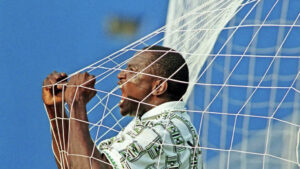
Who can forget Rasheed Yekini’s first goal when he entered the net, shaking the net in that iconic picture of Nigeria’s soccer mastery? USA ’94 was our baptism of fire, and Yekini was our high priest. When he slotted that ball past Bulgaria’s Borislav Mihaylov, gripped the netting, and screamed to the heavens in a mixture of disbelief and pure ecstasy, he wasn’t just celebrating a goal. He was announcing the arrival of a footballing superpower. We went on to dismantle Bulgaria 3–0, and suddenly, the world realised that West African football wasn’t a novelty—it was a threat.
And then came Daniel “The Bull” Amokachi, bull-dozing his way through defences with a terrifying blend of power and grace. Who can forget Amokachi and the crazy dance accompanying his goal against Greece? It was a celebration that mirrored the vibrant, unyielding spirit of the streets of Lagos and Kaduna. We played with a smile on our faces and fire in our bellies. We took on Argentina, matching them stride for stride, trick for trick. Even in defeat against Italy in the second round, Roberto Baggio knew he had been in a war.
Two years later, at the Atlanta ‘96 Olympics, that same golden generation turned hubris on its head. Down 3–1 against a star-studded Brazil featuring Ronaldo, Rivaldo, and Roberto Carlos, the Dream Team refused to blink. Nwankwo Kanu flipped the script with that impossible, gravity-defying flick-and-turn inside the box, equalising in the dying minutes, before striking the golden goal that broke Brazilian hearts. We went on to conquer Argentina in the final. We were the kings of the world, and the Super Eagles moniker carried the weight of royalty.
The eras of magic and majesty
What made those Super Eagles teams so much more than the present crop? It was the distinct identity. Look at France ’98. Sunday Oliseh’s 25-yard absolute rocket against Spain’s Andoni Zubizarreta didn’t just secure a famous 3–2 victory over one of the tournament favourites; it encapsulated the audacity of Nigerian football. We believed we could beat anyone, anywhere, at any time. Jay-Jay Okocha was so good they named him twice, turning world-class defenders into confused statues with step-overs that defied human anatomy. Taribo West played with a fierce, colourful intensity that intimidated strikers before the whistle even blew.
Other News
When Julius Aghahowa scored against Sweden in 2002 and launched into a sequence of seven consecutive, flawless back-flips, it wasn’t just a goal celebration—it was a cultural exhibition. The Eagles of yesteryear understood that they carried the hopes, the frustrations, and the collective sanity of over 200 million people. They played with a sense of patriotic duty that money couldn’t buy.
The silence of the drums
Of course, the world will miss Nigeria, but perhaps nothing will be missed more than their fanciful supporters club.
The World Cup is a carnival of colour, but without the Nigerian Supporters Club, the soundtrack of the tournament is missing its heartbeat. Who will provide the relentless, rhythmic thumping of the drums that builds a wall of sound for 90 minutes? Who will blow the trumpets in that familiar, undulating cadence that turns a foreign stadium into a home ground?
Our supporters are a spectacle unto themselves. Dressed in outrageous shades of green and white, faces painted, bearing mascots ranging from live chickens to elaborate towering headpieces, they brought the Carnival of Calabar to the global stage. They didn’t just sit and watch; they performed. They sang through winning streaks and kept drumming through heartbreaking losses. They were the ambassadors of our joy, showing a global audience that despite our systemic struggles back home, our spirit remains entirely unbreakable.
To watch a World Cup without that brass band, without the synchronized dancing in the stands, feels sterile. The tournament has lost a layer of its soul.
The price of hubris
So how did we arrive at this point of national mourning? The answer lies in our collective complacency. We assumed that because we possess the reigning African Footballer of the Year in Victor Osimhen, because Ademola Lookman can score a hat-trick in a European final, and because our forwards dominate the scoring charts of Europe’s top leagues, qualification was a birthright.
We forgot that names on a team sheet do not score goals in hostile African qualifying campaign venues. We mismanaged our coaching staff, treated administrative logistics with casual disdain, and allowed internal politics to fester within the glass house of the football federation. While we were busy resting on the laurels of past glories, our continental neighbours were building structures, hiring tactical masterminds, and playing with hunger. We treated qualifiers against supposedly “lesser” nations like mere exhibition games, and we were duly punished.
The tragedy of the current Super Eagles is that they possess an abundance of talent but a deficit of cohesion. They are a collection of brilliant individuals who often look like strangers wearing the same jersey. The swagger of Amokachi, the tactical discipline of Oliseh, and the leadership of Stephen Keshi have been replaced by a fragile anxiety. When the going gets tough, this team buckles under the weight of expectations, lacking the street-smart grit that defined our legendary squads.
A time for sobriety
This forced sabbatical from the world stage must serve as a brutal wake-up call. The giant is naked, and the excuse of “bad luck” will no longer suffice. We cannot continue to run our football on emergency prayers and last-minute permutations.
As the opening whistle blows in America, we must endure the pain of watching others chase the trophy we once dreamed of holding. Let the shame burn, but let it also purify. It is time to dismantle the hubris, rebuild from the grassroots, honour the template of the 1994 pioneers, and ensure that our flags are never folded during a World Cup summer again. Until then, the drums are silent, the trumpets are packed away, and a nation weeps for what could have been.