Follow Us on Google
From Juliana Taiwo-Obalonye, Abuja
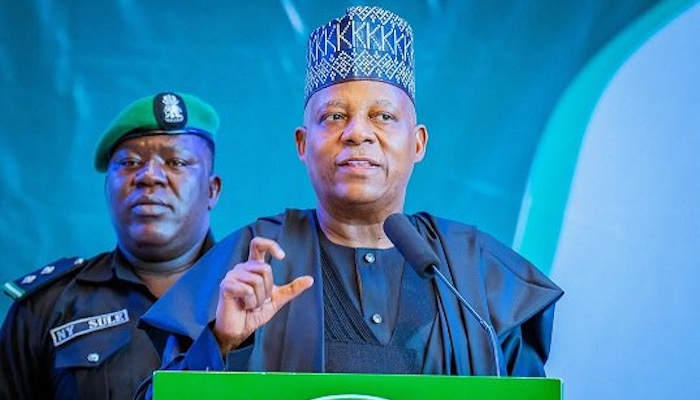
Vice President Kashim Shettima has said that the Federal Government is making bold strides toward revolutionising Nigerian port operations through the rollout of the National Single Window policy, targeted for 2026.
He emphasised this at the Presidential Villa during the second Ports and Customs Efficiency Committee meeting, noting that this initiative will be a breakthrough in streamlining cargo clearance. The platform, he added, will unify documentation processes, reduce human contact, and foster complete transparency.
Shettima declared, “By the end of 2026, we aim to reduce average cargo clearance time in Nigeria to under seven days and to position our ports among the top three most efficient trade gateways on the continent. The forthcoming implementation of the National Single Window in the first quarter of next year will be a game changer, a single platform that harmonises documentation, minimises human contact, and brings full transparency to the cargo clearance process.”
According to a statement by his media aide, Stanley Nkwocha, the VP tasked the Nigerian Ports Authority (NPA), Nigerian Customs Service (NCS), National Agency for Food and Drug Administration and Control (NAFDAC), Standards Organisation of Nigeria (SON), and other stakeholders to develop a roadmap strengthening Nigeria’s weights and measures framework, crucial for ensuring accuracy in trade transactions and protecting consumers.
Other News
Expressing concern over the current sluggish average cargo dwell time of 18 to 21 days at Nigerian ports—a stark contrast to Ghana’s five to seven days and Benin Republic’s four—Shettima criticised the inefficiencies: “The cost of clearing goods in Nigeria is estimated to be 30 percent higher than in many of our regional peers. Our ports record cargo dwell times 475 percent above the global average benchmark. These inefficiencies are not just statistics; they are symptoms of an economic ailment that costs us investments, drives up consumer prices, and weakens our export competitiveness. We simply cannot afford to continue down this path.”
Optimistic about reforms in progress, the Vice President praised the Executive Order on Joint Physical Inspection pending approval by President Bola Tinubu as a critical step towards integrated agency operations fostering predictability and speed. “But no reform succeeds without ownership. Every agency represented here… must see ourselves not as isolated operators, but as links in a single, integrated value chain. The era of siloed operations must end. Inter-agency rivalry must give way to inter-agency synergy. We are only as efficient as our collaboration allows, and our success will depend not only on what we do individually, but on what we achieve together.”
Director General of PEBEC, Zahrah Audu, highlighted the negative impact of current port inefficiencies on Nigeria’s Ease of Doing Business ranking, calling for united stakeholder efforts to enhance cargo clearance speed and efficiency.
Managing Director of NPA, Abubakar Dantsoho, underlined the necessity of collaboration to overcome port bottlenecks and sustain competitiveness. “Until there is collaboration and partnership you cannot achieve efficiency at the ports.” He pointed to ongoing successes from joint inspections facilitated by the Customs and Ports Efficiency Committee and advocates for greater adoption of technology, infrastructure upgrades, and capacity building.