Follow Us on Google
By Izunna Nkwachukwu
In a defining moment for Africa and its diaspora, the Senate Committee on Reparations and Repatriation, under the leadership of Senator Ned Munir Nwoko, has etched its name in global history by convening the first ever Senate-led side event at the United Nations Headquarters, New York.
The hybrid summit, held on October 14, 2025, in Conference Room 6, was organized in partnership with the Federal Ministry of Foreign Affairs, coming on the heels of the UN’s International Day for Reparations and Colonialism.
The Global Summit on Reparations and Repatriation, which was inspired by Senator Nwoko’s earlier motion and the subsequent establishment of the Senate Committee on Reparations and Repatriation, marked a bold assertion of Africa’s readiness to engage the world in a structured dialogue on justice, healing, and restitution.
The event was a confluence of policymakers, scholars, and advocates from Africa, the Caribbean, and the global African diaspora, each voice united by a shared history and a renewed determination to correct the moral and economic imbalances of colonial legacy.
Vice Chairman of the Senate Committee on Reparations and Repatriation, Senator Aminu Abbas, presided over the landmark summit, while Hon Gloria Okolugbo anchored and coordinated the proceedings, and brought a blend of intellectual depth and emotional resonance to the event.
The gathering featured contributions from notable figures, including Dr Sontoye Briggs, a distinguished scholar of African descent, whose presentation explored the persistent emotional and economic scars of colonialism that have spanned generations. His submission drew a standing ovation as he laid bare the enduring inequities that continue to shape Africa’s post colonial realities.
Adding a deeply human layer to the discourse, Mr. Ephraim Emilimor, representing the younger generation, recited a stirring poem titled “The Man Across the Street Called Africa.” His words, poignant and raw, captured the daily struggles, resilience, and unyielding hope that define the African experience.
Speaking for the Caribbean community, the President of the Bonair Human Rights Association, an organization in Special Consultative Status with the UN Economic and Social Council and an associate member of the CARICOM Reparations Commission, called for the establishment of a joint African Caribbean Council. She emphasized the need for a united front to pursue reparative justice, stressing that the time had come for former colonial powers to reckon with the truths of history.
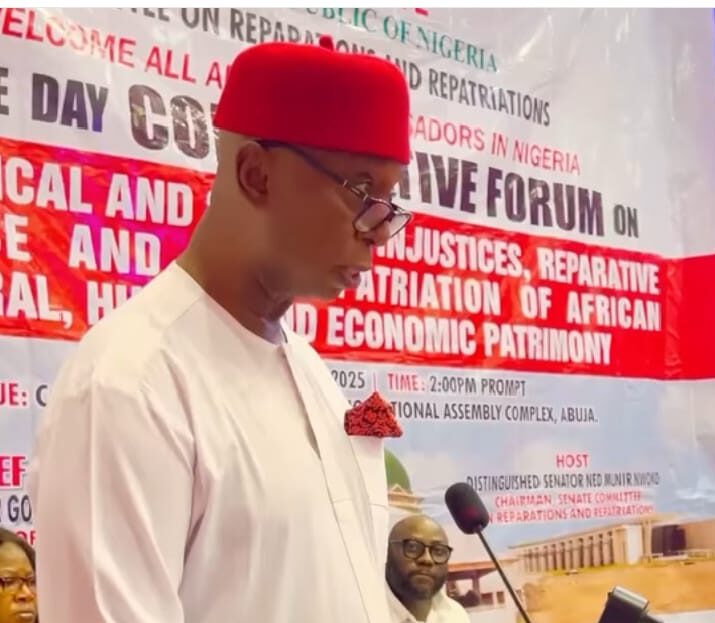
In his welcome address, Senator Nwoko called upon nations that participated in the colonial enterprise to begin the process of restitution by offering formal apologies for the atrocities committed. He noted that such acknowledgment must serve as a foundation for structured engagements aimed at addressing the ongoing social and economic consequences of colonialism.
In his closing remarks, Abbas reaffirmed the committee’s commitment to advancing the reparations agenda, referencing successful precedents from Japan and South Africa. He praised Nwoko’s vision and persistence in ensuring Africa’s voice resonates in global policy spaces, describing the summit as “the beginning of an irreversible journey towards justice and restoration.”
In a broader reflection of legislative innovation, he said Nwoko had once again set a precedent in parliamentary diplomacy by influencing the establishment of a dedicated Senate Committee on Reparations and Repatriation, created specifically to address the historic and ongoing injustices against Africa.
Within a matter of months, his leadership and commitment culminated in convening a global African summit within the United Nations, “a feat that signals both courage and clarity of purpose.”
Abbas announced that the next engagement will be an inter-parliamentary session, drawing together members of parliaments across Africa to consolidate frameworks for collective action.
From the online platform, Mr. Eric Ogbekene echoed the sentiments of the youth, celebrating the summit as a beacon of hope for a new generation that seeks both dignity and global relevance. Mr. Festus Otasowie, in his vote of thanks, commended the synergy of voices raised on behalf of Africa, calling the summit “a major milestone in humanity’s collective conscience.”
In her remarks, Hon. Okolugbo drew attention to the contemporary challenges faced by Africans, particularly in migration and mobility. She urged the United States Government to consider more inclusive diplomatic engagements that facilitate access to non-immigrant visas for Africans engaged in legitimate business, innovation, and cultural exchange. She underscored tourism and people to people relations as crucial economic drivers that can bridge divides and foster mutual growth. She thanked the Senate President for his leadership and the opportunity granted to Senator Nwoko to work closely with him in coming this far and in the process ahead, noting the guaranteed support from his office.
The session, which drew unprecedented participation from diverse regions, concluded with an agreement to reconvene in March 2026, when a communiqué negotiated in the United Nations format will be adopted as a global working document on reparations.
The Nigerian Senate’s unprecedented engagement at the United Nations stands as a resounding testament to Africa’s emerging leadership in shaping global justice conversations. More than a policy statement, it was a human story of pain remembered, dignity reclaimed, and a collective vision for a fairer world.