Follow Us on Google
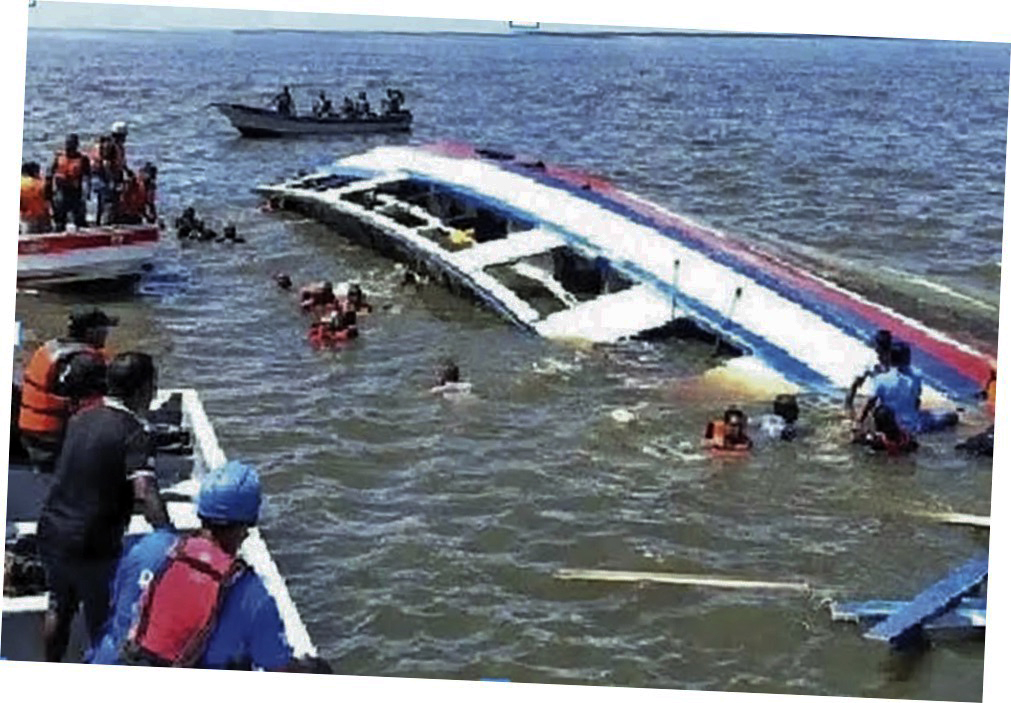
The enforcement of water safety regulations on Nigeria’s waterways is facing stiff resistance, with some defiant passengers allegedly threatening officials of the National Inland Waterways Authority (NIWA) with daggers over attempts to enforce the compulsory use of life jackets. The development, stakeholders insist, has raised genuine concerns about the disregard for basic safety measures by passengers and operators.
The challenge exposes commuters to avoidable risks and highlights the challenges confronting authorities in ensuring compliance with established safety rules on the nation’s waterways.
However, the federal government says it is not backing down and has intensified its safety awareness campaigns across the nation’s littoral states and riverine communities as part of efforts to achieve zero boat accidents and improve safety compliance among water transport users.
This becomes necessary when recurring boat accidents have taken so many lives due to the refusal of boat drivers and passengers to adhere strictly to basic safety rules and regulations of inland waterways.
The government invested so much in life jackets and other safety tools and distributed them in the riverine communities through NIWA to ensure passengers comply by wearing the life jackets.
A life jacket, also known as a personal flotation device, is one of the most basic and effective safety requirements for inland waterway transportation. It is designed to keep a person afloat when a boat capsizes, collides with another vessel, develops a mechanical fault or encounters dangerous weather and water conditions.
Daily Sun learnt that despite these efforts to promote safety, life jacket compliance largely remains low at about 40 per cent, as the struggle to make the nation’s inland waterways safer has taken a dangerous turn in Niger and Kwara States, where passengers resisting the enforcement of life-jacket rules have allegedly threatened officials with daggers.
The revelation provides a disturbing insight into the difficulties faced by officials working to prevent avoidable deaths on the waterways, where wearing a life jacket, one of the simplest measures available to protect passengers in the event of a boat mishap, remains a major compliance challenge.
Experts who spoke with Daily Sun said that the act of threatening government officials and other security personnel who are mandated to carry out the enforcement of life jackets and other basic rules on the waterways with daggers and other dangerous weapons will put Nigeria into a deep crisis if care is not taken,
However, the ugly incidents in Niger and Kwara have been condemned vehemently by security experts and stakeholders, by stating that the strict enforcement of life-jacket regulations must become a non-negotiable requirement for all passengers, boat operators and other users of Nigeria’s inland waterways, warning that disregard for basic safety measures continues to expose lives to avoidable risks.
In previous boat accidents, Daily Sun learnt that those who were wearing life jackets were rescued, while those who usually refused to wear life jackets sank and died, and they were unable to be rescued alive.
This is why the enforcement of life jackets has become increasingly important as water transportation expands across the country, with more Nigerians relying on passenger boats to commute between riverine communities, commercial centres and other destinations. While waterways provide an important alternative to road transportation, inadequate compliance with safety regulations remains a major concern.
Speaking on the incidents in Niger and Kwara states, the National Inland Waterways Authority (NIWA) Area Manager for Niger and Kwara, Mr Akapo Adeboye, revealed that only about 40 per cent of waterway users in the two states currently comply with the compulsory use of life jackets.
According to him, the resistance to safety enforcement had become one of the major challenges confronting efforts to prevent boat accidents, particularly in communities where water transportation is central to people’s livelihoods.
He added that some passengers often argue that they understand the waterways better than the officials enforcing the regulations, making them reluctant to comply with safety requirements.
He said the resistance had on several occasions become confrontational, with officials facing threats and attempts at physical assault.
“They will always try as much as possible to resist us, telling us that this is where they understand the water, even more than us. At a point, they have removed daggers for me several times. They have even tried to fight us,” he added.
Adeboye said the current compliance level was about 40 per cent despite sustained sensitisation and the distribution of life jackets to water users.
He explained that the challenge was particularly pronounced in the northern waterways because water transportation was not merely an alternative means of transportation but a critical part of the economic life of many communities.
According to him, large numbers of residents depend on boats to access markets and move between communities, resulting in heavy passenger traffic on market days.
“Most of the time, the market is normally on a Friday and a Saturday, scantily on a Wednesday. When they come out like that, they come all the way, en masse, from their communities, from their creeks; they come out to the water,” he added.
Adeboye said the volume of passengers during such periods made it difficult for the available safety equipment to cover everyone.
He noted that about 3,500 life jackets distributed to waterway users had made an impact, but were still inadequate considering the number of people who travel through the waterways, particularly during busy market days.
The situation, he said, had made enforcement and continuous public education necessary.
Adeboye said NIWA had consequently intensified sensitisation campaigns through radio stations, waterfront markets and local communities, with officials also using local languages to ensure that safety messages were understood.
He said river marshals and emergency response officers had been deployed across several locations in Niger and Kwara states and were working around the clock to monitor the waterways and respond to emergencies.
The areas covered, according to him, include: Malale, Loko Mene, Shagunu, Duga, Okokoli, Wara, Jebba, Kacha, Baro, Budon and Shiroro, as well as areas towards Lokoja.
“We have our river marshals, our emergency responders, and they’re all cut across, working around the clock,” he said.
He added that NIWA also conducts patrols along the waterways as part of efforts to identify dangerous practices and prevent accidents before they occur.
At Jebba, Adeboye said, NIWA has stationed an ambulance boat with a driver and an assistant to respond to emergencies.
He said the authority’s emergency response time was generally between 20 and 30 minutes, depending on the location of an incident.
Other News
He said a safety and surveillance boat has also been stationed on the high waters of Kainji Lake since 2022, according to him, to provide surveillance and protect lives and property along the waterways.
However, Adeboye disclosed that NIWA’s emergency response capacity in Kacha had recently suffered a setback following the vandalisation of a rescue boat.
He said the two 75-horsepower engines attached to the boats stationed at Kacha were vandalised, forcing the authority to begin efforts to restore the equipment.
“That is one of the things that we are looking at to resuscitate and bring that engine back,” he said.
He said NIWA was also working with other boat operators and stakeholders in areas where the authority’s own operational boats were not available.
Adeboye disclosed that there was currently no dedicated NIWA boat stationed at Shiroro, but said the authority was collaborating with boat owners in the area to ensure that emergency assistance could still be provided when necessary.
Beyond the threat of boat accidents, the NIWA official said the authority was also preparing communities for the possibility of rising water levels and flooding as the rainy season progresses.
He said residents living close to waterways were being sensitised to move to higher ground where necessary, with NIWA working alongside sister agencies, including the National Emergency Management Agency (NEMA).
Meanwhile, Gbenga Leke Oyewole, a seasoned maritime security expert and former Senior Special Assistant on Maritime Services to ex-President Goodluck, said that Nigeria has only two problems, and every other problem falls under those two problems.
He said the number one is non-automation of the nation’s procedures and processes, while the number two is interagency collaboration.
“In this particular instance, the absence of automation of systems has put the life of the NIWA manager in danger because he is using his own strength to ensure compliance.
If all the skis and the flyboats in Nigeria are registered the way they register cars and the ownership of each boat is in the database of Nigeria, the fear that incidents like this will be traceable to the owner will not make people go so lawless.
“Even if they were trying to, he would have supported the newer man to say he’s not going if you are not going to wear the life jacket. Is it doable? The answer is yes, it’s completely doable.
Just like we number cars in Nigeria, all the flyboats can be numbered digitally, and satellites will know the position of every boat in Nigeria and the ownership of such boats,” he explained.
In fact, he said entering boats to travel from point A to point B should be like registering people who are entering an aeroplane because if anything happens, people need to know who to contact if there’s an accident along the waterway, adding that they need to know who to contact and they know who has registered for which boat.
“The non-compliance with basic things is really putting the country in deeper problems. That is just extreme lawlessness. And for somebody in Kwara State that speaks Yoruba and all that to be drawing a dagger, it’s unheard of.
“So, I think we just have to continue to encourage the operators of our agencies and various commissions to open their minds and do the needful as it is done elsewhere in the world. I think that’s just the only way to foster this kind of thing.
“As long as it is that man that will continue to use his strength, his boldness to tell people, say, don’t do this, go out of that place, do this, it will not work. We must remove ourselves from that manual labour into a situation where every good doing and wrong doing are appropriately rewarded. I think that’s all I would want to say on this particular matter,” he pointed out.
However, he said that there must be punishment for non-compliant passengers who refuse to wear life jackets and threaten the government officials who are mandated to ensure compliance, adding that there is nothing in Nigeria that doesn’t have the appropriate law guiding it.
A tourism expert and maritime media consultant, Frank Meke, has called for strict enforcement of life-jacket regulations on Nigeria’s inland waterways, saying compliance with safety requirements is backed by law and must not be treated as optional.
Meke made the call while reacting to growing concerns over resistance by some passengers and waterway users to the enforcement of mandatory life-jacket use, stressing that anyone who deliberately obstructs safety enforcement or threatens officials of the Nigerian Inland Waterways Authority (NIWA) should be arrested and prosecuted.
According to him, compliance is fundamentally an enforcement strategy backed by law, adding that allowing individuals to intimidate or threaten enforcement officers could undermine efforts to improve safety and reduce accidents on the nation’s waterways.
“Compliance is an enforcement strategy and backed by law; so such persons threatening NIWA officers should be arrested and made to face the law,” Meke said.
He stressed that enforcement officers must be allowed to perform their statutory responsibilities without intimidation, particularly when their actions are aimed at protecting passengers and preventing avoidable accidents.
Meke recalled a recent visit to Niger State, particularly the palace of the Etsu Nupe, where the traditional ruler expressed strong support for measures to remove people who violate waterway safety regulations from jetties and boats.
He said the position of the Etsu Nupe demonstrated that traditional institutions and local communities could play an important role in supporting government agencies in the enforcement of safety standards across Nigeria’s inland waterways.
“Recall during our visit to Niger State and specifically at the palace of Etsu Nupe, the emir strongly supported the arrest and removal of such persons from the jetties and boats wherever they are found,” he stated.
According to the tourism and maritime consultant, the challenge is not necessarily a lack of understanding of the importance of life jackets, but the ability of the enforcement system to respond quickly when officers encounter resistance or threats.
He identified an organised security support system as critical to strengthening the authority of NIWA officials and ensuring that enforcement operations are not frustrated by passengers, boat operators or other individuals who refuse to comply with safety regulations.
“The issue, however, lies with the organised security system to quickly support NIWA in arrestin those threats to safe navigation practices,” Meke said.