Follow Us on Google

By Chukwuma Chibueze
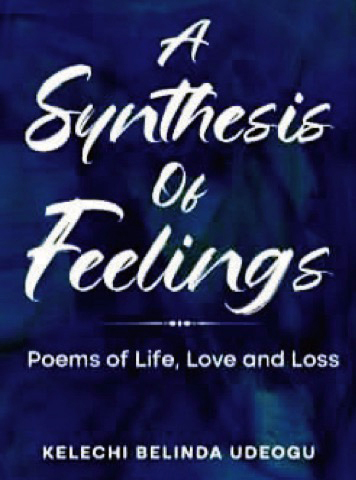
Kelechi Belind Udeogu’s poetry collection entitled Synthesis of Feelings is both reflective and culturally engaging as it interrogates the essences of human existence through moral, philosophical and psychological lenses. The one hundred-and-thirty-one-page (131) collection published in 2026 by Paperworth Books Limited presents a wide range of poetic reflections about life, love, loss, human feelings and relationships. This review focuses on selected poems in the collection namely, “A Tale of the Green Passport People and the Undesirables”, “Live”, “Love Did Not Break Your Heart”, “In Forgetting You, I Remembered You”, “Let Me Bury My Dead” and lastly, “An October to Remember”. These are representative poems that reflect the dominant themes in the collection as well as the structural and stylistic features that are deployed.
The term “synthesis” means combining separate things into a new whole that is bigger than the parts. With this, the title of the text, A Synthesis of Feelings suggest a cataclysmic mélange of human experiences where being alive, caring deeply for people and also losing them, all happens at the same time causing some heartthrobs and heartaches. In the collection, there is a logical flow of lived experience, which implies loving and being loved, but in the end comes loss. In the human society at large, people live lives, love the life they live but at the end everyone faces death which is regarded as a loss. In the collection, the poet reiterates the fact that life is but a process of living, loving and losing, and every human being is a partaker in these processes. The poems in Udeogu’s A Synthesis of Feelings collectively explore the realities of human existence, including societal and moral decay, interpersonal relationships, and the enduring impact of human actions towards the community they live in. The poetry collection is divided into three segments, namely – Life, Love and Loss. Although it contains numerous poems, the selected poems illustrate recurring thematic concerns that cut across the entire work. In the text, the poet presents Life, Love, and Loss as an experiential journey shaped by both individual choices and influences from the society.
Some of the dominant themes in the collection include societal condemnation, cruelty of the living, hope, grief, interpersonal relationships, love, loss and communal bonding. In the first two poems, “Live” and “A Tale of Green Passport People and the Undesirables”, the poet portrays how humans live. The poet tells us that life is not a bed of roses as it is filled with ups and downs. For instance, in the poem, “Live”, the poet chants: “let your heart break again and again / so it can mend again and again” (10). This statement suggests the harshness of life. That one must have to pass through pains and struggles in other to heal from them.
Another theme explored in the collection is that of societal condemnation as seen in the poem, “A Tale of Green Passport People and the Undesirables.” In the poem, the poet presents a people and their varied experiences; then he lampoons them because of their ways of life. Stanza two of the poem reads: “when you see a green passport people/Always interrogate further/Screen their passports thoroughly/ they hide lies in the pages of those small booklet…/Ensure they never get in here/they are garbed in duplicitousness” (p.25). Furthermore, the poet continues, “Green is a wrong colour/green is a colour of chicanery/green is the colour of malefactors (p.25). The last statement suggests a total condemnation of the Nigerian society metaphorically represented by the people of Green Passport. The Nigerian passport is green in colour; it shows moral decay in the condemned society itself.
In the two poems on the segment entitled Love, namely, “Love Did Not Break Your Heart” and “In Forgetting You, I remembered You”, the poet portrays the real motive of love. She tells us that love is not slanderous, lecherous nor cruel but love gives hope and cares immensely. The lines, “love does not break your heart/love is the custodian of your heart/love drives away hunger/love conquers all your faults”, are not mere statements, they are assurances of what love does. The line, “love drives away hunger”, simply suggests that true love kills the urge of immorality. In another poem, “In Forgetting You, I Remembered You”, the poet sings: “the process of forcing your memories/out of my mind only forced me to recall them… they feel like a continuum, a continuance”. The above expressions suggest that true love never forgets; the more you try to forget, the more you recall and the process is a continuum.
In the segment entitled “Loss”, there are two poems that are quite outstanding. One is “Let Me Bury My Dead” and the other is “An October to Remember.” In the poems, the poet presents the losses incurred during the course of living and loving in this life. Through the two poems, the poet shows the true nature of relationships, grief, solidarity and communal bonding amongst people. For instance, the lines, “let me bury my dead, watch his new home get swallowed by the earth …” and “let my love be buried with the heart of his people, in the land of his people” (118) suggests grief and loss the poet faces with the death and burial of a loved one. Also, it shows the relationship between the living and the dead.
In another poem, “An October to Remember”, the poet tells a fascinating story about the #EndSars protest of October 2020:
To the youths in Ugheli
Who started this movement on that day in October…
To the youth in Benin city
who took up the fight
To the young people in Ogbomoso
Who joined the protest and fought on
To those in Manchester, Ontario, New York, Houston…
Who carried on with us and for us
We salute you (pp. 122 & 126)
Through the verses that are crafted above, the poet recounts how some young Nigerians united together to fight a cause at a given moment. This particular poem, “An October to Remember”, is actually on the events of 20th October, 2020, when troubled and traumatized young Nigerians decided to rise, to stop and condemn police brutality and irresponsible policing in Nigeria. Across the collection, these themes explored and explained above recur in different forms, suggesting a unified moral vision that underpins the poet’s vision.
Udeogu’s poetic style is characterized by simplicity, clarity, and repetition. Her diction is accessible, allowing the poems to communicate directly with a broad audience. The repetition of structures, such as “let your…’’ in “Live”, creates rhythm and reinforces thematic emphasis. The poet also employs metaphor and symbolism, particularly in the depiction of a nation as ‘Undesirables ‘which underscores the theme of moral degeneration and societal condemnation. In addition, the use of declarative statements, such as: “make sure they never get those stamps of approval ” (25), gives the poems an authoritative and philosophical tone. This stylistic approach appears consistent across the collection, suggesting a deliberate effort to prioritize clarity and impact over complexity. Structurally, the poems are written in free verse, with no strict rhyme or metrical pattern. This allows flexibility in expression and aligns with the reflective nature of the poems. The use of short lines and strategic line breaks enhances emphasis and readability. Despite variations in subject matter, the structural simplicity of the poems contributes to the overall unity of the collection.
Generally, Udeogu’s A Synthesis of Feelings is a didactic and thought-provoking collection that successfully combines cultural criticism with personal reflection. The most appropriate classification of A Synthesis of Feelings is that of contemporary African culturally committed poetry, because the collection aligns with a tradition of African poetry that prioritizes cultural criticism and accessibility. However, something kicks the collection off the total balance of being termed a typical African poetry. The poem “A Tale of Green Passport People and the Undesirables” seeks not to address the African issues, but condemns Africans from the lenses of the Westerners. In the poetic discourse of “Art for Art’s sake and Art for Society’s sake”, Africa leans on that of society’s sake because through their art, African poets portray Africans and their struggles not to condemn them. However, the above-mentioned poem, does the opposite and condemns African immigrants, particularly Nigerians migrants whose passport color is Green and flag colour Green and White.
While the simplicity of language used in the collection ensures accessibility, it leans more to the prosaic, thus, limiting deeper interpretive capacity for some readers. Also, this use of prosaic lines can also be viewed as a strength, as it allows the poet’s message to be clearly understood. The poems in Udeogu’s A Synthesis of Feelings lend themselves effectively to deeper stylistics analysis due to their use of repetition, metaphor, simple diction, and foregrounding. For instance, the repeated structure “Let your” in “Live” demonstrates syntactic parallelism, while expressions such as “Green is not a good colour/Green is the colour of crook” reveal semantic deviation. These stylistic features not only enhance aesthetic quality but also reinforce the thematic concerns of societal condemnation and the struggles of life.
In conclusion, A Synthesis of Feelings by Kelechi Belinda Udeogu is a thematically rich and stylistically consistent collection that engages with important aspects of human existence. Through some artfully created poetic lines, the poet articulates a coherent vision centered on live, love and loss. These poems serve as representative examples of the broader concerns of the collection, demonstrating its unity despite thematic diversity. The work stands as a meaningful contribution to contemporary poetry, offering both critical insight and reflective depth.
CHUKWUMA, KENNETH CHIBUEZE is with the Department of English and Literary Studies, Alex Ekwueme Federal University Ndufu-Alike Ebonyi State