Follow Us on Google

By Henry Akubuiro
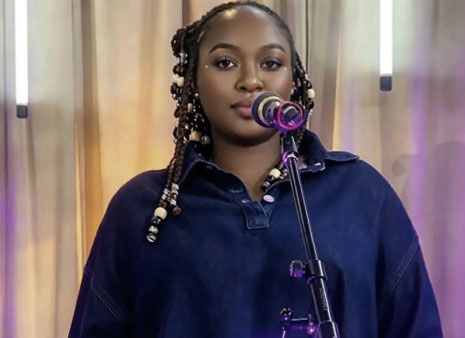
Michelle Nnanyelugo is a confessional poet, spoken word artist, writer and interdisciplinary artist whose work cuts across performance, literature and visual art. Her work is experimental, candid in its observations and often satirical, drawing on the personal, the peculiar and the absurd theatre of everyday life. Primarily a performance poet, Nnanyelugo works with voice, gesture, rhythm and presence. Her practice extends beyond the stage and printed page through unconventional poetry exhibitions and installations.
Her solo exhibitions include Soggy Cookies (2025), Fish Bones: The Spiky Textures of Grief (2026) and Pink Onions (2026), a satirical poetry exhibition exploring the hyper-domestication of women. Pink Onions was first presented at the Rotunda Theatre before a second showing at Firepit Art Gallery.
Her writing has appeared in Librettong, Punocracy, Kreative Diadem, Sprinng, Brigette Poirson, Genti Media and COAL NG, alongside commissioned work.
Nnanyelugo is interested in the many lives a poem can have: spoken, performed, read, seen and experienced. In this interview with Daily Sun, the poet speaks on her literary journey from Nigeria to the UK.
The literary journey starts first as a private engagement. How did you move from the room to the stage?
Writing began as schoolwork and leisure before becoming a way to understand and confront my emotions. I wrote privately, often in response to an outburst or trigger, and lacked the confidence to share my work.
Over time, I developed an intimacy with my mind. I often say, ‘I love to travel, but my mind is my favourite place to be.’ Turning persistent thoughts into something more elaborate, and finding release through expression, paved the way for performance.
Which spoken word performance of yours made you think you had a future in performance poetry?
“Times and Seasons” holds a special place in my journey. I wrote and first performed it as a corps member in Enugu. It became my debut performance piece, which I carried to almost every poetry event I attended.
It opened doors to performances with the Enugu Literary Society, Poets in Nigeria (PIN) Slam, the Street Project Foundation bootcamp, the Centre for Memories and Literary Festivals.
How does a poem change when you move it from the notebook to a live microphone?
Live performance is like breathing life into my words and extending a hand to the listener. My work is laden with imagery, punch and attitude. I enjoy the musicality of performance: pacing, modulation and rhythm. People have told me they couldn’t tell whether I was rapping, singing or performing poetry. I want each performance to feel like a soothing conversation, but I also think of myself as a town crier, approaching the stage with urgency and purpose.
Tell us about your undergraduate days and your poetic trajectory?
I didn’t really begin performing on poetry circuits until after graduation. I stumbled upon poetry as an undergraduate, writing my first poem, Insomnia, one sleepless night.
The turning point came after graduation. ASUU strikes disrupted the NYSC process, leaving fresh graduates waiting for clearance and call-up letters. I spent about a year at home, writing and performing on my WhatsApp status, recording videos and sharing them with friends. I eventually took my work to the stage as a corps member in Enugu, performing with the Enugu Literary Society and Poets in Nigeria (PIN) Slam, and participating in events at the Centre for Memories and other literary festivals.
As a performance poet, how do you use pacing, pauses, vocal tone and body movement to shape the stage atmosphere?
My memory becomes a posture that I can wear. Like hot pepper in an open wound. I choreograph my thoughts subconsciously, so by the time I’m on stage, the poem has become part of my body mechanics.
Pacing is distinctive to my style. I stress words at different tempos, allowing my voice and body to move with the subject. In “Fish Bones”, my voice quakes as I explore grief. I want the audience to feel the work, not just hear it. I tease with delivery, sometimes provoking laughter, tears and unexpected reactions. Even a sad poem can tickle your eardrums.
Different audiences react differently. How do you adjust a set when an audience is quiet or distracted?
I don’t particularly adjust my set to suit audience reactions. Once a poem is ready, I deliver it as conceived. My priority is to do justice to the work.
I value attentive spaces; background noise can disrupt my train of thought, so I sometimes request quiet before beginning. Participation can mean finger-snapping, humming or repeating lines. A lack of immediate reaction doesn’t mean a poem hasn’t resonated; someone may tell me afterwards what it meant to them.
Where do your poems usually start: a rhythm, a phrase, a memory or an argument?
My poems can begin with conflict or interrogation. Sometimes, it’s simply the temperature and tension of my mind at a particular moment: the pinch, spark or urge to detach from tangled emotions and examine them more closely.
Other times, they begin with a phrase lingering in my memory. I scribble it down before it slips away and watch it metamorphose into something more elaborate. It is through this probing, intertwining and dissection that my poems emerge, taking on their elastic, condensed, abrupt or solemn forms.
Do you deliberately build tension, repetition and cadence for listeners to follow without a printed page?
I think much of it happens instinctively. When I memorise a poem, the emotions become heightened and gradually engulf me. The inflections and rhythm infiltrate my body until the performance takes on a life of its own.
I’m robust in my delivery. I want the audience to be swept into the movement of the words, to feel their weight and intensity rather than simply hear them. Depending on what I’m performing, my poetry can be both contagious and prickly.
How do you decide when a poem is finished versus when it needs a different delivery?
I write until I’ve exhausted an idea to a large extent, depending on what I want to make of it and how much I want to milk from it. Sometimes, I know a poem has reached its limit when I’ve taken it as far as I can.
Other times, I return with fresh eyes and realise there’s more to explore. A poem may be complete on the page but still require a different approach on stage. I don’t think every poem announces when it’s finished. Sometimes, you simply have to know when to leave it alone.
What determines a confessional poem for you?
Sophistication. Awe. Reverence. Urgency. Guilt. Injustice. Anguish. Oppression. Sacrilege.
The weight of an experience, an emotion or an uncomfortable truth can compel me to write. I don’t have to experience something firsthand; I can embody experiences beyond my own to stir compassion and draw attention to unheard stories.
In “Sweet Chili”, I explore the contradiction behind the perfect family portrait. At my “Pink Onions” exhibition, a woman became emotional after encountering the poem and its family portrait on calico. She said it reflected her childhood and the contrast between a happy family image and abuse behind closed doors. It reminded me that a poem can reach beyond its inspiration and touch another person deeply.
In “Fish Bones”, I explore the spiky textures of grief. With “Pink Onions,” I interrogate domestic violence and the hyper-domestication of women through satire. My writing draws on experience, empathy, observation and imagination.
How do you keep personal poems from boring the audience over time?
A lot depends on delivery: tone, inflection, body language and pacing. I don’t simply recite my poems; I interpret the mood and inhabit the emotions. I want the audience to feel the tension and shifts within the work, not just hear a recounting of an experience.
As a visual artist, what themes excite your consciousness?
Satire and grief continually excite my consciousness. I’m drawn to the absurdities and uncomfortable realities of human experience, particularly those exposed through humour.
“Pink Onions” explores the hyper-domestication of women through satire, using food and domestic imagery to interrogate social expectations. “Fish Bones” examines how grief inhabits and alters the body. I enjoy taking these experiences beyond conventional writing and allowing materials, images and physical arrangements to participate in the storytelling.
Do you feel a sociopolitical urge when you write?
Absolutely. My poetry is heavily infested with sociopolitical concerns. There is a kind of holy anger running through my work, a refusal to become comfortable with injustice or look away from what must be challenged.
I write about police brutality, the EndSARS protests, massacres in Nigeria, poor governance, corruption and electoral processes. I see myself as a crusader, using poetry as advocacy and activism.
Poetry can question authority, challenge the status quo and hold those in power accountable. It lets me resist with invisible placards, calling out government excesses without necessarily taking to the streets, where protests can expose people to arrest and intimidation.
Being a poet and a visual artist is not common these days. Which artists influenced your hybrid artistic taste?
My interest in visual art predates my poetry career. I was drawn to it in primary school and have always loved visiting museums and interpreting artworks, although I never imagined I would become so involved in the visual arts myself.
I admire many brilliant artists. Sometimes I think I could have become a full-time visual artist if I hadn’t already found my footing as a poet.
Are you more restricted as a poet or an artist when it comes to sexuality?
I’m quite reserved about exploring this theme. During a writing fellowship, a mentor encouraged me to develop a short story I’d written, but I couldn’t bring myself to invest the time and emotional energy. It wasn’t a genre I felt naturally drawn to.
That said, I’ve written “How to Love a Woman”, which is raw in a few stanzas. Since I first performed it publicly in 2020, audiences have giggled, snapped their fingers and responded enthusiastically. It’s less about restriction than inclination; I tend to gravitate towards other subjects.
You have done both visual exhibitions and a satirical poetry exhibition. Were you not afraid the audience might not relate to your poetry exhibition?
Of course not. I feel fulfilled if even one person interacts with a piece, takes a lesson from it or finds some healing or closure.
With “Soggy Cookies”, I printed poems onto cotton and draped the fabric across the space like clothes on a line, alongside illustrated postcards. For “Fish Bones”, I presented framed poems on GSM paper in what I called a showroom of grief, with recorded performances playing through speakers.
“Pink Onions” stretched me most. I created about 21 handwritten poetry pieces on calico, using felt-tip markers and blue lines and red margins to recreate an exercise-book page. The combination of a domestic material and handwritten spoken-word poetry was deliberate. The ruled lines also suggested instruction, boundaries and expectations imposed on women.
I added illustrations, postcards, a track list with chilli peppers, pink hangers and wooden pegs. Even the pink floral dress I wore became part of the display.
Visitors were curious about the materials and ideas. Some had goosebumps, and the postcards were popular. These exhibitions have shown me how receptive people can be to unconventional presentations of poetry. “Pink Onions” has opened the door to another solo exhibition at Firepit Art Gallery on Greenwich Peninsula, close to The O₂.
How has your UK experience shaped your art?
The UK has introduced me to a different creative atmosphere and artistic spaces that have expanded my practice. I’m still finding my feet, building connections and discovering my place in the creative landscape.
I’ve performed for audiences beyond the spaces I knew in Nigeria and been welcomed into new creative spaces. Most recently, ‘Pink Onions” had its third outing, with “Red Nail Polish” featured at an exhibition opening.
I’m learning to wean myself off isolation and embrace creative exchange. I can be reserved, sometimes attending events and observing rather than putting myself forward. I need to be more intentional about visibility, making connections and joining a wider creative conversation.
The UK hasn’t defined my art, but it has opened possibilities. I want to experiment, collaborate, reach wider audiences and keep developing as a poet and visual artist. I’m looking for spaces where I can perch, observe, exchange ideas, learn and ultimately find the freedom to flap my wings.