Follow Us on Google

By Vivian Onyebukwa
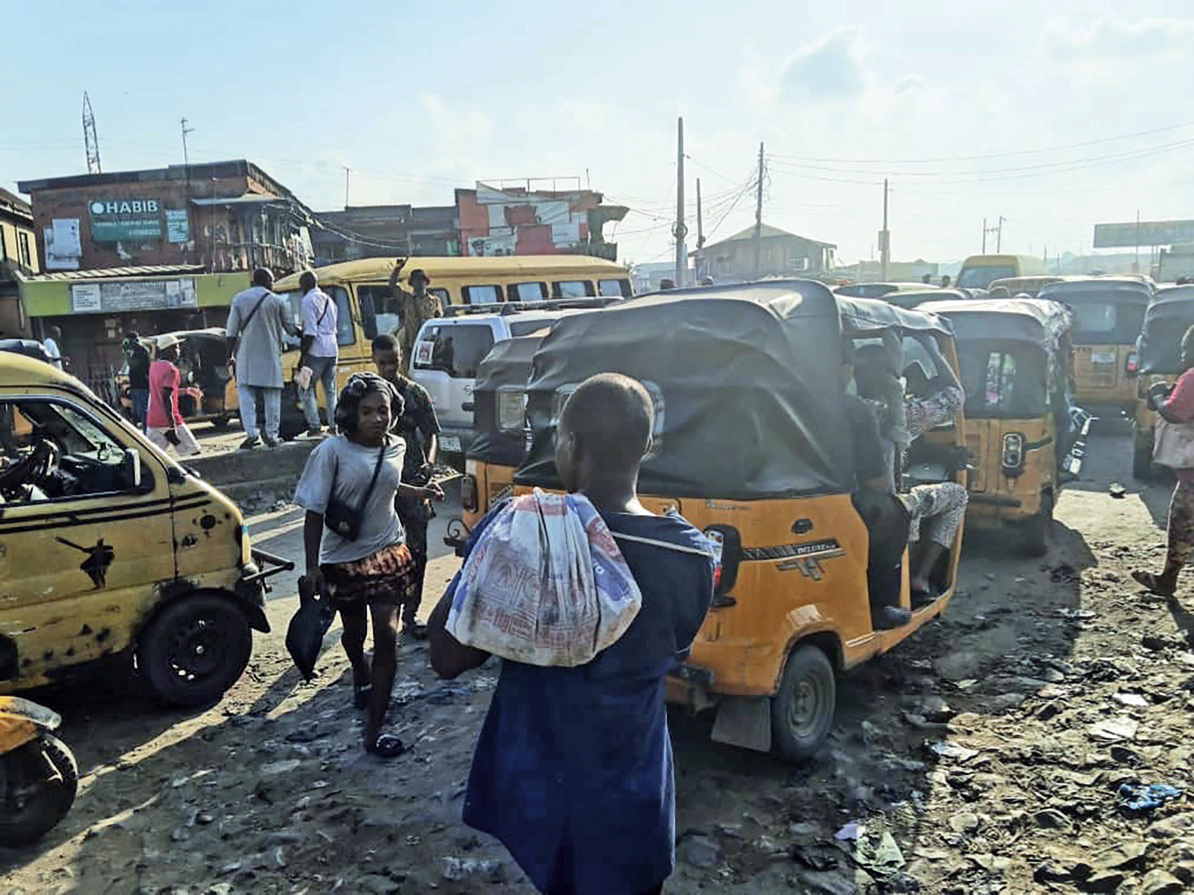
Motorists, residents and transport operators along the Jakande Gate axis of Ejigbo, Lagos, are groaning under persistent traffic congestion caused by poor road conditions and delayed ongoing construction work. The situation has worsened commuters’ daily journeys, increased transportation costs and raised concerns over public safety.
For motorists and commuters travelling through Jakande Gate in Ejigbo, Lagos State, the journey to work, business appointments and other daily activities has become an increasingly frustrating experience.
What should ordinarily be a few minutes’ drive has turned into an agonising journey that sometimes lasts more than an hour; leaving commuters exhausted, transport operators counting their losses and residents questioning when the seemingly endless road construction will be completed.
A visit to the area revealed the extent of the traffic congestion, particularly during peak hours, when motorists struggle to navigate the bad portions of the road, potholes and construction-related obstacles.
The situation is especially difficult between 7am and 9am, when workers and business owners rush to their destinations, and between 6pm and 8pm, when commuters return home.
For residents of Jakande Estate and surrounding communities, the daily gridlock has become more than an inconvenience. It is a recurring challenge that affects their livelihoods, personal schedules and quality of life.
A resident of Jakande Estate, Brian Njoku, said the traffic congestion had become a familiar feature of the area, blaming it on the poor condition of the road and the slow pace of construction along the Jakande-Isolo axis.
“The gridlock at Jakande Estate junction along Ejigbo/Ikotun Road has remained for several years because of the bad road. The junction has become notorious for spending several hours daily in traffic.
“A visit to the junction during peak hours, between 7am and 9am and 6pm and 8pm daily, shows that the bad spots with potholes slow vehicles to a crawl. What should be a five-minute drive now takes about one hour and 30 minutes to accomplish,” Njoku said.
For residents who have endured the situation for years, the prolonged construction has become a source of growing frustration.
Mr John Okwara, who said he had lived in Jakande Estate for about 10 years, acknowledged the government’s efforts to rehabilitate the road but expressed disappointment over the time it was taking to complete the project.
“I appreciate the effort of the government in trying to fix the road, but it is taking a long time. Road users are suffering.
“The government should make haste and complete the road construction to save commuters a lot of stress,” he said.
Beyond the inconvenience, the gridlock is also affecting business appointments and productivity.
A businessman and commuter, James, narrated how he missed a 9am appointment in Surulere despite leaving Abaranje as early as 7am.
He attributed the delay to the congestion and poor road infrastructure, particularly the prolonged construction along the Isolo-Ejigbo/NNPC corridor, which he said had severely restricted vehicle movement.
“This Jakande Gate traffic is becoming worrisome. The road construction is taking much time. Our leaders should learn to take seriously the issues concerning their subjects.
“They should stop playing politics with the welfare of the masses,” he said.
For transport operators, the congestion has translated into fewer trips, increased fuel consumption and declining daily earnings.
Joseph, a transporter who operates along the Cele-Gate route, said the traffic had significantly reduced the number of trips he could make daily.
According to him, he would ordinarily make about 10 trips under normal traffic conditions, but the congestion has reduced that number to approximately seven.
“Not just that, I would use more petrol as a result of the traffic. As you know, petrol is more expensive now. To us, it is a loss.
“I plead with the authority in charge of repairing this road to please come to our rescue. Things are becoming more difficult each day,” he said.
The situation is particularly challenging for commercial tricycle operators, whose vehicles are frequently exposed to damaged road surfaces and construction materials.
Umoh, a commercial tricycle operator, otherwise known as Keke driver, who operates along the Cele-Jakande route, said the condition of the road had increased his maintenance expenses, leaving him with little profit after spending hours in traffic.
Other News
He complained that rather than properly completing the remaining sections of the road, the contractor had used heavy concrete materials for filling, which he said were damaging the tyres and wheels of commercial tricycles.
“Instead of fixing the remaining part of the road, the contractor poured heavy concrete on the road to sand-fill it. These heavy concretes are not friendly to our Keke; they spoil the tyres and wheels.
“The little money I make after spending hours in traffic, I still give to the mechanic to fix the shocks and other issues on my Keke. We are suffering a lot on this route.
“I pity the passengers because they are the ones who pay for all these expenses, which we add to the transport fares. I implore the government to come to our aid,” he pleaded.
For passengers, the consequences are reflected in higher transportation fares and difficulty getting vehicles during rush hours.
Jane, a resident of Buknor, Ejigbo, said the congestion had contributed to a significant increase in transport fares along the route.
“From Cele to Gate, the Keke fare, which used to be N400, is now between N600 and N700.
“It is more difficult to get vehicles moving from Cele to Gate during rush hours because of the traffic. Some transporters decide to park their vehicles instead of spending hours in traffic.
“This is telling on the commuters. I wonder why the government cannot fix this road. It is taking a long time. I hope they are not waiting for an election so as to use it for campaigns. It is unfair. People are suffering,” she said.
Beyond the economic consequences, residents have also raised concerns about the potential health and safety implications of the prolonged gridlock.
One commuter recounted a disturbing incident involving a two-year-old baby who reportedly fainted inside a vehicle caught in traffic in the scorching sun.
According to the commuter, the vehicle was travelling from Ijegun to Cele on a Sunday when it became trapped at Jakande Gate for almost an hour.
“The traffic was so heavy that we spent almost an hour there under the hot sun. The baby could not take it.
“Thank God the mother noticed that the child was no longer breathing properly and screamed. Everyone in the bus was made to disembark, and the baby was resuscitated.
“How long will it take the government to complete the construction of this road? It is taking too much time,” the commuter questioned.
Residents have also expressed concern over the apparent absence of traffic officers at the junction, arguing that inadequate traffic management contributes to the congestion.
George Ogu, an Ejigbo resident, said the situation required the immediate deployment of traffic officials to control vehicle movement and prevent motorists from obstructing one another.
“In a situation like this, there are supposed to be traffic officers stationed to control the traffic. This is a serious issue, therefore, the government should take it seriously.
“When there is no proper control of traffic, motorists try to outwit one another, thereby causing traffic. People are suffering on that route.
“As a result of vehicle traffic, you also experience human traffic. A lot of people have lost their personal items, such as phones, there. It is a terrible situation. Something should be done urgently,” he said.
The worsening situation has forced some motorists to seek alternative routes, including passing through Elemu and the inner streets of Jakande Estate to avoid the congestion.
However, the detours often involve longer journeys and additional delays before motorists eventually rejoin the traffic.
Ikechukwu, a spare-parts dealer at Ladipo, said motorists travelling from Ijegun and Ijegemo sometimes resorted to alternative routes through Elemu to avoid the worst sections of the gridlock.
“At times, when the traffic is heavy, coming from Ijegun and Ijegemo to Cele, we pass through Elemu. This means going through the inner streets of Jakande Estate to cover some distance before joining the traffic again.
“This is time-wasting, but we cannot do anything about it. The government should urgently come to our rescue by fixing this road completely,” he lamented.
As the complaints continue to mount, residents, motorists and transport operators are calling on the Lagos State Government and relevant road construction authorities to accelerate work on the project, improve traffic management and ensure that the road is completed without further delays.
For commuters who endure the congestion daily, the demand is simple: a properly constructed road that allows them to travel safely, efficiently and without losing hours of their productive time.
Until that happens, Jakande Gate remains a painful reminder of how poor road infrastructure and prolonged construction can disrupt livelihoods, increase transport costs and turn an ordinary journey into a daily ordeal.