Follow Us on Google
From Stanley Uzoaru, Owerri
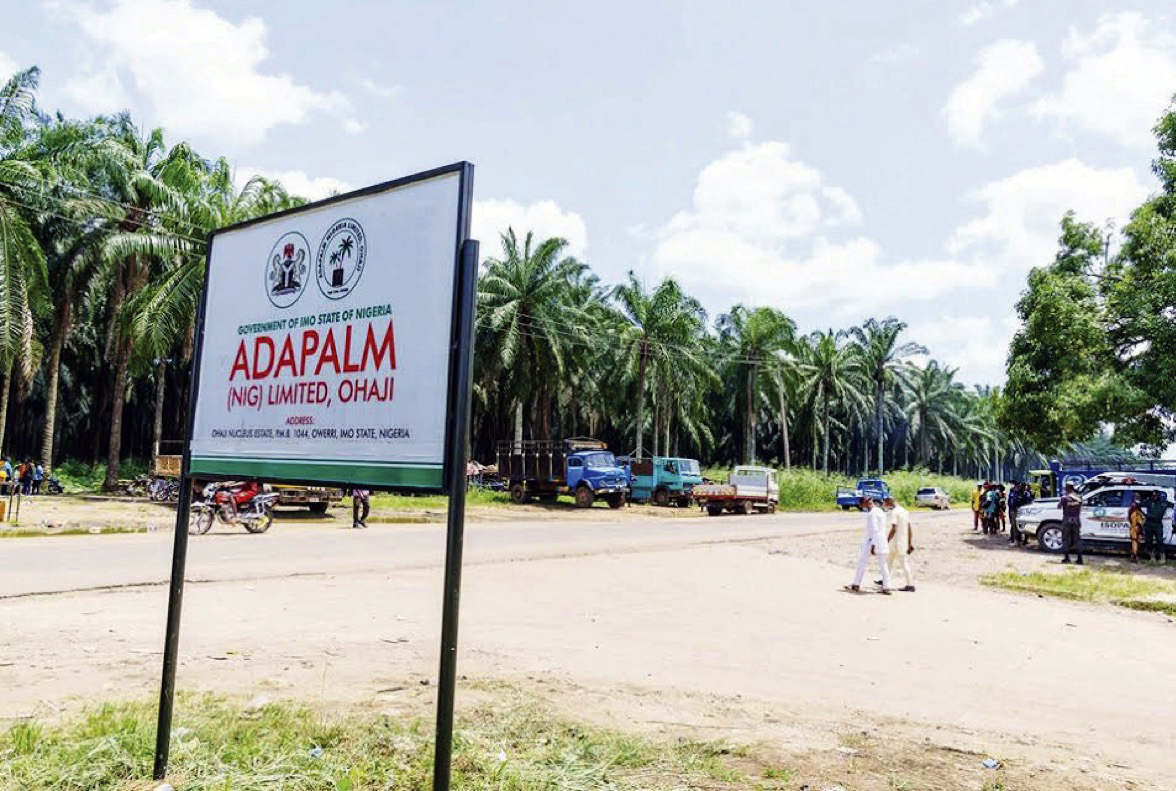
At its peak, Adapalm Nigeria Limited wasn’t just a plantation. It was a statement. Sprawling across over 4,310 hectares in Ohaji/Egbema and bordering Oguta LGA, the Imo State-owned agro-industrial complex churned out at least 150 metric tons of crude palm oil daily. Trucks queued from dawn. Revenue flowed. The state called it a “gold mine,” and for good reason: Adapalm employed thousands, fed local refineries, and bankrolled parts of the state budget.
Today, the hum of the mills has faded to a whisper. Production is a fraction of what it was. Instead of remitting profits to Owerri, Adapalm now waits on government subvention to pay salaries. The gold mine is running on charity.
The big question now is what happened? And more importantly, can it be revived?
Adapalm was commissioned in 1975 as a flagship of the then East Central State’s agricultural drive. By the 1980s and 1990s, it was one of Nigeria’s largest palm estates, complete with a 50-ton-per-hour mill, kernel crushing plant, and refinery. The business model was simple: the state owns the land and assets, professionals run the operations, and profits sustain expansion.
The cracks began with a familiar Nigerian cocktail, aging palms, aging infrastructure : Most of the estate’s trees were planted in the 70s and 80s. Oil palms have a 25-30 year economic lifespan. After that, yields plummet. Without systematic replanting, Adapalm’s fruit bunches became smaller and fewer. The mill, last overhauled decades ago, now breaks down for weeks. A 2023 assessment by the Ministry of Agriculture found the mill operating at less than 15% capacity.
Many have also blamed its decline on the politics of management. Successive administrations appointed boards more for political loyalty than agribusiness expertise. Each election cycle risked policy shifts, contract reversals, and leadership purges. Private managers were brought in under PPP deals in the 2000s, then ejected. Institutional memory left with them.
Also, the estate sits on land from 14 host communities. As profits dipped, so did corporate social responsibility projects. Youth unemployment rose, and parts of the plantation became flashpoints. Illegal harvesting, or “scramble,” now costs the company an estimated 30% of potential fruit. Security can’t police 4,000+ hectares without community buy-in.
Adapalm’s refinery stopped working in the late 2000s. That meant selling crude palm oil instead of higher-margin vegetable oil, soap noodles, or margarine. When global CPO prices crashed, there was no buffer. Meanwhile, smaller private mills with newer tech now surround the estate, buying fruit from outgrowers Adapalm once relied on. The result: an asset that once produced 150 tons/day now struggles to hit 10.
The company moved from profit to subvention around 2018, according to budget reports.
Nigeria spends over $500 million annually importing palm oil. The CBN’s 2019 forex restriction on palm oil was meant to spur local production. Yet the supply gap is still 1.3 million metric tons. In that context, a fully functional Adapalm could displace 54,000+ tons of imports yearly. At today’s $900/ton, that’s $48 million retained in Nigeria, and most of it in Imo.
Other News
There’s also mass jobs. At peak, Adapalm directly employed 3,200 staff and supported 15,000 smallholder families through outgrower schemes. Those jobs don’t require PhDs. They need cutlasses, harvesters, and mill technicians. In a state with youth unemployment above 40%, that’s not trivial.
Some agric experts, ex -staff, and community leaders have suggested how it can work again.First is “replant, don’t repair “: Nursing 4,000 hectares with new tenera seedlings is a five-year project. It costs money Adapalm doesn’t have. Imo State has two options: recapitalise with a ₦15-20 billion bond tied to the estate, or bring in a credible technical partner on a rehabilitate-operate-transfer model. The partner handles agronomy, mill upgrade, and marketing. Government keeps the land and a minority stake. Restructuring only the board won’t grow new palms.
Secondly, de-politicise operations : The most successful state-owned estates today, like Okomu and Presco, are 100% privately run. Government’s role is regulation and land equity, not day-to-day. Adapalm needs a 10-year performance contract with an operator, insulated from election cycles. KPIs should be public: tons/year, outgrower tons bought, jobs created.
And lastly, fix the community equation :The host communities aren’t just neighbours. They’re the unpaid security. A revival plan needs an outgrower scheme that intercrops new plantings with food crops for three years, plus 5% of CPO revenue ring-fenced for community projects. When the villages see fresh fruit = new classroom blocks, the “scramble” problem eases.
In January 2026, the Imo State Executive Council approved a “diagnostic audit” of Adapalm ahead of a proposed PPP. The new Commissioner for Agriculture has also floated converting 1,000 hectares to a pilot replanting scheme with NSIA funding. It’s early, but it’s moving.
“We’re tired of using Adapalm as a campaign line,” says Chief Felix Obi, 67, a retired mill supervisor in Ohaji. “We want to see smoke from that boiler again. Real smoke, not politics.”
Reviving Adapalm isn’t nostalgia. It’s economics. The global palm oil market will hit $98 billion by 2030. Nigeria consumes 3% of that but produces 1.5%. The trees are already in the ground in Ohaji. The mill foundation is poured. The demand is domestic and waiting.
What’s missing is the will to treat Adapalm like a business again, not a bailout.
The gold mine hasn’t disappeared. It’s just been buried under 20 years of weeds. The question for Imo is simple: will it dig, or keep writing subvention checks?
But the chairman of Ohaji/Egbema Local Government council, Marcel Amadioha believes that there is a remarkable improvement in the palm industry which he noted the governor, Hope Uzodimma, has greatly improved.