Follow Us on Google
-
Gov. Mbah, Ken Nnamani, Ozekhome, Melaye, others celebrate an oracle at the pinnacle of justice
From Henry Umahi
If only the dead could see, late Justice Augustine Nnamani would be smiling in his grave. He would be happy that though he had gone to the other side of the divide, his good deeds live on.
This contrasts sharply with William Shakespeare’s postulation that “the evil that men do lives after them; the good is oft interred with their bones.” Thirty -five years after his transition to higher glory, the exploits of the legal icon in the judiciary remain evergreen, never to die, never to be forgotten.
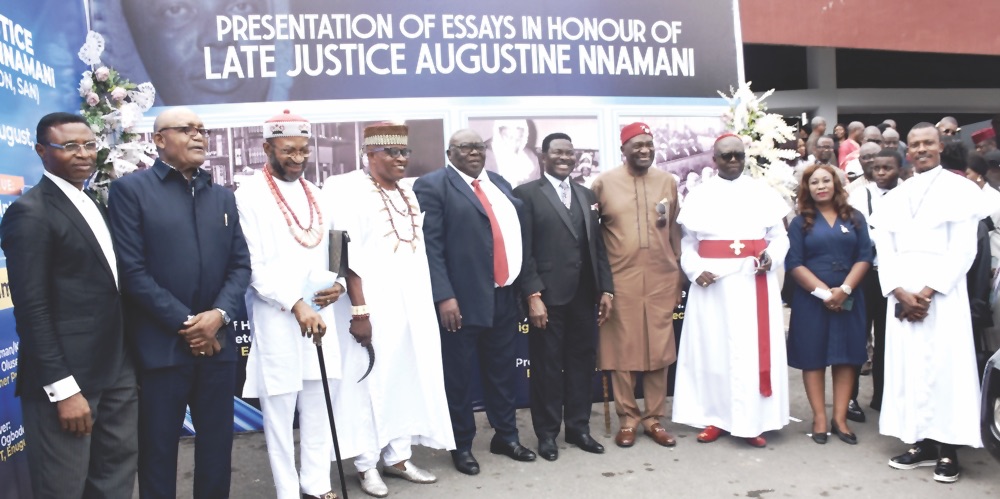
On August 29, 2025, essays written in honour of Justice Nnamani was presented to the public at Enugu International Conference Centre. The auditorium was like an intellectual marketplace dominated by legal luminaries, and scholars, including Governor Peter Mbah of Enugu State, former President General of Ohanaeze Ndigbo, Chief Nnia Nwodo; former Senate President, Ken Nnamani, Senator Dino Melaye, Prof. Mike Ozehkome, Barr. Eze A. Eze, PhD and former Minister of Aviation, Fidelia Njeze, among others.
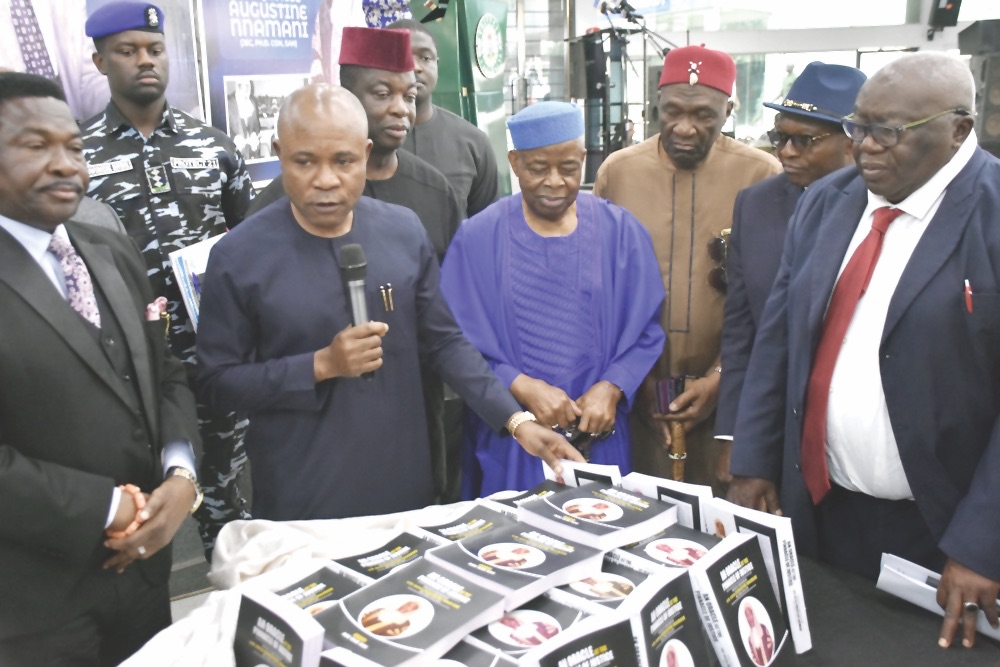
In his welcome address, the editor in- chief of the book, Prof. Agu Gab Agu, stated: “The Renaissance Law Publications Ltd is resolved to help in the development of the law by bringing to the general public our personages of the Bar and Bench of stellar qualities in the area of law and its development. It is our intention to publish on a quarterly basis on, and about them.”
He also gave the list of such projects being presently working on by his team.
Agu, a professor of international law and jurisprudence, added: “It is unfortunate that these men have not been celebrated the way they ought to. These are who can and indeed stood their ground in the comity of jurists. They posses the can-do spirit of our heros past. Justice Nnamani JSC particularly deserves accolade. He was the first Senior Advocate of Nigeria from this part of the country. He also was one of the two persons in the history of Nigeria that ascended to the hallowed chambers of the Supreme Court from the bar. He bypassed the High Court and Appeal Court.”
Nwodo, who chaired the event, explained the robust relationship between the Nnamani family and his. He acknowledged that the late judge was intellectually gifted.
Revealing that Nnamani slumped during his father’s burial, Nwodo regretted that he and others could not revive him. And the man died.
Mbah described Justice Nnamani in superlatives, stating that the book was a refreshing window into some defining national policies that had the late judge’s imprints. He said: “Justice Nnamani was not merely a jurist. He was a philosopher, a steward of justice.”
He further described Nnamani as “an intellectual giant and a philosophy in robes,” adding that his legacy continues to define justice and scholarship in Nigeria.
“From his humble beginnings here in Enugu to the rare heights Nnamani attained in the legal profession, his story is a lesson of discipline, resilience and purposeful leadership.”
Mbah, who noted that the period between the 1970s and 1980s was often regarded as the golden age of the Supreme Court, said: “When people pine for that glorious era, it is not a mere idolising of a ‘good old days. It is essentially because the judiciary captured the public’s imagination – neither cowering to authority nor pandering to populism. Justice Augustine Nnamani was a member of that eminent body of jurists whose brilliance defined that judiciary heyday.
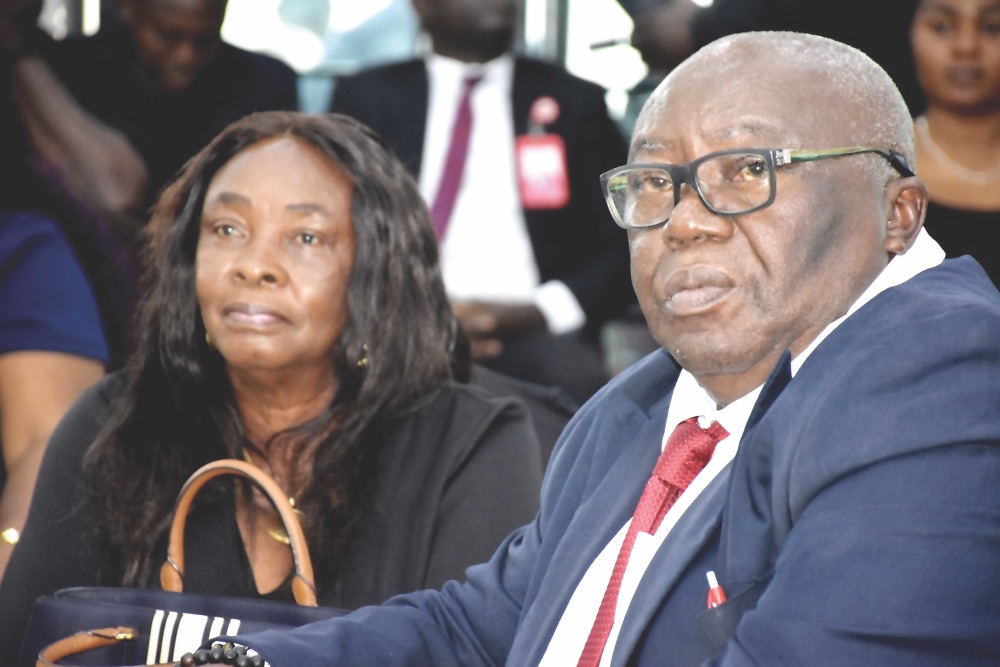
“When we speak of Justice Nnamani, we speak of excellence without compromise; we speak of brilliance harnessed for the common good; we speak of courage in the service of justice. Justice Nnamani understood something that speaks to us even today – that the purpose of law is not to exist in abstraction but in an environment where people can flourish.
“The 22 essays constitute important historical and legal stories, lending perspectives to an asset of jurisprudence that illuminates our understanding to budding law students and cultural veterans alike. So we have gathered here not just to unveil essays but to celebrate a supreme legacy.
“They are also a refreshing window into some defining national policies that had his imprints.”
Indeed, the essays cover not only Nnamani’s judicial philosophy but also provide insight into national policies that bore his influence, such as the Land Use Decree of 1978, the Legal Aid Council, and the Declaration of Assets by Public Officers
The governor commended the editorial board for their “painstaking diligence and insight” in producing the collection. He also lauded the editor in-chief, Prof. Agu for a job well done.
The guest lecturer at the event, Prof. Mike Ozekhome, a senior advocate of Nigeria, said late Justice Nnamani was not a typical legal figure. According to him, Nnamani “was a rare breed. He was a jurist who carried law not as a club of power but a vessel of justice. In a period when Nigeria convulsed under the weight of corruption, inequality and injustice, his presence stood as a quiet but immovable rebuke to mediocrity. Where others saw law as a ladder of ambition, he embraced it as a calling. When many hid behind robes, he wore his robe as one wears a priestly garment: sacred, purposeful and never lightly.”
Ozekhome disclosed that pharmacy was actually Nnamani’s first love. He trained as a pharmacist and graduated with distinction. But because such brilliance as his was restless, if demanded wider vistas. So, he crossed the seas to the London School of Economics, where his genius for law and governance found it’s true home.
Ozekhome further discussed Nnamani’s radical elevation. He said: “We cannot fail to recognize his meteoric rise to the Supreme Court. The story of Justice Nnamani’s elevation is as exceptional as it is emblematic of his brilliance. In a judicial system long chained to rigid seniority, his appointment was a radical departure, a recognition that merit can outrun hierarchy.
“On August 15, 1979, he was appointed a justice of the Supreme Court of Nigeria directly from the office of the Attorney General, a leap achieved only once before in Nigeria’s history by the illustrious Hon. Justice Taslim Olawale Elias.
“His appointment to the highest court was more than personal triumph; it was symbolic. It proclaimed that the Supreme Court is not merely a conclave of career judges but a sanctuary for the finest jurists of the land, wherever they might be found, be it at the Bar, at the Bench, in the academia or in government.”
Ozekhome highlighted Justice Nnamani’s belief that the law should serve the people, and described his judgments as filled with “fire of scholarship and the fragrance of wisdom.”
He said: “Nnamani was a man of rare humanity. His judgements, though celebrated for their doctrinal precision, we’re alive with literary grace and moral weight. They bore the rhythm of a scholar-poet who believed law must teach, inspire and uplift.”
According to Ozekhome, Nnamani wrote not only to decide cases but also to instruct, resolve, and inspire, adding that by temperament, Nnamani was a philosopher of justice. He said Nnamani was a reminder that the law must serve the people and not entrap them, noting that he was a name that should be engraved into the granite of legal history and not buried beneath its footnotes.
“His judgments should be studied not just for their outcomes, but for the discipline, clarity, erudition and foresight they embodied. And his legacy should be honoured not merely in ceremony, but in how we train lawyers, appoint judges, and build a legal culture that prizes integrity over expediency.
“In the final analysis, Justice Nnamani stands as one of those rare figures whose life proves that the law is not merely a profession, but a vocation of destiny. His path was not the ordinary path.”
He called for Nnamani’s legacy to be honored by how lawyers are trained and how judges are appointed, emphasizing a legal culture that prioritizes integrity over expediency. He concluded that Nnamani’s legacy challenges legal practitioners to uphold justice as the “cornerstone of peace and development”.
In his remarks, Mr Onyemuche Nnamani said: “We are celebrating a former justice of the Supreme Court who was not just a justice. He was an oracle of the bench. The legacy of Justice Augustin Nnamani is justice. Both for those who cannot afford it and those who can afford it. Justice for the poor and for the rich and for everyone. His legacy is justice.”
In his remarks, Melaye urged Nigerians to live a worthy life, life worth celebrating when they are no longer there.
The 657-page book was reviewed by Gozie Ogbodo, a professor of law and Rector, Institute of Management and Technology (IMT), Enugu.
The legal trajectory of Hon Justice Augustine Nnamani was phenomenal, just as his imprint, input, and contribution to the development of our jurisprudence. He was born in August 8, 1934 in his hometown Agbani.
After his secondary education, he went to England, at London School of Economics and Political Science. He made a strong Second Class Upper Division in Law, did his masters (LLM) and capped it up with a Ph.D. (Constitutional Law). He was thereafter called to the Gray’s Inn in 1962 and in 1966 enrolled as a Legal Practitioner in Nigeria.
On the 1st of December 1976 he was appointed Attorney -General of the Federation and Commissioner for Justice. This followed his satisfactory service as Commissioner for Lands and Urban Development of East Central State and later Attorney General of Justice in Anambra State.
On the 15th of August, 1979, he was appointed a Justice of the Supreme Court of Nigeria. Interestingly, both appointments to the office of Attorney General of the Federation and to the Supreme Court were facilitated by H.E Chief Olusegun Obasanjo.
He became one of the only two Nigerians that were appointed from the Bar to the Supreme Court Bench –side stepping the High Court and the Court of Appeal, the first being Judge Teslim, Elias, who eventually made it to the International Court of Justice (World Court) at The Hague.
Justice Nnamani had before this elevation and in clear attestation to his mastery of his profession, been conferred the ultimate attainment for practicing Lawyers-the Senior Advocate of Nigeria (SAN) in 1978. He was the first of Enugu State extraction.
Nnamani, who had a stint in the chambers of Nwakamnma Okoro, SAN, was married to his adorable wife Gloria, with whom they were blessed with three great Nigerians, including Nwakaego Boyo, one of the most sought after Nigerian actresses and film producers in Nigeria.
Nnamani’s footprint in our legal firmament and contribution globally include: He was one of the architects in the promulgation by the United Nations of the law of the Sea which defines the rights and obligations of all the States and Countries of the world in the use of the Sea.
He established the Legal Aid Council, to provide legal assistance to the poor and defenceless in both Criminal and Civil matters. His legal dexterity is evident in the invocation of the Constitution Drafting Committee and the Constituent Assembly and other legal framework for the transition from Military rule to civil government in 1979.
He was behind the Promulgation of the Corrupt Practices Decree. He initiated the declaration of Assets by Public Officers.
Perhaps what defined him as a deep thinking legal avatar remains the Land Use, Decree 1978 (now Land Use Act). It is on this piece of legislation and his adjudication on issues relating to same that many scholars have doffed their caps. HE Judge Bola Ajibola KBE SAN had this to say about him:
“Dr. Augustine Nnamani was obviously a great constitutional jurist. I have again looked at his powerful dissent in Chief R.O Nkwocha V. Governor of Anambra State and 2 others (1984) 1 S.C.N.L 634, a case which turned on the nature and status of the Land Use Act, 1978. I have also had another look at the facts and decisions in Sken Consult V. Sekondy Ukey; Obayuwana V. Governor of Bendel State and Peenock Investment Ltd V. Hotek Presidential Ltd & Anor and discovered that his footprints on the sands of the law are indelible. Whenever he wrote a lead judgement, his reasoning and conclusion were clothed with deep learning and impeccable logic”.
The Chief Justice of Nigeria, at the time of his death Hon. Justice Mohammed Bello, CON, stated: “His judgements are rich gold mines for excellence in the knowledge of the law and legal scholarship. He was a great jurist, an erudite scholar, a sober and human judge. He combined all these qualities with his broad appreciation of the Nigerian societies in his judgements which have always earned the admiration of judges, legal practitioners, scholars and other members of the legal profession. They inspire the appetite for learning of the law students”
By convention, he would have ascended to the office of the Chief Justice of Nigeria on 18/12/95 on the retirement of Hon. Justice Mohammed Bello but like all mortals, he died on the 22nd of September, 1990.