Follow Us on Google
From Juliana Taiwo-Obalonye
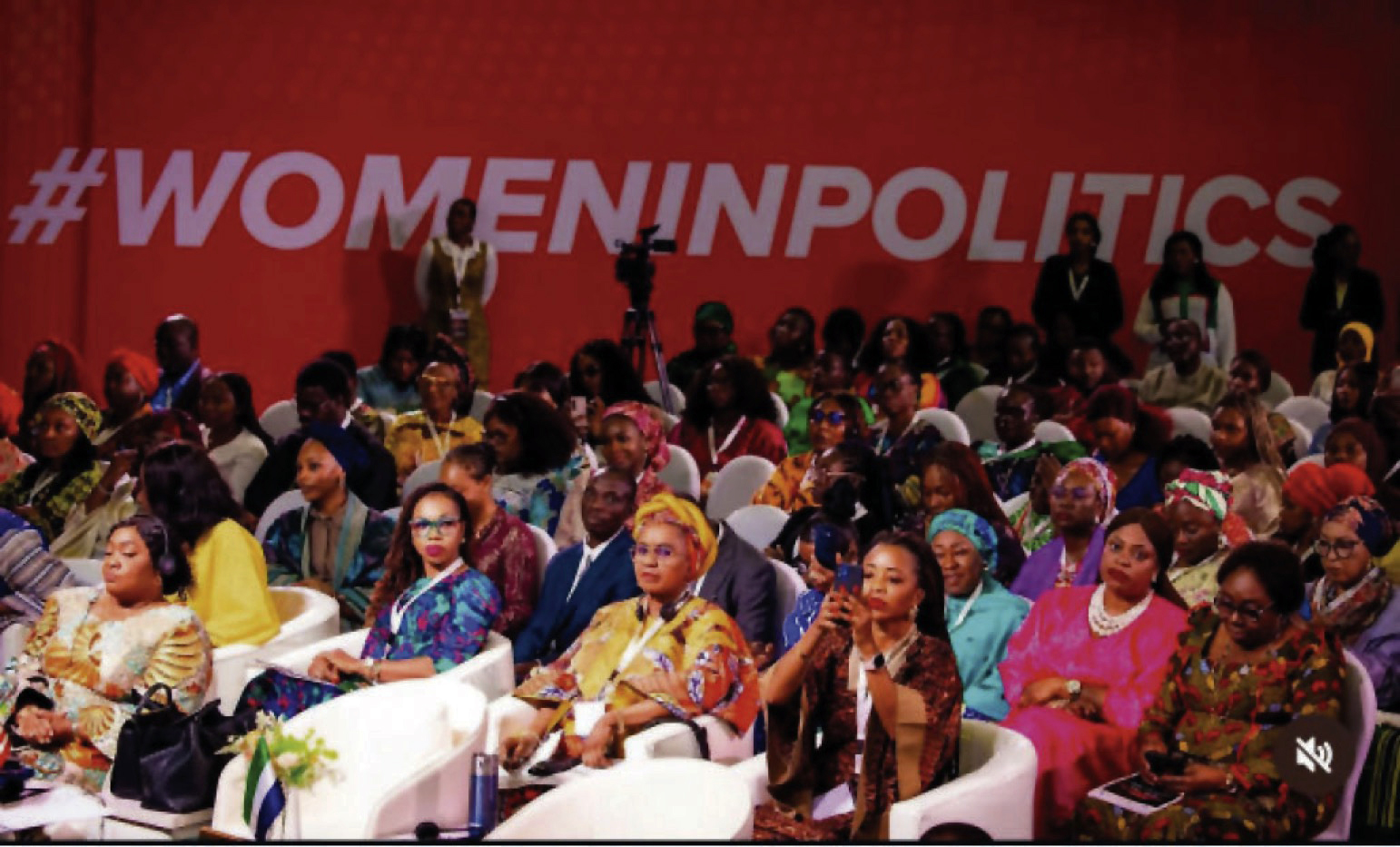
The applause inside the Congress Hall of Transcorp Hilton in Abuja came easily. The path to political power, however, has never been easy.
Around the room sat cabinet ministers, parliamentarians, diplomats, election managers, civil society leaders and development partners from across West Africa. Yet, despite representing countries where women make up more than half of the population, they gathered around one uncomfortable reality: politics in the region remains one of the last frontiers where women continue to be systematically locked out – not because they lack competence but because the system itself was never designed to let them in.
For two days, the West Africa Women’s Political Leadership Forum became less of another international conference and more of a strategy room. The discussions moved beyond familiar calls for inclusion to practical questions of money, mentorship, law and political will. How can women compete when campaigns are becoming more expensive? How do young girls see politics as a realistic ambition if they rarely see women at the highest tables? And perhaps most importantly, what reforms are needed to ensure that the next generation of women leaders no longer face the same barriers that have frustrated those before them?
The answers that emerged formed the basis of the Abuja Action Agenda, a regional blueprint adopted by governments, ECOWAS, the African Women Leaders Network (AWLN), the United Nations Development Programme (UNDP) and other partners to accelerate women’s political participation across West Africa.
For Nigeria’s Minister of Women Affairs, Imaan Sulaiman-Ibrahim, the conversation is no longer about symbolism or fairness.
“The issues of equality and parity are no more that of emotions or about balance. It’s about national development and it is an economic imperative,” she declared during a ministerial briefing.
She argued that the forum was deliberately convened at a defining moment, following the adoption of the ECOWAS Presidential Declaration on Gender Parity in Political Representation, because the region must now move beyond lofty promises.
“This forum particularly is about turning commitments into action. We’ve been talking for so long. At the heart of the Abuja Action Agenda are commitments to accelerate the ECOWAS 2035 Agenda for Gender Parity, to unlock sustainable financing for women’s political leadership, to make politics safe for women through zero tolerance for violence against women in politics, to place our young women and women facing multiple forms of exclusion at the centre of political leadership and to strengthen regional solidarity among women.”
For Sulaiman-Ibrahim, excluding women from politics carries consequences that extend far beyond gender.
“We cannot achieve inclusive development while women remain excluded from the decisions that shape public investment, policy, social protection, peace and security and the delivery of services to our families and communities. Women’s political leadership is essential to each of these objectives.”
Her position echoes figures she presented earlier at the forum. While women head 11 of Nigeria’s commercial banks, occupy roughly one-third of superior court positions and hold more than 30 per cent of senior positions in the Federal Civil Service, they account for less than five per cent of elected political offices.
To the minister, those numbers expose where the problem truly lies.
“Africa does not suffer from a shortage of capable women. It suffers from structures that were never built to let them through. Where competence is the measure, she rises. Where the cost of entry and structural barriers stand in the way, too many are held back. Our challenge is not the candidate. It is the pathway.”
That pathway, participants agreed, has become increasingly defined by money.
Across West Africa, elections have become progressively more expensive. Purchasing nomination forms, running campaigns, mobilising supporters and sustaining political structures often require resources beyond the reach of many aspiring female candidates.
Instead of merely identifying the problem, delegates proposed perhaps the forum’s boldest recommendation—the creation of dedicated financing mechanisms, including a Women’s Political Leadership Trust Fund or Women’s Political Endowment Fund, designed to support nomination fees, campaign financing, leadership development and other political costs for credible female candidates.
The proposal received strong backing from UNDP’s Director of Programmes for Africa, Jide Okeke, who described political financing as one of the biggest obstacles preventing women from entering public office.
“Women are good for development, peace and security and, ultimately, if we have more women in leadership, many of our development challenges will be addressed,” he said.
Drawing from his own upbringing, Okeke personalised the argument.
“My mother invested significantly in my education and today I am one of the leaders within the UNDP system. My journey reflects the transformative role of women’s leadership. Women make leaders, they are good leaders, and more women in leadership is good for peace and security on the African continent.”
He noted that despite women’s enormous contributions, they currently occupy only about 18 per cent of parliamentary seats across West Africa.
According to him, the solution lies not only in encouraging women to contest elections but in deliberately dismantling the financial barriers that discourage them from participating in the first place.
“In countries like Nigeria, women are not asking for special treatment. They want a level playing field and an ecosystem that enables them to mobilise the same resources available to men. I hope we can endorse from this meeting the establishment of funds for promoting, helping and supporting women in politics.”
The emphasis on sustainable financing resonated strongly with Liberia’s Minister of Gender, Children and Social Protection, Gbeme Horace-Kollie, who described campaign financing as perhaps the greatest obstacle facing women politicians.
She argued that governments must stop relying on voluntary goodwill and instead legislate equal access to political resources.
“Electoral reform is very important to mandate political parties to give a percentage of their revenue to female candidates. A lot of times the distribution of internal political party financing is restricted to the men alone benefiting while the women struggle on their own. It has to be a law because anything you ask outside legislation becomes a challenge.”
Horace-Kollie also proposed reducing nomination fees for women and establishing dedicated funding structures to prevent aspiring female politicians from exhausting personal and family resources during elections.
“Women are ambitious. We have the capacity to lead, but sustainable financing remains a critical gap. Women get into the political process, expend all their resources, sometimes husbands walk away, families split because of that, and they have nothing left to come back for another try. That is a problem we need to solve.”
She even revealed that discussions were underway in Liberia on how the country’s central bank could provide financing opportunities for women seeking political office.
“Women are credit-worthy. We should begin talking about how central banks can support female politicians because we have the capacity and the integrity to succeed.”
Rather than treating the proposal as a Nigerian initiative alone, ECOWAS Vice-President Damtien Tchintchibidja described sustainable financing as central to implementing the recently adopted Presidential Declaration on Gender Parity.
She acknowledged that ECOWAS cannot impose laws on sovereign states but can provide leadership, coordination and accountability.
“It is important that ECOWAS uses its convening power to get all Member States together and help them understand the implications of such a declaration. We cannot enforce such measures, but we can guide the process so Member States develop the legal frameworks needed to make room for women to fully participate.”
She said the regional body would work closely with UNDP and other partners to mobilise funding while helping countries translate declarations into measurable reforms.
“The ECOWAS Commission has the duty to establish a roadmap. We cannot do it alone. We have to do it together with Member States, civil society, women leaders and our development partners. We also need accountability systems where we measure progress and allow Member States to learn from one another instead of reinventing solutions.”
While financing dominated much of the discussion in Abuja, delegates agreed that money alone would not transform women’s political fortunes. The region, they argued, must begin preparing future leaders long before they pick up nomination forms or mount campaign podiums.
That thinking is behind another major pillar of the Abuja Action Agenda—the creation of a strong pipeline of women leaders through mentorship, leadership academies and cross-generational support systems.
UNDP’s Jide Okeke announced that the organisation, working with the African Women Leaders Network (AWLN) and the African Union, is investing in that future through the Women’s Political Participation Academy, an initiative designed to equip women with the political, governance and leadership skills needed to compete effectively.
He disclosed that the academy would immediately begin training 40 women political leaders from 28 African countries in Kigali.
Beyond that, he said, UNDP is already nurturing a new generation of female leaders through its Africa Young Women Leaders Programme, which has trained about 140 exceptional young women over the past five years and deployed them across UNDP country offices worldwide.
For Okeke, leadership development cannot wait until election season.
He argued that governments, development partners and the private sector must deliberately invest in women years before they decide to run for office.
His remarks complemented the vision outlined by Nigeria’s Minister of Women Affairs, who proposed the establishment of a Regional Women’s Leadership Academy to identify promising women from wards, local governments and communities across West Africa and prepare them for leadership.
She said the Federal Government had already begun reforming its six leadership academies spread across Nigeria’s geopolitical zones.
“As an ongoing effort, our six leadership academies across the country in each geographical zone are undergoing a major reform. We’re expanding economic opportunities because we cannot separate women’s political, social and economic growth. They are all intertwined. We’re improving security and ensuring that government policies deliver meaningful results in the lives of our citizens.”
Sulaiman-Ibrahim said the reforms were also linked to Nigeria’s implementation of the Third National Action Plan on Women, Peace and Security, which places women at the centre of conversations around peacebuilding and national security.
For her, preparing women for political leadership is inseparable from preparing stronger families, stronger institutions and stronger democracies.
She noted that President Bola Tinubu had declared 2026 the Year of the Family, with Nigeria preparing to host an International Family Summit that she hopes will launch a decade of sustained investment in families across the continent.
“It’s important that we connect the regional commitments made by ECOWAS with the practical work required at the national level and identify where stronger laws, institutions, partnerships and investments are still needed.”
Other News
Perhaps the strongest message from the minister, however, was that women must stop seeing themselves as competitors first and allies second.
She repeatedly returned to what she described as a cross-party and cross-generational sisterhood.
“This forum is about building solidarity, collective strength, and we’re creating a cross-party and cross-generational sisterhood for women leaders across Africa. A network through which women can share knowledge, open doors for one another, mobilise collective influence and ensure that no woman enters political life alone.”
That vision found a powerful ally in Bineta Diop, Co-Convener of the African Women Leaders Network, who argued that no single law or programme would deliver gender parity unless governments build what she repeatedly described as an ecosystem.
“We cannot achieve what we are talking about—women’s political leadership—without putting an ecosystem in place. We cannot work in silos. That ecosystem must include strong laws, women’s movements, political parties, institutions, financing and accountability.”
Drawing from Senegal’s experience, Diop recalled that the country’s parity law was itself inspired by reforms adopted at the African Union.
“When the African Union adopted the parity principle, women’s movements in Senegal insisted that our government implement it nationally. That is what accountability means. If governments adopt ECOWAS or African Union commitments, they must implement them. Our role as women’s movements is to hold them accountable.”
For Diop, accountability remains the missing link.
“There are laws. There are programmes. What is missing is accountability—accountability to the people. If governments say they are going to do something, they must do it.”
She welcomed the launch of the Women’s Political Participation Academy but stressed that the initiative goes far beyond classroom learning.
“It is not just about training. It is also about accompanying them, mentoring them, pushing them, opening the door for them. That is what the women of Africa need—that chain of solidarity and exchange. We are not counting just more women into leadership. What we need is to build the continental movement.”
That emphasis on mentorship was echoed by Senator Dr Chapel Mosakura Fani, who described mentoring not as charity but as an obligation.
“Mentoring is very important. It is not generosity on our part; it is our responsibility to support other women. The young people should dream and say, ‘We also want to be there.’ We who are already at this level need to carry them along because if we don’t nurture these young people’s aspirations, then our struggle has been in vain.”
Across the forum, delegates also exchanged practical lessons from countries making measurable progress.
Sierra Leone’s Minister of Gender and Children’s Affairs, Dr Isata Mahoi, explained how legal reforms—including the Gender Equality and Women’s Empowerment Act, the Political Parties Regulation Act and electoral reforms—had helped raise women’s parliamentary representation to about 30 per cent.
Yet she cautioned that legislation alone would not be enough.
“The laws and implementation and enforcement of the laws are critical, but we also need to ensure that the political landscape is fit for women. Political parties should review their constitutions to make them gender-friendly instead of limiting women to ceremonial roles.”
Mahoi also stressed the importance of investing in girls long before they enter politics.
“The intergenerational divide is important. We need mentorship programmes. Education is critical for the girl child. We must support girls in STEM and continue building their confidence because tomorrow’s political leaders are sitting in today’s classrooms.”
She urged West African countries to support one another by sharing successful reforms rather than working in isolation.
“When elections are over, we should identify the women who contested but did not win, bring them together, support them and prepare them for the next election cycle.”
As the forum drew to a close, Sulaiman-Ibrahim delivered perhaps its most optimistic message.
She warned that constantly portraying politics as an impossible space for women risked discouraging the next generation before they even tried.
“In Nigeria we have challenges. People wonder why I don’t speak about the challenges. Because whatever you focus on is what you get. In recognising our challenges, we don’t understand how far we’ve come.”
She pointed to women who had already won elections—including senators and Nigeria’s First Lady—as proof that success was possible.
“It means that all we have to do is find out how to replicate those successes. If we continue telling the wrong narrative, we will lose the young girls because they will not be interested.”
Rejecting the notion that women seek preferential treatment, she instead called for equal opportunity.
“Politics is negotiation. It is not entitlement. We want a level playing ground. When we hire a hall for an event, we don’t ask for a 50 per cent discount because it is a women’s event. When we buy an airline ticket, we don’t ask for a discount because we are women. We want partners and allies. If we don’t have the money, we will have people to invest. We will learn to fund ourselves. That should be the conversation.”
Those words captured the essence of what emerged from Abuja.
The Liberian Vice President, Jewel Howard-Taylor, brought a deeply personal perspective to the conversation, urging African women to stop internalising narratives that portray them as perpetually unprepared for leadership.
Introduced as “the jewel of Liberia” and recognised for her decades of advocacy for women’s leadership, peacebuilding and inclusive governance, Howard-Taylor said the Abuja forum must become more than another gathering that produces declarations. Instead, she challenged participants to ensure that the conversations translate into political reforms capable of changing the lives of women across West Africa.
“As we gather today under the theme of accelerating women’s political participation and leadership in West Africa, I believe our conversations go beyond commitments towards political reform, to making strong decisions and changing the narrative,” she said.
Reflecting on women’s contributions across the region, the Liberian Vice President noted that women had consistently demonstrated their leadership abilities in communities, businesses, civil society organisations and public service, yet continued to remain underrepresented in the very institutions where national decisions are made.
“Across our region, women continue to demonstrate extraordinary leadership in communities, in business, in civil society and public service. Yet, despite decades of advocacy, our representation in elected offices—where it actually counts—continues to be far below what we expect.”
Howard-Taylor rejected the often-repeated argument that women must first prove they are ready before being entrusted with political office, describing it as a standard rarely applied to men.
“People say women should get ready. Women should be prepared. I have never heard them ask a man who is running for elected office whether he is prepared. As long as he is male, it doesn’t matter. But when it comes to women, they always say the women should be ready, the women should be committed.”
She insisted that leadership preparation begins long before adulthood, arguing that girls are raised from childhood to shoulder enormous responsibilities.
“Women are prepared from the time we are little girls. We are prepared to lead. We are prepared to create. We are prepared to drive the legacy of our families and our children. How then, when it comes to leadership at the national level, they always say the women are not prepared?”
The former First Lady attributed much of the imbalance to deeply rooted socialisation that gives boys greater exposure to leadership opportunities while confining girls to traditional domestic roles.
“When we raise our children, we believe that boys have more leverage than girls, that the girls should be the keepers of the home while the boys go out, make friends, play football and learn the games of politics. I pray that one day there will be a change.”
Drawing from her own remarkable political journey—from First Lady to Senator for Bong County, to becoming Liberia’s first female Vice President and one of the country’s few female standard-bearers of a political party—Howard-Taylor said her experience had convinced her that women can overcome even the most entrenched political barriers.
“As one who has walked this road—from being First Lady to Senator, to being the first female Vice President of our country, and one of the very few female standard-bearers of political parties in Liberia—I understand both the challenges and the opportunities that women encounter. I also know that anything is possible if you just believe it.”
But she cautioned that success should not be measured simply by increasing the number of women occupying public offices.
Instead, she argued, the real objective should be to ensure women wield genuine influence over governance and hold governments accountable for promises already made.
“Our responsibility at the end of this conference extends beyond just increasing the numbers of women. We must ensure that we are empowered to influence policy, to keep our governments’ feet to the fire to do what they have promised and signed to do, to promote peace and democracy, and to inspire the next generation of leaders.”
Howard-Taylor also challenged senior women leaders to be mindful of the stories they tell younger women about politics.
She recalled speaking at another event where she described politics as “walking on fire” and immediately noticed the apprehension it created among young women in the audience.
“It may be easy when we meet the young generation to tell them how difficult this road is. It may be easy to tell them it can be done, but it is just too difficult. I remember sitting on a platform a few months ago and I said that as we get involved in these processes, we walk on fire. And I saw the young women cringe. Do they want to walk on fire? No. They want to get involved.”
Her remarks reinforced a recurring theme throughout the Abuja forum—that while acknowledging the obstacles women face in politics is necessary, leaders must avoid presenting political participation as an impossible journey. Instead, delegates agreed, the focus should be on dismantling those barriers through financing, mentorship, institutional reforms and sustained solidarity so that the next generation of women enters politics with confidence rather than fear.
The forum was never simply about increasing the number of women occupying parliamentary seats. It was about redesigning the political ecosystem itself—through financing instruments such as a Women’s Political Endowment Fund, stronger laws, regional partnerships with organisations like the UNDP, leadership academies that prepare women before elections, and a continent-wide sisterhood committed to opening doors rather than guarding them.
For thousands of young girls watching from villages, classrooms, universities and communities across West Africa, the success of the Abuja Action Agenda will not be measured by the speeches delivered in Nigeria’s capital.
It will be measured by whether, years from now, they inherit a political landscape where leadership is determined not by gender, wealth or inherited networks, but by vision, competence and the courage to serve.