Follow Us on Google
From Ndubuisi Orji, Abuja
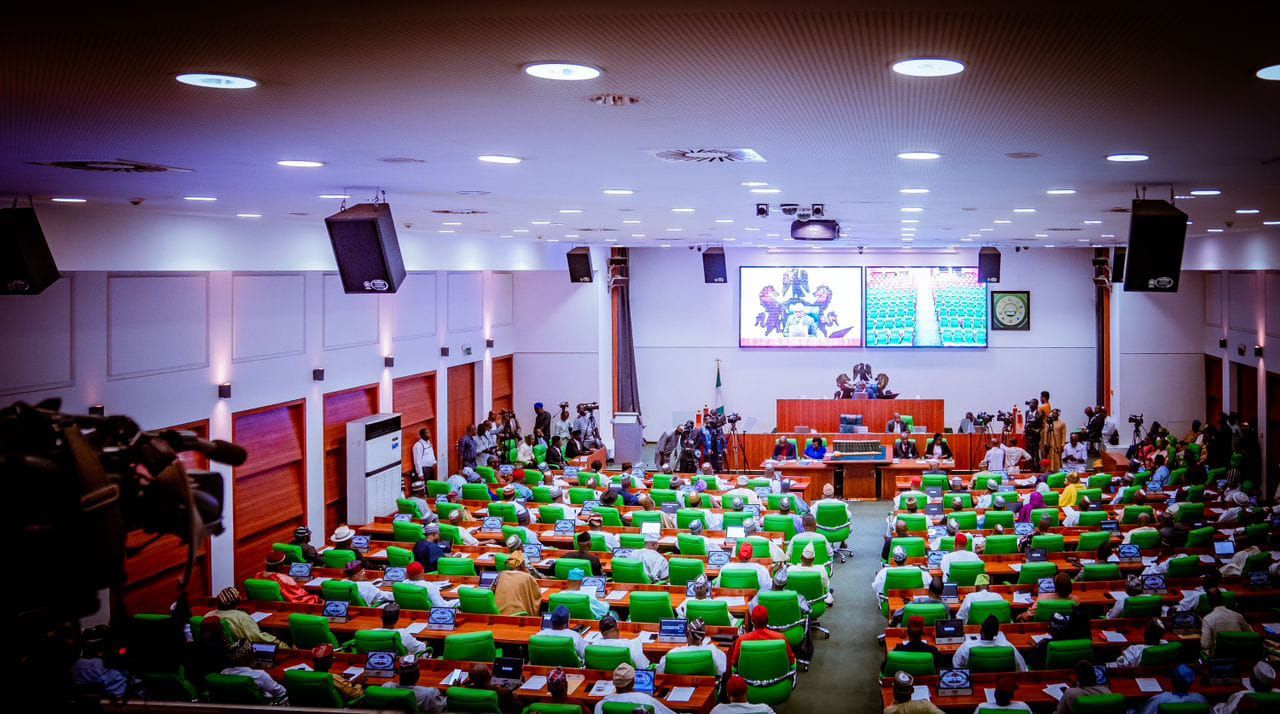
The House of Representatives, yesterday, approved the Medium Term Expenditure Framework (MTEF)/Fiscal Strategy Paper (FSP) for 2025- 2027.
The House, which pegged the oil benchmark for 2025 at $75 per barrel, with a projection of 2.6 million barrel per day, okayed the MTEF, at plenary, after it considered the report of the Committee on Supply.
The Chairman House Committee on Finance, James Faleke, had earlier laid before the House the report of the Committees on Finance and National Planning and Economic Development on the MTEF/FSP.
The chamber also approved $76.2 and $75.3 per barrel and daily oil production at 2.10 million and 2.35 million barrels for 2026 and 2027, respectively.
The parliament also approved a total expenditure of N47.9 trillion for the 2025 fiscal year, with a fiscal deficit of N13.08 trillion and new borrowings, consisting of domestic and foreign debts, of N9.22 trillion. Debt servicing was pegged at N15.38 trillion and N1.443 trillion approved for pensions, gratuities, and retirees’ benefits.
According to the report, capital expenditure is projected at N16.48 trillion, which is exclusive of transfers; statutory transfers stand at N4.26 trillion; the sinking fund is projected at N430.27 billion, while total recurrent (non-debt) expenditure is projected at N14.21 trillion.
Similarly, the House approved a Gross Domestic Product (GDP) growth projection of 4.6 percent, 4.4 percent and 5.5 percent for 2025, 2026, and 2027, respectively, with an exchange rate of N1,400 to a dollar adopted for the three years.
The House resolved that the parliament would probe private-public partnership agreements by the Nigeria National Petroleum Limited (NNPCL), Nigeria Immigration Service (NIS) and other revenue generating agencies. The MTEF/FSP report had accused NNPCL, NIS and other revenue generating agencies of going into partnerships that are inimical to the growth of the country’s revenue.
The lawmakers said: “The National Assembly Committees on Finance, National Planning and other relevant committees should carry out an in-depth investigation of such agreements by the NNPC, NLNG, and Immigration Services, with a view to reconciling remittances to the Federation Account.”
According to the report, “Most revenue generating agencies violate the Fiscal Responsibility Act due to the lack of punitive provisions in the Act. It also identified noncompliance with the Nigerian Export Supervision Scheme (NESS) Act by relevant government agencies, specifically focusing on the inspection and monitoring of oil and gas exports as well as non-oil exports.”
Consequently, it mandated “the Committees on Finance, Petroleum Upstream, and Petroleum Downstream to investigate reports from the Revenue Mobilisation, Allocation, and Fiscal Commission, alleging that the NNPC withheld N8.48 trillion as claimed subsidies for petrol.
“Additionally, the investigation will address the NEITI report stating that NNPC failed to remit $2 billion (N3.6 trillion) in taxes to the Federal Government. The committees are further directed to verify the total cumulative amount of unremitted revenue (under-recovery) from the sale of Premium Motor Spirit (PMS) by the NNPC between 2020 and 2023.”
Nevertheless, the Minority Leader, Kingsley Chinda, during the clause by clause consideration of the MTEF/FSP at the Committee on Supply chaired by the Deputy Speaker, Benjamin Kalu, picked holes in some of the projections.
“Because of the importance of this MTEF and its sensitivity, I will ask that we consider it thoroughly before we pass it. This is one of the most important things that the parliament will ever pass.
“If you look at clause one, it has to do with the oil benchmark and we are recommending that $75, $76.2 and $7.3 be the benchmark per barrel of crude for 2025, 2026 and 2027.
“For 2024, we are aware that what we recommended is $77.96. That is the current budget. And the selling price today is about $85 per barrel. That was in the first quarter of 2024. We achieved 85.
“So, recommending $75 for 2025, which is next year, as against $77 that we recommended for this year, I will urge and advise that we maintain the minimum as a benchmark for this year, because the disparity might be too large. Rather than increase we are reducing,” Chinda said.
However, Faleke explained that if the oil benchmark is shot up too much, it might lead to ‘bloated’ expectations.
“I listened attentively to the issue raised by the minority leader. The crude oil price is not controlled by any state or any country. The fact is that we did $77.9 this current year and we were lucky to have a crisis (unfortunately) within some producing countries which shot up the price of crude.
“We envisage that in the next year, the crisis might subside and the price will crash. If you shoot up too much, it means that you are bloating your expectations. As of today, the price has crashed to $74. So, I think that $75 is reasonable.”