Follow Us on Google

“Mass Communication by day. Music at my free time. I thought I would end up as a disc jockey, in a radio station, like Alex Conde, the leading disc jockey of that era. And through it all, the influence of voices like Otis Redding remained constant.“
This morning, I mounted my stationary exercise bike—not so much in pursuit of fitness as in search of rhythm. There are mornings when the body moves, but it is the soul that truly travels. And then, as if summoned by memory itself, it came—soft, unhurried, eternal. (Sittin’ On) The Dock of the Bay.
That gentle whistle. That lazy tide of sound. That voice—ah, that voice.
And just like that, I was no longer in the present. I was gone. Transported. Taken back to a time when life was simpler, dreams were young, and music was not just heard—it was lived.
Otis Redding has that effect on you. He doesn’t just sing; he reaches into your memory and rearranges your emotions.
As I pedalled, slowly, almost reverently, the years began to roll back.
Sekondi College.
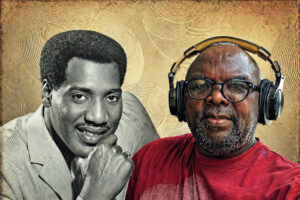
Axim Secondary School.
Those golden Ghanaian days—sunlit, innocent, unburdened. Days when music was a companion, not a background noise. When every song carried meaning, and every lyric felt like it was written just for you.
In those days, we didn’t have playlists curated by algorithms. We had instinct. We had taste. We had feeling.
And somewhere in that growing world of sound, the voice of Otis Redding stood apart—raw, aching, unmistakably human.
From Ghana, my journey took me to IjebuJesha my hometown, to the hallowed grounds of IjebuJesha Grammar School, where I pursued my Higher School Certificate. Another chapter. Another layer of life. But the music followed me.
Always.
Then came University of Lagos.
Ah, UNILAG!
That was where everything came alive in a different way. Where passion met purpose. Where I became not just a listener, but a curator of sound—a DeeJay spinning records, shaping moods, commanding dance floors.
Mass Communication by day. Music at my free time. I thought I would end up as a disc jockey, in a radio station, like Alex Conde, the leading disc jockey of that era. And through it all, the influence of voices like Otis Redding remained constant.
What was it about him?
It was not just the songs. It was not just the melodies.
It was the truth in his voice.
Listen to him closely and you hear a man who is not trying to impress you. He is not performing for applause. He is expressing something deeper—something honest, something vulnerable.
In a world where many strive to sound alike, Otis Redding chose to sound like himself.
That, perhaps, is the greatest lesson he left behind: uniqueness is power.
He did not polish his voice into perfection. He let it breathe, crack, stretch, soar. He embraced its imperfections—and in doing so, made it unforgettable.
Today, as I rode that bike, I found myself slowing down—not from fatigue, but from reflection.
Where did those days go?
The laughter in dormitories. The debates over music. The excitement of discovering a new sound. The thrill of placing a needle on a record and waiting for magic to happen.
We did not know then that we were living the “good old days.”
We were simply living.
Other News
Now, those days return only in fragments—triggered by a song, a scent, a fleeting thought.
And this morning, it was Dock of the Bay that opened the floodgates.
Sitting on the dock of the bay… watching the tide roll away.
There is something profoundly philosophical about that line. A quiet acceptance. A gentle surrender. A man at peace with time, even as it slips through his fingers.
Perhaps that is where I find myself now—watching the tides of memory roll in and out.
From Sekondi to Axim.
From IjebuJesha to UNILAG.
From a young boy discovering music to a man looking back at the journey.
And in that long arc of life, the voice of Otis Redding remains—steady, soulful, eternal.
We often celebrate greatness in loud, flamboyant terms. But some greatness whispers.
Otis Redding’s greatness whispers.
It does not shout. It does not demand attention. It simply endures.
Even now, decades after his passing, his music finds its way into headphones on a quiet morning in Lagos, riding on the rhythm of a stationary bike, stirring memories that refuse to fade.
That is immortality.
So today, I remember.
I remember the boy I was.
I remember the music that shaped me.
I remember the journey that carried me across borders and into purpose.
And above all, I remember the man whose voice taught me that to be truly unforgettable, you must first be unapologetically yourself.
Oh, Otis Redding.
Thank you for the music.
Thank you for the memories.
And thank you for the lesson in uniqueness.
The tide may roll away—but your voice remains.
This is what Wikipedia has to say about this great soulful singer: Otis Ray Redding Jr. (September 9, 1941- December 10. 1967 was an American singer and songwriter. He is regarded as one of the greatest singers in the history of American popular music and a seminal artist in soul music and rhythm and blues. Nicknamed the “King of Soul”. Redding’s style of singing drew inspiration from the gospel music that preceded the genre. His vocal style influenced many other soul artists of the 1960s.
Cause of death: Plane crash
Resting place: Round Oak, Georgia
Spouse: Zelma Atwood (married 1961)
Shortly before his death in a plane crash, Redding wrote and recorded “(Sittin’ On) The Dock of the Bay” with Steve Cropper. Released in January 1968, the song became the first posthumous number-one record on both the Billboard Hot 100 and R&B charts. The album The Dock of the Bay was the first posthumous album to reach number one on the UK Albums Chart.