Follow Us on Google
By Kehinde Aderemi
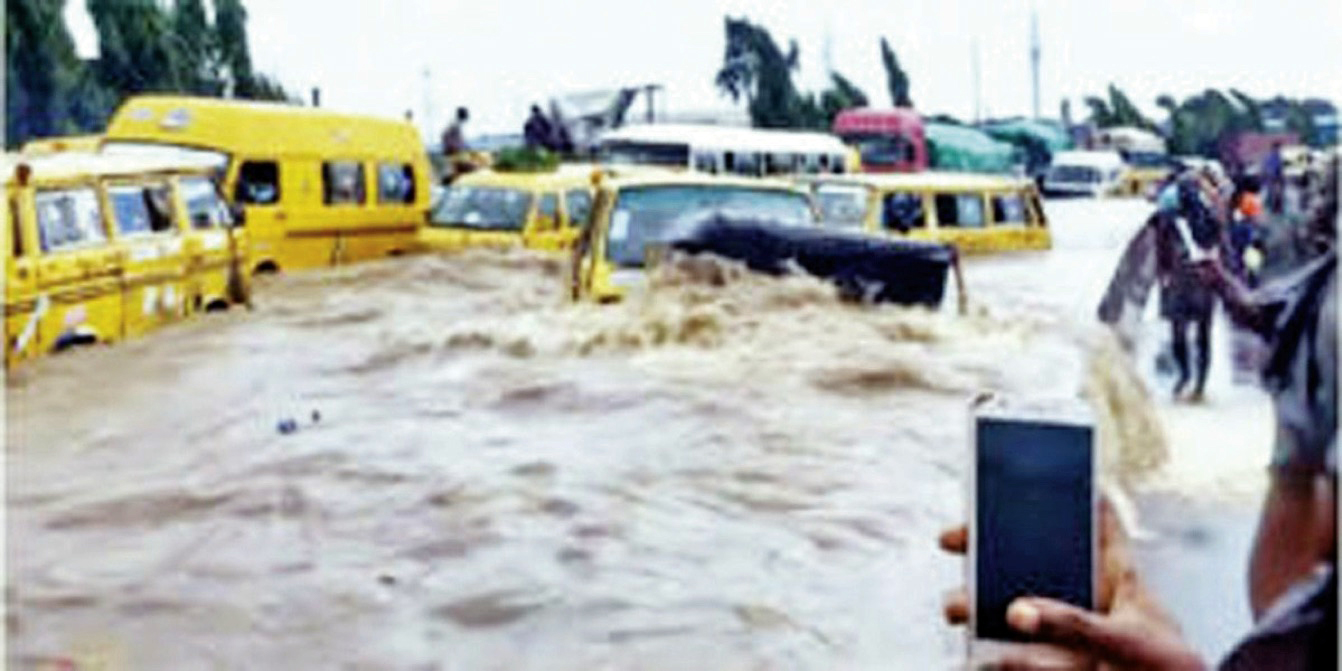
It is July and the rain is here in full force. Flooded streets, blocked drains, and mounds of refuse are already surfacing. Flood is now cutting off roads, even as waste is choking waterways.
Findings revealed that the pattern is familiar- and it points to one root cause: environmental degradation driven by poor public attitude.

Recent heavy rains in some parts of the country these days further expose a deeper crisis of flooding and environmental degradation in major states across the country.
But as Nigerians witness another rainy season, Saturday Sun gathered that there is more to the dangers hanging around as the season begins in earnest.
Environmental experts have continued to express concern over open sewage and poor management of bodies of water generated from rain.
They explained the factors that contribute to flooding, insisting that government’s intervention might not be enough as there’s a need for attitudinal change.
An environmentalist and former lecturer at the University of Education, Winneba, Ghana, Professor Kolawole Raheem, said the issue of flooding, environmental degradation and maintenance is all about the citizens’ attitude to how they dispose their waste.
He said there is a need for government to think of doing things differently.
Prof Raheem stated further that not all the citizens understand where the waste they throw inside gutters goes.
He described the citizens’ attitude as failure of human nature to understand the environment.
“I feel concern about how we dispose our refuse. We throw them into the gutters. That is what’s called open sewage. We forget that as we throw waste into the gutters, we are causing a lot of damage to the environment because the bodies of water around us have been contaminated.
“This is very bad and I want to say that the government has to be serious, be disciplined to get things done the right way.
“It’s not enough for the government to just come up with laws against environmental degradation. Government must be ready to do something different from what they have been doing and proffer better ways of managing our environment.
Raheem also faulted the way the government built the gutters and drainages in the country. He noted that such construction makes it easy for people to throw waste in the open gutters.
“People in this part of the world will always throw their waste into those open gutters because the human nature is that when you see a place where you can throw your waste, and especially in the gutters where you have the moving water, the assumption is that the water will just wash the waste away. But to where, is what we don’t understand.
“Nigerians need to understand that whenever we throw our waste into the gutters, the waste will choke the drainage and then the water is not flowing, then you have flood all over.
“It’s the same thing with our water bodies. For instance, if you travel from Ikorodu to Mile 12, and you see how we are polluting the water, you wonder what is wrong with us in Nigeria. During the rainy season, it is possible for a body of water to travel from Ikorodu to as far as Victoria Island or even beyond.
“You go to some areas in Ajah and you see how people still drill the sand, degrade the environment, but they don’t know that such acts could as well pollute the water.
“That is why the water in areas like Ajah and its environs become so brown, that you can’t get any fish inside that water. It is the same thing in some parts of the country, and flooding, and environmental degradation is a big problem in Nigeria .
Other News
“However, government must start with a good example by making sure that all those open gutters are covered. When they are covered, people will not see anywhere to throw waste as it is in developed society,” he stated.
The former don described Lagos State as a mega city with open gutters. He said Lagos has the capacity to build modern gutters and drainages where water will be flowing without people seeing it.
“It is very unfortunate that in this time and age, we still have open gutter everywhere in Lagos. I think our development should have gone very higher than what we see today in a mega cities like Lagos.
“So, that is the major problem. Now, it is every year. Every rainy season we have problems of flood. It has started happening also this year because we have not changed our attitude.
“Unfortunately, our attitudes toward the environment has not changed. It’s even getting worse because the government is allowing people to just cut down trees. And when you cut all those trees down, of course, you have more possibility of flood to rise.
“So, I would say it is the government that has to start disciplining itself by creating the environment that will discourage throwing waste into the open gutters, because when you don’t see places that you can’t throw waste, then you know that you cannot just throw it anywhere.
“And then, when that is done, then the government can now send its officers around to monitor people who are throwing waste in the gutters.
It is unfortunate also that many communities in Nigeria don’t even have gutters because government has not created it. It is the house owners that create the gutters and it’s just in front of their own houses. So you will always have erosion and flooding all the time,” he said.
Also in her remarks, a US- based Nigerian hydrologist, Sakinat Ahmad, said it is not unexpected that urban flooding occurs when rainfall overwhelms a city’s ability to collect, convey and drain storm water.
According to her, urban flooding, including flash floods, can happen quickly, even during relatively short periods of heavy rain, causing damage to homes, businesses, roads, and public infrastructure.
Ahmad mentioned those factors that contribute to urban flooding including, increased impervious surfaces such as roads, parking lots and buildings that prevent water from infiltrating into the ground.
She explained further that intense rainfall due to climate change, inadequate storm water infrastructure, poor land use planning, as well as poor drainage system and maintenance, can also be responsible for flooding.
“Although factors such as intense rainfall could be beyond human control, several factors are preventable, with poor urban drainage system being one of the most preventable.
“Storm drains, culverts, channels, and ditches are designed to carry storm water away from developed areas. When these drainage systems become clogged with garbage, plastic bags, yard waste, sediment, and other debris, their capacity is significantly reduced.
“Illegal dumping and littering can block the flow of water, causing storm water to back up onto streets and surrounding properties. Even a well-designed drainage network can fail to function effectively if routine maintenance is neglected.”
Ahmad also pointed out that urban flooding can also be addressed through improved infrastructure and community participation.
According to her, regular inspection, cleaning of storm drains, culverts as well as drainage channels can help maintain their capacity.
“Public education programmes can also discourage littering and dumping in drainage systems, while enforcement of waste disposal regulations can further reduce blockages.
“In Nigeria, there is a need for a mindset change regarding waste disposal and littering. People must understand that proper garbage disposal is everyone’s responsibility, even if they have to pay to get it done the right way.
“The ultimate solution to urban flooding requires the combination of different measures, including installation and maintenance of resilient storm water infrastructure, responsible waste management, and sustainable storm water practices.
“If these measures are properly implemented, communities can significantly reduce the frequency and severity of urban flooding and improve their resilience to future storm events,” she stated.