Follow Us on Google

How NDLEA is turning illicit fields into sustainable future
By Henry Umahi
Since his appointment in January 2021 as chairman and chief executive officer of the National Drug Law Enforcement Agency (NDLEA), Brigadier General Mohamed Buba Marwa (retd) has led a massive transformation of the Agency, shifting it from a reactive agency to a proactive, high-performance and intelligence-driven organization.
The transformative era is marked by aggressive enforcement, record-breaking seizures, high profile arrests, a renewed focus on rehabilitation and comprehensive reforms.
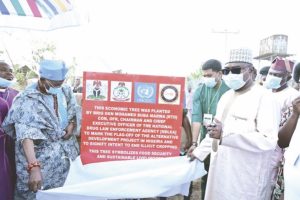
Few weeks ago in 2026, the Agency launched an Alternative Development Pilot Project aimed at ending illicit cannabis cultivation by providing affected communities with sustainable and legal livelihood options. The initiative was unveiled in Akure, Ondo State, at a town hall meeting attended by national stakeholders, international development partners, traditional rulers, and community leaders.

The Alternative Development (AD) project is a strategic, community-centered initiative by the NDLEA and state partners to replace illicit cannabis cultivation with legal, sustainable agricultural livelihoods such as food and cash crop production. Launched as a pilot programme, it aims to shift from a solely confrontational enforcement approach to one of empowerment and partnership to combat rural poverty and reduce drug-related insecurity.
The project moves away from purely punitive enforcement, aiming to address the root causes of poverty, insecurity, and environmental degradation in communities that rely on cannabis farming.
Speaking at the event, Marwa informed that the programme represented a shift from confrontation to cooperation between law enforcement and farming communities involved in illicit crop cultivation.
According to him, the Alternative Development Project will help break the long-standing cycle of poverty, insecurity, and environmental damage associated with cannabis farming, while supporting Nigeria’s food security goals under President Bola Tinubu’s Renewed Hope Agenda.
He explained that drug cultivation often benefitted criminal networks rather than host communities, leaving behind degraded farmland and social instability.
“Illicit drugs generate huge profits, but that wealth rarely reflects in the communities where they are grown. While kingpins prosper elsewhere, these communities are left with poverty, soil degradation, and insecurity. Our focus is empowerment as an alternative to enforcement.
“We want to facilitate a total shift from illicit cropping to massive food and cash crop production,” he said. He added that crops such as Artemisia Annua, which has medicinal properties, could provide financial benefits greater than those of cannabis, while also contributing to public health and local economic development.
The landmark event at the Sunshine State blended symbolism, policy dialogue and grassroots engagement aimed at reshaping the narrative around drug control and community development.
The visit, which attracted eminent personalities from across the country, was widely described as a moment of hope for many ordinary cannabis farmers who have resolved to abandon illicit cultivation in favour of lawful and sustainable livelihoods. For them, the NDLEA’s Alternative Development Initiative represents not just a policy shift, but a lifeline.
During the visit, Marwa paid a courtesy call on Gov. Lucky Aiyedatiwa, who received him and his group warmly. Indeed, the visit combined high-level policy discussions with direct community engagement.
Marwa visited the palace of the Deji of Akure and met with the leadership of the Christian Association of Nigeria (CAN). He also visited the Chief Imam of Akure kingdom. All the personalities agreed to collaborate with NDLEA to eradicate illicit drugs in the state.
At a well-attended town hall meeting in Akure, organised under the Renewed Hope Alternative Development Advocacy Mission, Gov. Aiyedatiwa called for a comprehensive and people-centred strategies to tackle drug abuse, urging young people to reject illicit substances and embrace alternative livelihoods.
Describing the NDLEA initiative as timely and visionary, the governor noted that drug abuse remains a serious threat to public health, social stability and economic productivity, often fuelling crime and youth restrictiveness.
He argued that tackling the root causes, which include poverty, unemployment and lack of opportunity, is far more effective than relying solely on enforcement.
Take this from the governor: “When people are productively engaged, the urge to indulge in drug abuse and other illicit activities is significantly reduced.”
Highlighting his administration’s investments in skills acquisition, agriculture, vocational training and youth-focused grants, the governor assured the NDLEA of the state government’s full support. He also pledged to collaborate with traditional rulers, religious institutions, civil society organisations and the private sector to strengthen prevention, rehabilitation and reintegration efforts.
Other News
The Minister of Agriculture and Food Security, Senator Abubakar Kyari, represented by the ministry’s South-West Regional Director, Mrs. Temitayo Alao, commended the initiative, describing it as a direct response to hunger, poverty and unemployment among vulnerable populations. He noted that the programme aligns with President Bola Ahmed Tinubu’s Renewed Hope Agenda by promoting food security and job creation.
The International Institute of Tropical Agriculture (IITA), Ibadan, through its Deputy Director-General for Partnerships, Dr. Tahirou Abdoulaye (represented by Dr. Noel Mulinganya), described the pilot project as timely and impactful, capable of addressing the vulnerabilities that push communities into illicit economies.
At the formal launch of the Alternative Development Pilot Project, Marwa described the initiative as a decisive shift from a purely enforcement-driven approach to one rooted in empowerment and partnership.
He said: “Alternative development changes our relationship from enforcement to empowerment. We want a total shift from illicit cropping to productive cash and food crops.”
Citing the 2018 National Drug Use Survey, Marwa noted that about 14.4 million Nigerians one in seven adults use drugs, a trend that fuels crimes ranging from kidnapping to terrorism. In Ondo State alone, drug use prevalence stands at about 17 per cent, translating to roughly 400,000 users.
Despite Ondo’s status as Nigeria’s leading cocoa producer, Marwa observed that the state is also the country’s highest producer of cannabis. Over the past five years, the NDLEA has seized about 12 million kilograms of cannabis nationwide, with a significant proportion traced to Ondo State.
He explained that the programme is designed to help communities to voluntarily abandon illicit crops such as cannabis and transition to legitimate alternatives, including cocoa, cassava, yam and beans. Ondo State was selected for the pilot phase because of its prominence in cannabis cultivation.
He assured participants that the programme would not be used as a ploy to arrest or detain farmers, stressing that it is open only to communities that are willing and sincere about abandoning illicit crop cultivation.
According to him, it is a collaborative effort supported by the Federal Government, the United Nations and other international partners, with strong emphasis on community ownership and sustainability.
On the final day of the visit, Marwa went to the three pilot communities: Ifon in Ose local government area, Ilu-Abo in Akure North, and Eleyeowo where the policy conversations found human faces.
In Ilu-Abo, residents erupted in excitement as the NDLEA chairman paid a courtesy visit to the monarch, Oba Samuel Oluyemisi, who praised the initiative as a product of “deep and creative thinking.” The monarch noted that while traditional efforts had reduced illicit cultivation, economic hardship had pushed some youths into crime.
“If they are given alternative engagement, they will have no interest in crime or drug production,” Oba Oluyemisi said, pledging total support for the programme.
Mr. Noel Mulinganya, who works with the International Institute of Tropical Agriculture (IITA), spoke during the project kickoff at Ilu-Abo after collaborating in the planting exercise and supporting the NDLEA, the state government, and the host community in initiating the project. He expressed admiration for the NDLEA’s efforts to take more youths away from illegal activities and engage them in agriculture.
According to him, IITA has a strong programme focused on youth engagement in agriculture as a means of wealth and job creation. He noted that IITA is committed to supporting the NDLEA by transferring relevant technologies, knowledge, and skills that will help youths and other members of the community understand the benefits agriculture offers, enabling them to build sustainable livelihoods beyond illegal activities.
In a profound demonstration of commitment, Marwa announced financial support for the communities: ₦15 million for Eleyeowo and ₦20 million for Ifon to kick-start lawful farming and other productive ventures.
For many residents, the support was overwhelming. Mrs. Bridget Olaoluwa, a 46-year-old farmer from Eleyeowo, admitted that she had been involved in illicit farming since her youth. With emotion, she pledged to abandon the practice and invest in a legitimate business if supported.
Another farmer, Mr. Victor Ajanaku, 50, described the initiative as an eye-opener. “For the first time, I see NDLEA personnel not as enemies, but as partners in progress,” he said, urging transparency to ensure that promised funds reached genuine beneficiaries.
Traditional rulers, religious leaders, the judiciary and civil society groups all pledged support during the visit. The Olowo of Owo, Oba Ajibade Ogunoye, and the Deji of Akure, Oba Aladetoyinbo Ogunlade Aladelusi, both assured the NDLEA of sustained collaboration to curb drug abuse.
As the visit drew to a close, Marwa warned that proposed amendments to the NDLEA Act would soon impose stiffer penalties between 15 and 25 years imprisonment for drug-related offences. Yet, the overarching message of the Ondo tour was clear: lasting change lies not only in punishment, but in opportunity.
From town halls to farmlands, the NDLEA’s Alternative Development Pilot in Ondo State signals a bold attempt to turn illicit fields into pathways of hope one community at a time.