Follow Us on Google

Opposition politics is difficult, particularly in Nigeria and other African countries, where politics of self-interest, rather than national patriotism dominates, and where parties do not necessarily differ significantly on ideologies. The ruling party looms large on the polity with its control of almost all the institutions of power; its greater access to the traditional media coupled with its ability to use such media to deploy propaganda against the opposition, to distort their words, ideas, and to define the opposition before the opposition defines itself.
In democratic politics, a strong opposition is not an enemy of democracy. On the contrary, it is one of democracy’s most important safeguards. A credible opposition scrutinises government policies, challenges abuses of power, presents alternative programmes, and gives voters meaningful choices at elections. When opposition parties become excessively fragmented, the electorate may be left with several competing anti-government candidates rather than one credible alternative capable of challenging the incumbent.
The greatest advantage an incumbent can obtain from a divided opposition is not necessarily the destruction of opposition parties. It can simply be the multiplication of them. If voters who are dissatisfied with the government divide their votes among several opposition candidates, the incumbent may win without necessarily enjoying overwhelming popular support. This is not merely theoretical. Nigeria’s 2023 presidential election demonstrated how votes could be distributed among several major candidates.
In 2023, according to the Independent National Electoral Commission (INEC), out of a total of 24,025,940 valid votes, Bola Tinubu had about 8,794,726 votes (36.61 per cent). Atiku Abubakar had about 6,984,520 votes (29.07 per cent). Peter Obi had about 6,101,533 votes (25.40 per cent). Others had about 2,145,161 votes (9 per cent). It is crystal clear that the Atiku and Obi’s votes amount to 13,086,053 (54.5 per cent). If the opposition had come together in 2023, they would have scored 15,231,214 votes (63.4 per cent) as against Tinubu’s paltry 8,794,726 votes (36.61 per cent). This would have meant a landslide victory for the opposition in 2023. However, because the opposition were divided against each other, Tinubu was declared winner in the wee hours of the morning with a minority of the votes.
Nigeria’s democracy is entering another critical phase as the country approaches the 2027 general elections. While political parties and candidates prepare for another contest for power, one feature of the emerging political landscape is particularly striking: the ruling All Progressives Congress (APC) continues to consolidate its political intimidation and manipulation of the opposition parties.
This raises an important question: is Nigeria witnessing a situation in which opposition to the ruling party is being weakened not merely by its own internal contradictions, but also by political strategies that encourage opposition forces to fight among themselves? Whatever may be anyone’s opinion on this, what can reasonably be argued is that a politically sophisticated incumbent has an incentive to exploit divisions within its opponents. That exploitation can take many forms: welcoming defectors and providing governmental shield for them even when they defected in contravention of the law, negotiating with influential politicians, encouraging political realignments, building alliances with governors and legislators, and taking advantage of disagreements among opposition leaders.
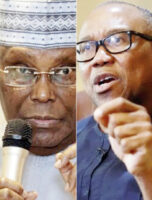
The opposition parties and leaders were aware of the danger of opposition working against opposition smarting from their experience of the 2023 presidential election. Atiku Abubakar, who was declared the first runner up in the 2023 presidential election, took the lead in arranging a meeting of all the contending leading opposition figures. Eventually he succeeded. as the opposition leaders, which included himself, Peter Obi, Chibuike Amaechi, and eventually Rabiu Kwankwaso came together and adopted the African Democratic Congress (ADC) as the coalition party to confront the APC and Ahmed Tinubu in 2027 general elections.
The effect of the unity among the opposition forces was electric and threatened the basis on which APC predicated their victory in 2027. APC has no good performance in governance to run on, but was relying on the disunity among the opposition to succeed. Seeing that the opposition had come together and removed the only obstacle to their victory in 2027, APC became frantic and desperate. It had to do something.
Other News
There’s no doubt that APC, under Tinubu has performed terribly. Tinubu’s removal of fuel subsidy from the first day in office without any plan to cushion the effect of the removal on poor Nigerians and his subsequent devaluation of the naira made life in his regime very unbearable. Nigerians are paying N1,300 per litre in a country where N1,400 is exchanged for a dollar. Tinubu met fuel at the price of N195 per litre and naira at about N450 per a dollar. This ill-thought out plan strangled the economy, with transportation and feeding costs unaffordable to Nigerians. More than 145 million Nigerians are wallowing in multidimensional poverty and seven million more Nigerians are added to the list daily.
To worsen Tinubu’s woes, his promise that the revenue he will save from the removal of fuel subsidy would be ploughed back to Nigerian people in the form of public infrastructures like security, electricity, roads, education, healthcare and so on has failed woefully. Tinubu ran in first term on the assurance that he would provide electricity for the people and even told Nigerians not to vote for him if he fails to provide the electricity. His regime has witnessed the highest number of national grid collapses per year in Nigeria’s history, with the result that there’s no electric power in Nigeria. To make matters worse, Nigerians are divided into bands A, B, C, and so on, with the consequence of creating a caste system in electricity utilisation where poorer people should be denied electricity in favour of richer ones who can afford higher prices.
All the major federal roads in Nigeria today are either impassable, dilapidated, or have some failed portions that make Nigerians use bush paths to circumvent the obstacles of bad roads. Benin-Onitsha, Benin Bypass/Benin-Warri Road; East-West express roads; Jebba-Mokwa-Tegina-Kagara Road; Makurdi-Nsukka-9th Mile Road; Maiduguri – Danboa – Biu road; Maiduguri – Damaturu; Abuja–Kaduna–Zaria–Kano expressway; Calabar–Itu Road; Lagos-Abeokuta expressway are all dilapidated. Nigeria is simply not working under Tinubu.
Insecurity is worse in Tinubu’s regime. It is a daily occurrence in Nigeria for people to be kidnapped, robbed, or killed. More than 500 persons were kidnapped in Niger State recently without stress or confrontation by the security agencies and marched into the bush for detention until ransom is paid, and no officer is held responsible for the lapse.
It is obvious that Tinubu stands no chance by his performance. His only choice is to scatter the opposition and destroy them. His Chief of Staff, Femi Gbajabiamila, was clear that the government would support the renegades of any contending opposition party to destroy their parties. APC started the attacks on opposition political parties through legislation and failed. It tried litigation and failed. Its only choice now is to instigate division among opposition opponents because divided they fall.
As 2025 was about folding up, the opposition was still operating together. Hitherto, INEC refused to register any new political party. From nowhere on 10 December 2025, news broke out that the Nigeria Democratic Congress (NDC) has obtained a court order to compel INEC to register it. The NDC, according to reports, had been seeking registration since 2018 but had not been deemed qualified to be registered by INEC. The allegation then was that NDC was registered to be used to lure Peter Obi out of the coalition with an offer of a free presidential ticket.
Obviously, Peter Obi fell for the trap, because on 3 May 2026, he left ADC for the NDC, after assuring the world that he will contest under the ADC. According to Gov Ayo Fayose, on the day Peter Obi left the ADC, he lost the election. This is a revelation that NDC was a scheme to divide the opposition and turn the opposition against itself not to provide any opportunity for Peter Obi to win. The NDC was deregistered by the same court that registered it after the primaries were concluded. As at today, except the appeal court decrees otherwise, NDC is not qualified to contest the 2027 election.
The coalition had been formed. There is only one presidential candidate for the coalition, who is Atiku Abubakar. In the eyes of the law, he is the only major opposition contender in 2027. The only reasonable choice now in the polity is for all the opposition parties and leaders to support the candidature of Atiku in order to secure the 63.4 per cent that the opposition had in 2023. The opposition must reject the manipulation of APC in which they contend against each other. Atiku had halted the opposition debating itself in 2027. Opposition should take the clue and forbid their voting against each other.
However, the Osun State election had proved that when the opposition leaders, who stand no chance to win, refuse to support the major contender, it may make it more difficult, but not impossible for the major contender to win. The people of Nigeria must not waste their votes in 2027 but must vote for the coalition ADC party. Any political party or major politician not in ADC is a tool by APC to get Tinubu re-elected.