Follow Us on Google
Edo state is known as the “Heartbeat of the Nation.” But it seems that its own heart stopped beating in the eight years that Godwin Obaseki presided over its affairs. Returning to its status as heartbeat of the nation would therefore require a surgical restore its own heartbeat and bring the state back to life. That is what Monday Okpebholo, who left the red chambers of the National Assembly to contest and win the governorship election in the state, is now doing. He is breathing life into Edo’s lungs, and the heartbeat is beginning to throb again.
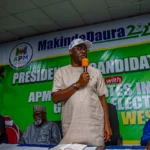
Okpebholo’s aspiration to lead Edo was not considered a threat to the ruling PDP. But, he got involved, beat his co-aspirants to break the tape and become the flagbearer of APC. From that moment, Obaseki’s PDP realised that a force greater than its own was advancing menacingly. His victory in the 2024 governorship election made many people in the state exhale in relief. Those who did knew what Okpebholo stood for. Those who did not, only now have to look back to realise that his choice, was apt for a state which heart had stopped beating, but which Okpebholo is reviving with a leadership philosophy that focused on security, health, infrastructure, natural resources and agriculture, and education. He tagged it SHINE. And with that, Edo is beginning to shine. Working that governance philosophy, the governor has moved to pull Edo out of the haze of what many Edolites called “powerpoint governance,” a reference to the past where governance was marked with promises but negatively deliveries.
One year later, on November 12, 2025, Governor Okpebholo’s administration stands as a testament to transformative leadership. His leadership philosophy, which he has executed so far, using his style for practical governance, has shifted focus from rhetoric to results. As an apostle of practical governance, Okpebholo emphasises action-oriented policies that prioritise citizens’ needs over political posturing. It involves hands-on inspections, transparent budgeting, and community engagement, which ensures that every naira spent yields visible impact from hospitals to schools and unto roads. This approach to governance has gradually rebuilt trust and positioned Edo as a model for sustainable progress with the delivery of over 255 kilometres of roads in its first year. This is added to his actions in reviving dormant water schemes and empowering thousands of Edo people through targeted reforms.
Okpebholo’s practical governance philosophy is pragmatic and people-centric. At his inauguration, he pledged to “restore hope in leadership, create opportunities, and set Edo on the path of lasting progress.” Those are the yardsticks the people now hold him to. Interestingly, he is proving that he came to power prepared. The governor effectively mobilised contractors and conducted frequent site inspections to ensure that work done matched funds disbursed. He amplified the loop by creating a governance feedback channel through which traditional rulers, community groups, and civil society regularly give feedback on project execution.
This leadership style aligns with global best practices in developmental governance, such as those expressed by Lee Kuan Yew in Singapore. For Okpebholo, it translates to the rejection of external c.v-bearing consultants and ‘technocrats’ in favour of home-grown hands, which saves costs and builds local capacity for project execution. The outcome of this has been the introduction of a governance model that enhances accountability in an open-budget era, which enables the people to track progress using citizen scorecards. So far, the scorecard has returned a ‘satisfied’ metric. This is the reason Senator Adams Oshiomhole, also a former governor in the state, said, “Edo people can now experience true and practical governance after eight years of rhetoric.” What this means is that there is a better trust quotient in the government of Edo state today than in the past.
Other News
Edo people are also scoring Okpebholo high on rule of law and citizen participation in governance. Before he assumed office, Edo suffered judicial bottlenecks and intergovernmental tensions, which eroded institutional integrity. Okpebholo will not have any of those. He was decisive and intentional with his response when he ensured that approved but sidelined judges were sworn in, and that the Customary Court was re-energised to play its role. He moved ahead to empower the traditional institution with an advisory role in government. These reforms, which were concluded within the first quarter of his first year, restored judicial independence and reduced case backlogs, thus enhancing the culture of inclusivity, which is another pillar of his strength.
Okpebholo’s cabinet also reflects his bias for balanced representation across the senatorial districts of the state. With this mindset, he made deliberate appointments, from across the zones, of women and youth into key positions in his government. His cabinet has over 40% of U-40s. This mirrors his philosophy of “governance for all,” and buys into the Machiavellian leadership thought where it said: “The first method for estimating the intelligence of a ruler is to look at the men he has around him.”
Edo’s Internally Generated Revenue (IGR) has also surged to over N10 billion monthly. This is said to be the state’s highest ever. Officials of the state government said this feat was achieved through digitised collections and anti-corruption audits through which some N5 billion in misappropriated funds have been recovered. The anti-graft efforts extend to market reforms where exploitative unions that forced an increase on food prices were dismantled, leading to a drop in the price of food items by 25%. This has also enhanced food security in Edo.
Perhaps, the most impactful action of the Okpebholo practical governance philosophy is his effort at recovering, and restoring to, the state, the Museum of West African Art (MOWAA). Something smelly had been sniffed out around the project. The governor is convinced that the project belongs to the people of Edo state and for this, has been relentless in the pursuit of its recovery and restoration to the state through the appropriate custodians of traditional and cultural arts in Bini kingdom. Public reaction to this indicates that the governor is right and properly guided in his actions on the project.
What’s more? Okpebholo has been able to align with President Tinubu’s Renewed Hope Agenda, and through it secured federal partnerships for the state, including N50 billion for infrastructure. This synergy has elevated Edo’s Ease of Doing Business ranking from 24th to 12th nationally, as well as helped to attract investments worth over N200 billion in his first year. This suggests that his practical governance approach has been infectious and has turned hitherto passive citizens into active stakeholders. This lays the foundation for sustained ethical leadership.