Follow Us on Google

Exactly 30 years ago, a meteor streaked across the Nigerian media and literary firmament, leaving behind a trail of brilliant light before fading into the great beyond. To the public, she was May Ellen Ezekiel (popularly known as MEE)—the glamorous, fierce, and incredibly talented journalist, publisher of Classique magazine, talk-show host, and philanthropist. She was the woman who wrote with the force of a hurricane and loved with the tenderness of a mother.
But to those who shared her blood, her home, and her quiet moments, she was simply “Sister May” or “Ellen”—a unifier, a protective shield, and the human personification of a second chance. Three decades after her painful exit, the vacuum she left behind remains unfillable. Yet, the seeds she planted in the lives of her siblings, her colleagues, and the public continue to grow into towering iroko tree. Thirty years after her transition, her younger siblings, Hannah Ezekiel and Benjamin E. Ezekiel, pay an emotional homage to an extraordinary woman whose life was short, but whose impact remains eternal.
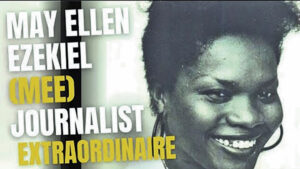
For Hannah Ezekiel, writing from Arlington, Texas, the passage of 30 years has done little to dull the sharp sting of that sudden departure. With deep sorrow and painful memories still lingering in her heart, Hannah reflects on the sister who was, by divine providence, born into the same family to become not just a sibling, but a true soulmate and friend.
“She was exemplary in showing love to everyone around her,” Hannah recalls, her words heavy with the nostalgia of a bond cut short in its prime. “I was constantly in touch with her and even spoke with her just a few days before her passing. There was no sign, no warning, no indication whatsoever that death was near. That is why, even three decades later, it still feels unbelievable, yet painfully true, that my beloved senior sister, Ellen, is no more.”
For many who lose loved ones, photographs become a bridge to the past. For Hannah, looking at Ellen’s pictures is a bittersweet ritual. Each time she gazes upon her late sister’s face, precious memories of beautiful, shared moments come flooding back with such vivid clarity that it feels as though Ellen has only travelled abroad and will soon return.
“Her life was indeed a blessing to many,” Hannah writes. “She was a woman with a large and compassionate heart—a unifier, a peacemaker, a great achiever, and an epitome of virtue and beauty. She carried herself with humility and respect, becoming a source of inspiration and courage to countless serious-minded people whose lives she touched positively.”
Coming to terms with her passing remains an uphill task for the family. The pain, Hannah admits, is indescribable. Yet, the comfort that sustains them daily is the undeniable truth that in her short stay on earth, Ellen impacted humanity and left behind an indelible legacy of love, kindness, and absolute excellence.
“To me and the entire family, there can never be another sister like Ellen,” Hannah says, offering a prayer that continues to echo through the decades: “I pray that the Almighty God, in His infinite mercy, will continue to grant her soul eternal rest in Heaven, in Jesus’ name. Amen.”
If Hannah’s tribute is a song of grief and sisterly love, Benjamin E. Ezekiel’s reflection is a masterclass in gratitude and mentorship. Benjamin recalls how his sister quite literally altered the trajectory of his life by giving him what she gave everyone else: a chance.
“She spent her life giving people something priceless: a chance. A chance to become the best version of themselves. A chance to dream bigger than their circumstances. A chance to rise,” he writes.
Benjamin’s personal journey with MEE began when their mother practically bundled him out of Warri and dropped him at her apartment in Agidingbi, Ikeja, pleading in her Warri-inflected pidgin: “Titi, dis pikin don dey lost for Warri o. Na why I bring am come meet you for Lagos. Abeg, help am make e go school.”
It was a chaotic, inconvenient time for May Ellen. She had just lost her mentor, the legendary Dele Giwa, whose assassination sent shockwaves worldwide. Newswatch magazine was reeling, and Giwa’s body was still in the morgue. Furthermore, Sister May was heavily pregnant with her daughter, Onome, and already housing her other sisters, Esta and Mercy. She had every reason to say no. Instead, she said yes. She reassured her mother, coordinated Benjamin’s grooming, and set plans in motion to get him admitted into the University of Lagos (UNILAG).
This, Benjamin notes, was the template of May Ellen’s life. When she returned from the United States after giving birth, her Classique magazine was born. And with it came the full manifestation of her philosophy: “I was given a chance. I must give others a chance too.”
MEE did not build her media empire with seasoned, cynical veterans; she built it largely with passionate young people who had little experience but a hunger to dream. Like Dele Giwa had done for her, she possessed the rare gift of seeing what people could become long before they saw it themselves. Credentials did not impress her as much as hunger and determination. Her favourite phrase was never, “You can’t.” It was always: “What can we do to make it happen?”
Benjamin recalls how she transformed his own confidence during a difficult season when he spent an extra year at the university. Instead of showing disappointment, she turned that setback into a practical school of business. She entrusted him with electronics supply deals, furnishing contracts, and major bank transactions, sending him to meet powerful individuals.
“Looking back now, I realize the enormous trust that required,” Benjamin reflects. “But with every successful assignment came her quiet encouragement: ‘Don’t worry. You can do it.’ She pushed you into responsibility until confidence began to grow inside you naturally.”
She taught her brother how to walk into any room with his head held high. More importantly, she taught him resilience in the face of human frailty. When faced with betrayal, she once told him words that became his lifetime anchor: “Betrayal by those I trust cannot diminish me. I will always get better.”
Thirty years later, the fruits of May Ellen’s labour are still visible. Through her Sunshine Foundation, she pioneered a form of compassionate journalism and social responsibility that was ahead of its time, caring for the elderly and the less privileged long before corporate social responsibility became a buzzword in Nigeria.
As the Ezekiel family marks this milestone anniversary, Benjamin extends his profound appreciation to everyone who brought joy to her life and kept her flame burning—the leadership and board members of the Sunshine Foundation and the MEE Educational Foundation, including Mrs Rose Odiete, Simbo, Razzaq, Nsikak; as well as Pastor Chris Okotie and the Household of God Church family.
May Ellen Ezekiel Mofe-Damijo did not merely live; she lifted. Three decades may have passed since she closed her eyes in eternal sleep, but as long as the lives she touched continue to thrive, and as long as history remembers those who dared to give others a chance, “Lady May” will never truly be gone.