Follow Us on Google
From Abdulrazaq Mungadi, Gombe
Gombe State clocked 29 years on October 1. Created by General Sani Abacha in 1996, the state has cause to celebrate.
It has witnessed growth in infrastructure, expansion of higher education and investments in health, among other sectors of the state’s economy. Yet, amid the festivities and celebrations of the developmental strides, the absence of a functional addressing system remains a glaring, unresolved omission.
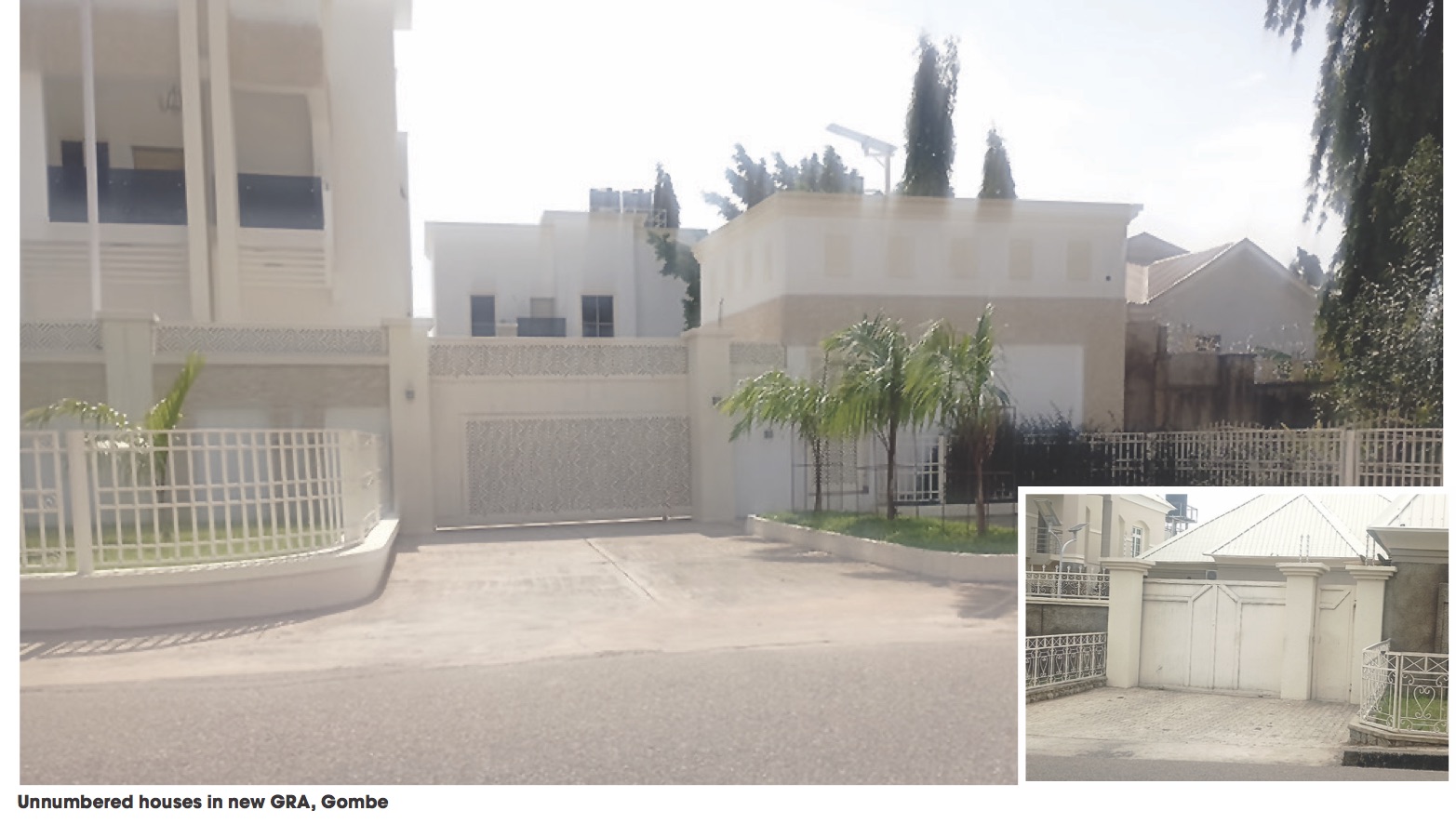
Nearly three decades after its birth, Gombe still runs on a patchwork of unnamed streets and unnumbered houses. Landmarks such as “by the mosque,” “behind the filling station,” “close to the big mango tree” continue to substitute proper addresses. This urban disorder has become more than an inconvenience; it is undermining security, choking e-commerce, stifling governance and costing lives.
Every October 1, while Gombe marked another year of statehood, residents have reflected on how far the “Jewel in the Savannah” has come. Roads, schools and hospitals dot the landscape where once there was little. But in terms of urban planning, the state is yet to modernize its addressing system, a basic feature of any 21st-century economy.
Observers argue that this oversight has slowed Gombe’s ability to compete. “We have advanced in many areas, but without proper addresses, we are still living like a pre-digital society,” said Sani Musajo, the Gombe branch chairman of the Nigerian Institution of Estate Surveyors and Valuers.
According to him, the absence of official addressing in Gombe State has negative effects, especially on property valuation, and business investments, as well as emergency services. “This makes street naming and house numbering critical for improved services and even taxation.
“You could be given a brief by somebody from somewhere like Lagos, asking you to value a particular property in Gombe. If you are not based here or familiar with the city, you will struggle to locate the property. You end up running around and depending heavily on local surveyors for directions and information,” Musajo told Daily Sun.

The most painful cost of poor addressing in Gombe is measured in human lives. Fire service, ambulances and security teams still rely on vague descriptions to locate emergencies. In July, a family in Tumfure called for urgent help when part of their house caught fire. The fire service arrived nearly an hour late after repeated phone calls for directions.
“The same thing would have happened if it was a health emergency. Minutes are everything in emergency response. We lose golden time because drivers can’t find houses. It is tragic and avoidable,” a medical worker said during the incident in Tumfure.
The police and other security agencies face the same hurdles, often struggling to trace homes during crises. “The absence of numbered houses has become a silent killer,” said Japhet Bulus, who has experienced the consequences firsthand.
“I lost a child because I had no car to rush him to the hospital, and there was ambulance services. I also lost my first two-bedroom house near the Matrix filling station in Tumfure because the fire service could not locate my home in time and arrived too late,” he told Daily Sun.
For Gombe’s business community, the addressing vacuum has stalled economic opportunity. Courier firms and delivery riders spend extra hours hunting for homes in the city’s expanding suburbs. Many e-commerce platforms simply refuse to deliver in certain parts of the state because the cost of locating customers outweighs the profit.
One logistics operator told Daily Sun that they now encourage customers to opt for station pick-up due to the difficulty of tracing delivery addresses. She said: “Over 80% of our orders in Gombe are collected at the office. The few we deliver are mostly to corporate businesses or government offices. Some customers get angry, but there’s nothing we can do. Without clear addresses, online trade is dying here.”
Mariam Andrew Aliyu of DHL decried the daily grind, saying: “Most houses are described with landmarks, a hospital, a big tree, or a shop. If the receiver doesn’t pick up our call, we have no choice but to return the shipment. It wastes time, money and frustrates customers. If the government fixed house numbering, couriers could simply knock on the right door and deliver.”
Faith Adamu of GIG Logistics also echoed the concern: “We manage with customer directions, but the turning up and down is too much. If streets were clearly marked and houses numbered, we’d invest in dispatch bikes and expand door-to-door delivery. Customers want convenience; a proper address system would grow our business and the state’s economy.”
As Nigeria’s digital economy races ahead, Gombe’s entrepreneurs risk being cut off. At 29, the state cannot afford to remain a dead zone for e-commerce while its peers embrace digital addressing solutions.
An effective addressing system is not just about locating homes, it is a governance tool. From property taxation to voter registration, from sanitation planning to utility distribution, governments rely on reliable address databases to serve their citizens.
However, in Gombe, government agencies still depend on outdated or incomplete records. The Gombe Geographic Information Systems (GOGIS) and the State Urban Planning and Development Authority (GOSUPDA) hold the legal mandate to implement house numbering and street naming as well as urban planning, development control. Yet nearly 30 years after the state’s creation, most homes still lack an official number.
The irony is that successive administrations have ceremonially named certain roads after national, regional and other political figures, including Yusuf Maitama Sule, Goodluck Ebele Jonathan, Namadi Sambo, Yemi Osibanjo, Senator David Mark, Aminu Waziri Tambuwal and Mai Mala Buni, among others.
While the plaques exist in some of the roads, residents rarely use or even recognize these names. The naming exercises often stop at the ceremony, without integration into daily navigation or house numbering. In effect, the gesture highlights visibility for the elite but leaves ordinary citizens invisible.
Efforts to get GOGIS to outline the state government’s plans for street naming and house numbering proved abortive. However, Mustapha Usman Hassan, who represents Gombe South in the State House of Assembly, acknowledged the gap. He noted that while other states navigate seamlessly with Google maps, Gombe continues to lag behind.
“For the past five years, house numbering and street naming have been captured in the state budget. I saw it myself just weeks ago. We even discussed raising it under matters of urgent public importance to remind the governor. The plan exists, what is missing is implementation,” Mustapha stated.
Gombe was carved out to bring governance closer to the people. Yet, without a functional addressing system, many residents remain invisible in the eyes of the state. This invisibility has financial implications, poor revenue collection, unplanned urban sprawl, and inefficient service delivery.
With e-commerce and fintech now pillars of modern economies, Gombe risks missing out on digital growth. While Lagos, Kaduna and others advance with address mapping, Gombe is still trailing.
Comparative lessons are within reach. Kaduna’s house numbering program improved tax collection and emergency response. Gombe can adopt similar reforms not just to catch up, but to leapfrog. Experts recommend a phased rollout of digital address system to boost commerce and public administration in the state.
According to Musajo, closing the gap requires synergy across government and service providers. He argued that GOGIS and GOSUPDA should lead, while agencies like the fire service, ambulance, police, and other emergency responders align their systems. NIPOST, he added, must also integrate Gombe into the national digital addressing framework.
He stressed that government and private players from courier firms to SMEs should jointly map neighborhoods in the state capital, while residents must be sensitized to adopt and display house numbers once assigned.
“Only a multi-sectoral approach can work. Without alignment, isolated efforts will collapse,” Musajo warned.
As Gombe marks 29 years of statehood, its story remains incomplete without confronting the gaps in its infrastructure. Chief among them is the absence of a proper addressing system, a silent reminder that growth without order is fragile.
The question is no longer whether Gombe needs a digital addressing revolution, but when will the leaders summon the political will to make it happen. The costs of delay are evident, lost revenue, lost opportunities, and, at times, lost lives and properties.
Perhaps the most enduring gift Gombe’s leaders can give as the state approaches three decades is not another ribbon-cutting ceremony, but something far simpler, a number on every house, a signpost on every street, and sensitized citizens ready to embrace the change.