Follow Us on Google
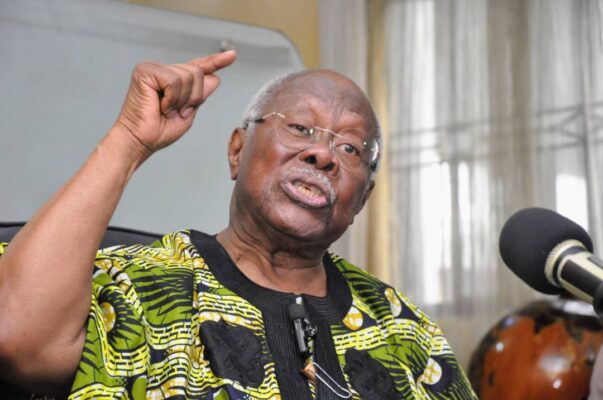
Chief Olabode George, former deputy national chairman of the Peoples Democratic Party (PDP), has warned that Nigeria’s democratic institutions are under strain.
Speaking during the memorial lecture to mark Herbert Macaulay’s posthumous birthday in Lagos yesterday, George argued that the strength of a democracy is not measured by the power of those who govern but by the strength of the institutions that restrain power.
He warned against what he said history shows weaken democratic systems including a decline in political competition, institutions that cease to appear impartial, the treatment of opposition voices as enemies rather than participants in the democratic process, and a public perception that political outcomes are predetermined.
“The strength of a democracy is not measured by the power of those who govern. It is measured by the strength of the institutions that restrain power. For democracy survives on confidence. Confidence in the rule of law. Confidence in the impartiality of institutions. Confidence that justice will neither be delayed nor denied. Confidence that public authority will always remain subject to constitutional restraint. Once citizens begin to lose confidence in institutions, the foundations of democratic governance begin to weaken.
“History offers a warning that no serious democracy should ignore the following: When political competition weakens, democracy weakens, when institutions cease to be visibly impartial, democracy weakens, when opposition voices are treated as enemies rather than participants in the democratic process, democracy weakens and when citizens begin to believe that political outcomes are predetermined, public confidence suffers.
“No patriot should desire a Nigeria in which democratic choice becomes an illusion. No patriot should desire a Nigeria in which institutions are viewed through partisan lenses. No patriot should desire a Nigeria where the concentration of power becomes a substitute for democratic legitimacy. Governments come and go. Political parties rise and fall. Presidents come and go. But institutions must endure. For when institutions are weakened, nations suffer. When justice is perceived to be selective, public confidence suffers. When power ceases to recognise restraint, democracy itself comes under pressure.
“History teaches us that nations rarely lose their way suddenly. They lose their way when corruption becomes normal. When injustice becomes acceptable. When power becomes more important than principle. When citizens become indifferent to the gradual erosion of the values upon which great nations are built. The real danger facing a nation is not merely corruption. It is the normalisation of corruption. The real danger is not merely injustice. It is the acceptance of injustice. The real danger is not merely the abuse of power. It is the silence of good people in the face of abuse.”
Other News
George, who is related to Macaulay through his mother’s lineage, delivered the lecture as part of a weekend of events in Lagos marking 80 years since the nationalist’s death in 1946.
The commemorations were organised under a “Spirit of Greatness” project by the Macaulay Heritage Foundation, with theme: “Herbert Macaulay (HM) Ideology: Documenting the True Spirits of Nigeria in the Prism of Lagos,” and began with a thanksgiving service followed by a banquet at the Naval Dockyard on Ahmadu Bello Way, Victoria Island, with dignitaries from the diaspora alongside state and federal government officials in attendance.
In his lecture, George said Macaulay’s title of “Father of Nigerian Nationalism” is one that was not inherited but earned through courage in the face of intimidation, conviction in the face of opposition, and sacrifice in pursuit of a cause greater than himself.
George traced Macaulay’s life from his birth in Lagos on November 14, 1864 and dwelt at length on Macaulay’s grandfather, Bishop Samuel Ajayi Crowther, the first African Anglican bishop, whom George credited with shaping Macaulay’s sense of duty and his conviction. From CMS Grammar School in Lagos, Macaulay went on to study engineering and surveying in England, returning to join the colonial civil service as a surveyor in the Public Works Department, a position, George said exposed him to a colonial system in which decisions affecting Nigerians were frequently made without meaningful Nigerian participation.
That exposure, George argued, transformed Macaulay from a civil servant into an activist and eventually a political pioneer. He recalled Macaulay’s repeated clashes with colonial authorities, which brought him harassment, prosecution and imprisonment, and his eventual founding of the Nigerian National Democratic Party (NNDP) in 1923, Nigeria’s first political party, which George called “a declaration of confidence in the political future of Nigerians.” He also highlighted Macaulay’s later partnership with Dr. Nnamdi Azikiwe, describing their alliance as a powerful convergence of experience and youthful energy that helped turn Lagos-based activism into a national independence movement.
On the issue of insecurity, he spoke about communities affected by violence and displacement and argued that no economy can flourish where communities remain insecure. He paid tribute to the armed forces, the Nigeria Police Force, intelligence services and the Civil Defence Corps for their sacrifices in service to the nation.