Follow Us on Google

By Titilayo Balogun
At the University of Idaho, United States of America (USA) and beyond, the name of Sodiq Babatunde Yusuf, a doctoral researcher in the institution has become an anthem on every lip.
In a remarkable feat of academic excellence and innovation, the lbadan, Oyo State-born researcher recorded a significant and outstanding breakthrough in his doctoral programme as a PhD candidate in Natural Resources and Conservation in the Department of Forestry, Rangeland, and Fire Sciences at the University of Idaho, Idaho, USA.
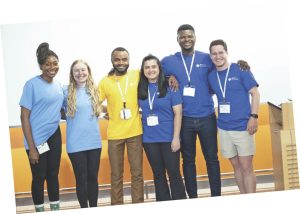
Thirty-four- year old Yusuf joined a promising team of researchers on an interdisciplinary project called Printimber, an initiative of U&l team of the university to create a framework to use waste materials in building design to make houses affordable and sustainable.
The young Nigerian’s academic success reminds one that young Africans also excel in academic pursuits abroad and not only in sports and music or entertainment.
According to Yusuf, his research team’s focus is to provide an alternative construction of buildings using sawdust and other natural resources and combining these with 3D digital printing to construct buildings in a more cost-effective and naturally beneficial way.
Speaking with Saturday Sun via a phone chat, Yusuf said he has made tremendous breakthrough in three distinct areas of printing, testing the viability of sawdust as more reliable material and also using naturally sourced resources to provide resin as glue for sticking together wood materials being used for the project.
Yusuf also spoke about his academic background, which prepared him for a fully funded doctoral programme in the U.S University, saying: “During my Bachelor’s degree in Chemistry at the Federal University of Agriculture, Abeokuta, Ogun State, Nigeria. I did my undergraduate thesis on the use of powdered groundnut husk to purify wastewater; I developed interest in the use of waste to provide sustainable solutions. I’m excited at the possibility of using waste to solve problems rather than seeing it as the problem.
“This motivation led me to pursue my PhD in Natural resources under the supervision of Professor Armando McDonald, a distinguished professor of forest and sustainable products in his renewable materials laboratory here at the University of Idaho, North America.
“I work with Professor Armando McDonald on the printimber project, with a goal to use renewable waste materials for construction of houses by 3D printing. This is expected to make housing more affordable, and reduce waste and pressure on our forests due to increasing housing demand,” he said.
Yusuf spoke about his key accomplishments on the project, saying: “I have developed sustainable materials such as carbon fibre from waste hemp and demonstrate its use in additive manufacturing applications, I have demonstrated the use of biochar to reduce cost, improve extrudability and biodegradability of wood-sodium silicate composites for additive manufacturing applications; I have also demonstrated the valorisation of hemp hurds, an industrial waste in 3D printing of houses. My PhD candidacy topic involves working on the use of pyrolysis to upscale waste materials and convert them to valuable materials such as fuel and sustainable materials for additive manufacturing applications. Most wastes are burnt, generating green house gases to the environment. I’m proposing pyrolysis to convert these wastes to sustainable materials while using them also as fuel to make a self-sustaining system producing sustainable materials. This technology can be applied by underrepresented rural people to control their wastes and develop their economy at the same time.”
Yusuf who is a member of several professional bodies such as American Chemical Society, Association of Energy Engineers, National Society of Leadership and Success, Xi sigma Pi (The forestry honours society in the US) and International Biochar Initiative, among others, added that: ”The goal of my project is to create a framework to use bio-based waste materials in 3D printing of houses. This will reduce cost of labour and injuries as well as address reducing the pressure on forest trees. Only 40 per cent mass of a tree is converted to logs of wood used in construction. The use of bio-based wastes in construction will reduce waste while reducing the cost of buildings. As a chemist, my role on the project is to experiment different binder formulations and extrude them as well as investigate properties.”
In another remarkable development, young Yusuf was recently selected among the top 70 chemistry graduate students and postdoctoral researchers from across North and South America, to attend the American Chemical Society (ACS) Green Chemistry Institute Summer School on Green Chemistry and Sustainable Energy at the University of Vermont, USA.
The ACS Green Chemistry Institute Summer School is one of the most competitive and respected programmes in the world, dedicated to training the next generation of scientists to design safer, cleaner and more sustainable chemical processes. Participants receive hands-on training and mentorship from pioneers who have shaped the global green chemistry movement.
During the intensive programme, which was sponsored by the American Chemical Society, Yusuf was taught by world-renowned figures such as Dr Audrey Moores, Dr Philip Jessop, and Dr John Warner, co-author of the seminal book Green Chemistry: Theory and Practice and one of the founding fathers of the field.
“Learning directly from these icons of green chemistry was a transformative experience,” Yusuf said. “Their work continues to inspire scientists around the world to create solutions that protect both people and the planet.”
Yusuf’s participation in the programme showcased his growing expertise in sustainable materials research. He presented two research problems — one on the “Effect of Biochar on the Properties of Wood-Sodium Silicate Composites”, a project aimed at developing low-cost, eco-friendly building materials from waste biomass, and another on “Mechanochemistry”, exploring solvent-free methods for chemical synthesis. He also worked collaboratively with other scholars to propose sustainable alternatives to industrial chemicals currently harmful to the environment.
In recognition of his outstanding research and leadership in sustainability, Yusuf was also awarded the “Advancing Science Grant” by the National Organisation for the Professional Advancement of Black Chemists and Chemical Engineers (NOBCChE), on August 1, 2025 at the awards dinner of the institute. The award is a grant that empowers him to present his findings at the organisation’s annual conference in Florida. The Advancing Science Grant is awarded to promising scientists whose work demonstrates innovation, societal impact, and a commitment to advancing diversity in STEM.
Speaking about the honour, Yusuf noted: “My work focuses on transforming waste into value — particularly using bio-based materials to create sustainable products for low-cost housing. Attending the ACS Green Chemistry Summer School reinforced my belief that science can be both innovative and responsible.”
Beyond his research, Yusuf is a passionate advocate for green innovation in developing economies. He envisions a future where sustainable chemistry drives Africa’s industrial and housing sectors toward self-reliance and environmental responsibility.
His journey reflects the growing presence of African scholars at the forefront of global sustainability research — combining world-class science with a deep commitment to solving real-world problems.