Follow Us on Google
From Juliana Taiwo-Obalonye, Abuja
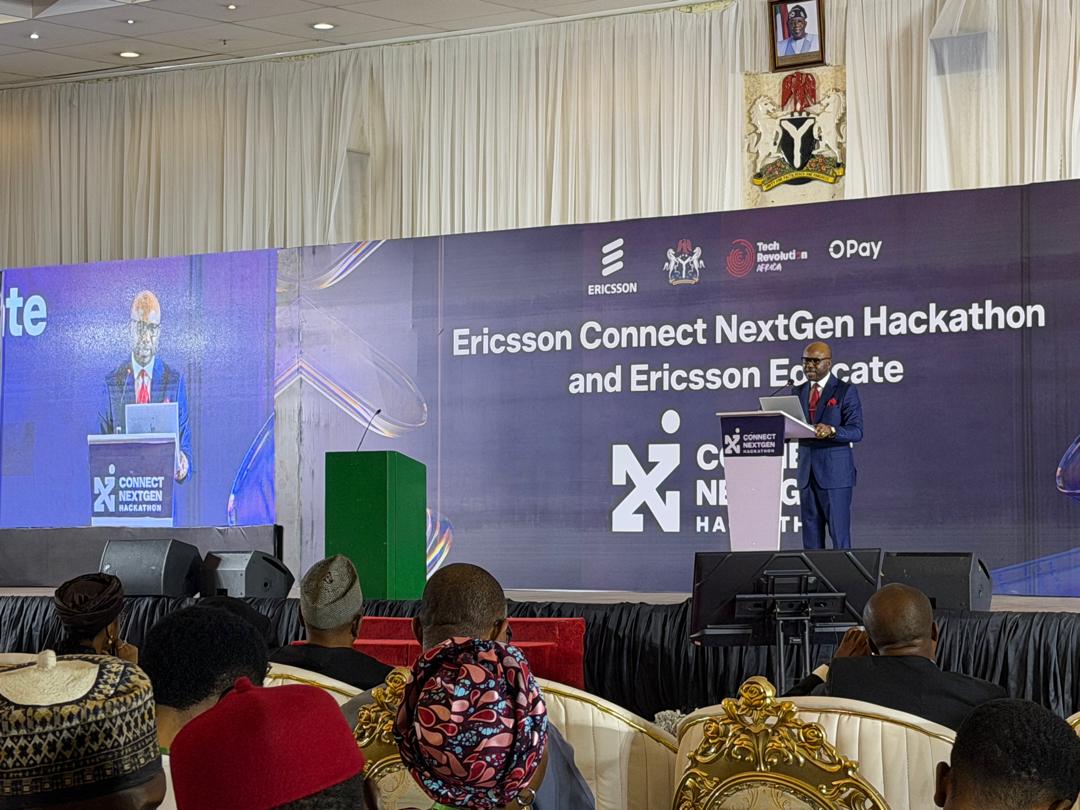
The federal government, in partnership with Swedish telecoms giant Ericsson, on Wednesday launched the Connect NextGen Innovation Hackathon at the State House Conference Centre in Abuja, aiming to position the country as a global supplier of AI and 5G solutions while scaling up tech job creation for millions of young people entering the workforce.
Vice President Kashim Shettima, who was represented by Deputy Chief of Staff, Ibrahim Hassan-Hadejia, emphasised that job creation tops President Bola Tinubu’s priorities, with digital skills as the key driver. “Nigeria’s greatest resource is not beneath our soil, it is within our people. Our demographic dividend tilts in favour of the youth. This is a young nation in age and in spirit and that reality alone places a moral obligation upon us to ensure that our young people have access to every disruptive technology of their time. To deny them access will be to deny the nation its future,” Hassan-Hadejia said.
He added: “His Excellency, President Bola Ahmed Tinubu GCFR has placed job creation at the very top of his priorities and job creation in this century is inseparable from digital capability. Together we will transform our demographic advantage into economic advantage. To the young innovators gathered here and across the country this platform is an invitation to imagine boldly, experiment fearlessly and build responsibly.”
The four-month programme, stemming from a 2024 MoU between Ericsson and the Federal Government and the Vice President’s visit to Sweden last year, targets youths, start-ups and university students. It focuses on hands-on training in 5G, artificial intelligence, cloud computing, IoT and sustainable technologies to tackle challenges such as food security, smart cities and digital inclusion. Hassan-Hadejia noted: “The future will not be handed to you but it will be coded, designed and engineered by you. So I appeal to each of you that this should not just be remembered as just another ceremonial launch. Let it be remembered as the moment when thousands of Nigerian youths decided that they will not wait for opportunity but they will create it.”
Shettima, through his representative, described the hackathon as a continuation of national strategy: “This hackathon is not an isolated event; it is a continuation of a national strategy. The Connect NextGen Innovation Hackathon is designed to deepen this reality—to make Nigeria a supplier of solutions to the world. A brilliant line of code written in Abuja can power a system in Stockholm; a solution imagined in Kano can transform a farm in Kenya.”
“The current wave of the Industrial Revolution—powered by 5G, artificial intelligence, cloud computing, IoT and sustainable technologies—is not a tide we can afford to watch from the shore. History is unkind to nations that choose the backseat in moments of transformation,” Shettima added.
Minister of Science, Technology and Innovation, Kingsley Udeh, pledged ministry support for commercialisation, competitions, research and inventions, turning MoUs into multi-billion-dollar projects.
Sweden’s Ambassador to Nigeria, Anna Westerholm, hailed Nigeria’s digital vibrancy: “Nigeria is a nation of talents, creativity and ambitions. That was the first thing I learnt when I arrived here. Nowhere is this more evident than in the country’s digital sector, one of the most dynamic and promising innovative ecosystems on the African continent.”
She stressed the public–private synergy: “Nigeria’s partnership with Ericsson demonstrates how the Swedish private sector contributes to national development priorities by combining technological leadership with long-term commitment and strong local collaboration. We are proud that the Swedish technology and Swedish values of openness and partnership and trust contribute to Nigeria’s development ambitions.”
Special Assistant to the President on Project Support, Suhdah Ahmed, called it a shift from policy to action: “Today is more than the launch of a hackathon. It is the activation of a vision. The collaboration between the Office of the Vice President and Ericsson marks a deliberate shift from policy ambition to practical execution. Through the Connect NextGen Innovation Hackathon, government and industry are doing what must be done by building the skills, systems, and opportunities needed for Nigeria’s digital future.”
Ericsson Nigeria Country Manager, Peter Ogundele, highlighted the company’s 40-year presence: “The initiatives represent a concrete step in delivering on the Memorandum of Understanding signed in 2024 between Ericsson and the Federal Government to boost innovation, skills development and the digital economy.” He detailed the AXN National Hackathon and AXN Educate Programme for policymakers to enhance digital governance.
Special Assistant to the President on ICT Policy, Salihu Dasuki, linked the initiative to the Renewed Hope Agenda, promising training and employment opportunities.