Follow Us on Google
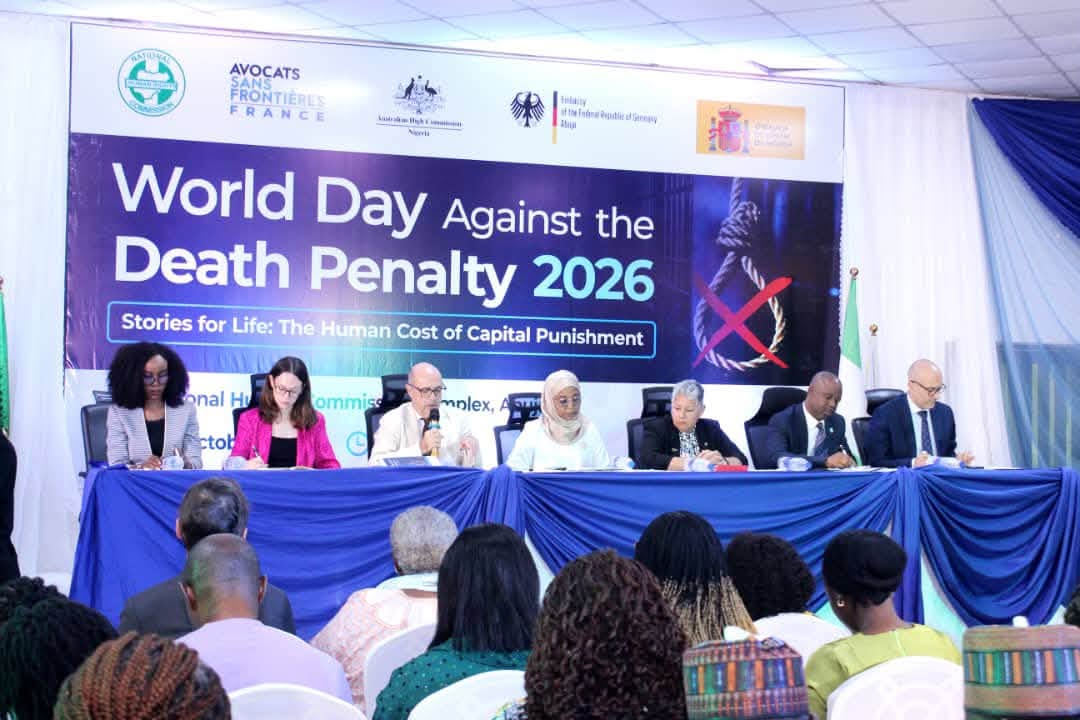
The National Human Rights Commission (NHRC) and the Australian Government have called on Nigeria to formalise its decade-long pause on executions, as more than 3,500 inmates remain on death row.
The NHRC’s Executive Secretary, Tony Ojukwu, SAN, and Australia’s High Commissioner to Nigeria, Ms Leilani Bin-Juda, made the call on Friday in Abuja at the commemoration of the 2026 World Day Against the Death Penalty, themed “Stories for Life.”
The event, held at the NHRC auditorium, was organised with Avocats Sans Frontières (ASF) France, the Australian High Commission and the German Embassy, with support from the Royal Norwegian Embassy.
Bin-Juda aligned with the Commission’s position and reaffirmed her country’s opposition to the death penalty in all circumstances. She urged Nigeria to use its approaching 10-year milestone without executions as a springboard for broader legal and institutional reforms.
She warned that the presence of more than 3,500 people on death row showed that the human consequences of capital punishment remained unresolved, even without executions.
The envoy urged the authorities to formalise the moratorium and, pending wider reforms, reduce the range of offences punishable by death.
She maintained that justice, accountability and public safety could be achieved without taking human lives. International experience and constructive engagement, she said, could help Nigeria strengthen its criminal justice system.
Bin-Juda also cited an earlier Federal High Court decision in which a judge reportedly declined to impose a death sentence. She described it as an indication of the evolving judicial and international debate on capital punishment.
Ojukwu said Nigeria will attain ten consecutive years without a state execution by December 2026, which meets the international standard for a de facto moratorium. He noted, however, that mandatory death sentencing continues, leaving more than 3,000 people on prolonged death row detention.
“The constitutionality of the penalty does not dilute the non-negotiable requirement of fair trial guarantees,” he said, referring to Section 36 of the Constitution.
He listed inadequate pro bono defence, forced confessions and pre-trial delays among the systemic problems undermining procedural justice.
Other News
Ojukwu described capital punishment under Nigerian law as a constitutional duality. Section 33(1) of the 1999 Constitution (as amended) protects the right to life but excepts court-ordered executions, while Section 34(1)(a) guarantees human dignity and protection from inhuman or degrading treatment.
He recalled that the Supreme Court affirmed the validity of the death penalty in Onuoha Kalu v. The State (1998) and reaffirmed it in Joseph Amoshima v. The State (2011).
Although Nigeria is not a party to the Second Optional Protocol to the International Covenant on Civil and Political Rights (ICCPR), he said, it remains bound by Article 6 of the ICCPR and Article 4 of the African Charter on Human and Peoples’ Rights. These require strict adherence to due process and limit capital punishment to the most serious crimes.
Citing Section 5 of the NHRC (Amendment) Act 2010, Ojukwu said the Commission calls for three immediate steps:
converting Nigeria’s 10-year pause into an official executive moratorium on executions;
state governors systematically invoking Section 212 of the Constitution and Section 12(2)(c) of the Nigerian Correctional Service Act, 2019 to commute death sentences to life imprisonment; and
a re-evaluation of mandatory death penalty statutes, so that judges can weigh mitigating circumstances and systemic vulnerabilities at sentencing.
He explained that Section 12(2)(c) of the Correctional Service Act authorises commutation for inmates who have exhausted their appeals and remain unexecuted after a specified period. Governors also hold prerogative of mercy powers under Section 212 of the Constitution, and the President under Section 175.
Ojukwu thanked the partners for their support and expressed hope that the day’s deliberations would produce a Joint Call to Action Communiqué to drive justice sector reform.