Follow Us on Google
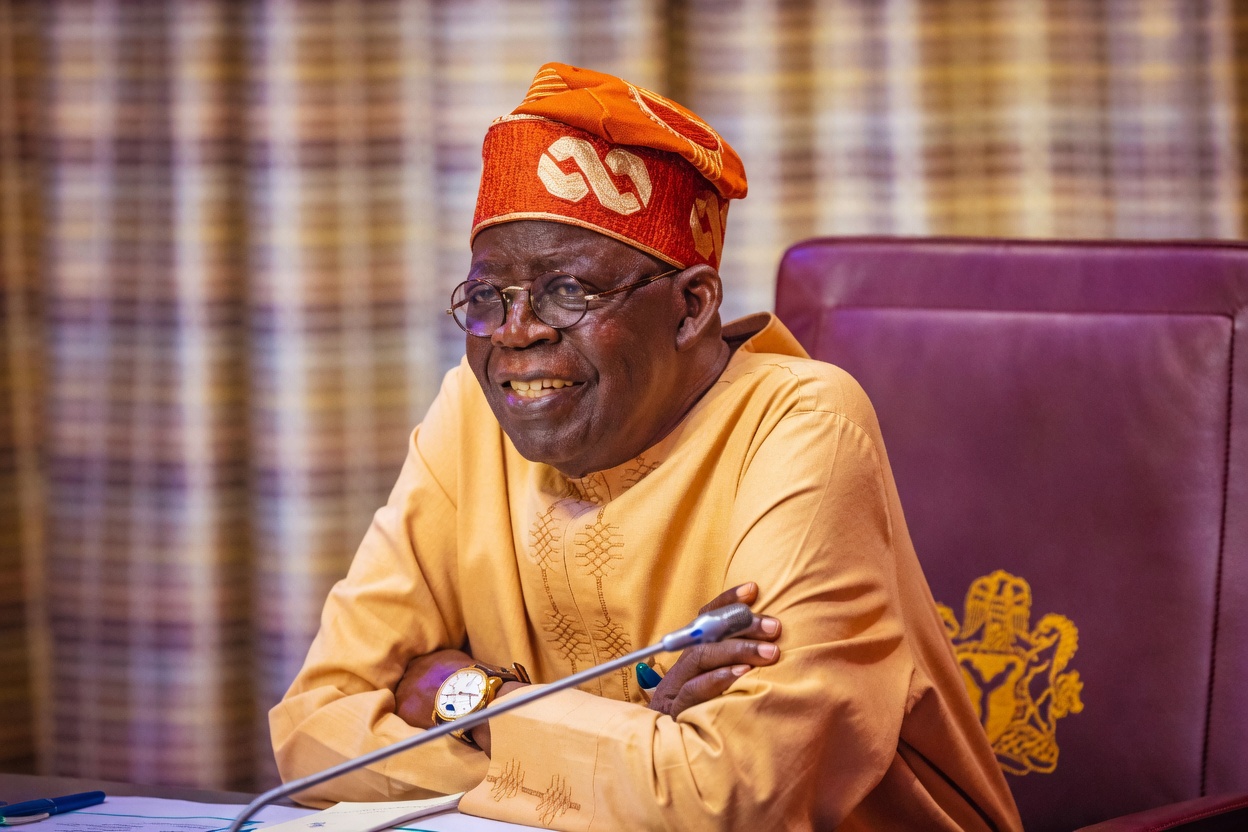
- Divided opposition weakens challenge
From Fred Itua, Abuja
Bola Ahmed Tinubu has entered the 2027 presidential race as the clear frontrunner, according to a new forecast by CellHub, a data analysis and political consulting firm, which projects the President as favoured to win a second term on the strength of a fractured opposition and a gradual shift in how voters are beginning to weigh his economic record.
The firm’s base case rests on a reading that is as straightforward as it is damaging to the opposition’s prospects. The vote against the President is splitting across three separate platforms while the vote behind him holds with one.
Under Nigeria’s electoral rules, which award victory to the candidate with the largest share rather than an outright majority, that imbalance is, on CellHub’s analysis, the decisive structural fact of the coming election.
The 2023 figures make the mechanism plain. Tinubu won with 36.61 per cent of valid votes. Atiku Abubakar recorded 29.07 per cent, Peter Obi 25.40 per cent and Rabiu Kwankwaso 6.23 per cent.
More than 60 per cent of valid votes went to candidates other than the winner, yet the nearest rival trailed by more than seven points because the opposition vote divided three ways.
Consolidated behind a single candidate, the same bloc would have produced a different result.
By mid-2026, that division has re-formed with striking familiarity. Atiku Abubakar is running on the African Democratic Congress ticket alongside Rotimi Amaechi. Peter Obi and Rabiu Kwankwaso were ratified on the Nigeria Democratic Congress ticket on 30 May.
A Peoples Democratic Party faction has advanced Goodluck Jonathan, a nomination still disputed within the party. Three candidates are now competing for the same anti-incumbent vote.
The President’s position, by contrast, is consolidated. Following a series of defections, the APC holds 31 of the 36 states, commands a two-thirds majority in the National Assembly and confirmed Tinubu as its candidate at its primary on 23 May.
History reinforces the advantage. Of all elected Nigerian presidents, only Goodluck Jonathan has lost a re-election bid, and he lost in 2015 to a single opposition party formed by merger, the step the 2027 opposition has so far declined to take.
The forecast does not depend on the President being popular. Independent tracking this year puts his approval in the low thirties, and a majority of respondents report being worse off than in 2023.
Against a single opponent, CellHub concedes, that reading would threaten him seriously. In a field of three or more, it does not, which is why the structure of the contest carries more weight in the firm’s model than the approval figure.
“Our modelling is not a statement about who deserves to win, or about how people feel, both of which point in a hard direction for the incumbent,” said Mohammed Aliyu, Managing Partner and Lead Data Scientist at CellHub.
Other News
“It is a statement about distribution. A unified bloc beats a divided one almost regardless of mood. Right now the opposition is divided and the governing party is not.”
The firm also challenges what it regards as a persistent misreading of Peter Obi’s support. His digital following is the largest in the field and CellHub accepts that he holds real support on the ground.
The firm’s point, however, is that the online sample is not the electorate. Social platforms skew young, urban and connected and under-represent the rural North, where turnout has historically been highest.
CellHub measures stated voting intention and turnout probability by zone rather than online activity, and on that basis it places the distance between Obi’s visibility and his projected vote share among the widest in the field.
A second factor works in the President’s favour. The administration has maintained that it inherited a weak fiscal position and that removing the fuel subsidy and floating the naira, however costly to ordinary Nigerians, prevented a sharper economic collapse.
The macro data is mixed: growth, external reserves and headline inflation have improved, while household income and the poverty rate have deteriorated. CellHub’s reading is that a growing share of voters now accepts the first explanation, which has begun to stabilise the President’s base even where approval remains low.
Geographically, CellHub identifies the North Central and the wider Middle Belt as the zone that will decide the presidency. The religiously mixed band running from southern Kaduna through Plateau, Nasarawa and the Federal Capital Territory down to Taraba and Adamawa was the terrain that carried Obi beyond his South-Eastern base in 2023, aided by Christian voters who reacted against the religious composition of the APC ticket.
The firm rates the zone the most competitive in the country and tracks it more intensively than any other.
“The South-West is largely decided, and the South-East in the other direction,” said Efemena Peter, Senior Political Risk Analyst at CellHub. “The result is set in the North Central and the FCT. Those states moved against the President in 2023, and they are the states we watch most closely for 2027. Whoever carries the Middle Belt carries the election.”
One condition could change everything. A merger of the Atiku and Obi tickets into a single candidacy combining the northern and South-Eastern vote would convert the race into a direct two-way contest fought squarely on the President’s record.
Without it, the structural arithmetic favours the incumbent. CellHub says it will revise its base case the moment any consolidation occurs and will publish updated scenarios each quarter ahead of polling day.
Nigerians vote on 16 January 2027.
On the data currently available, the result depends less on the President’s own standing than on whether the opposition finds the political will to unite behind a single candidate before it is too late.