Follow Us on Google
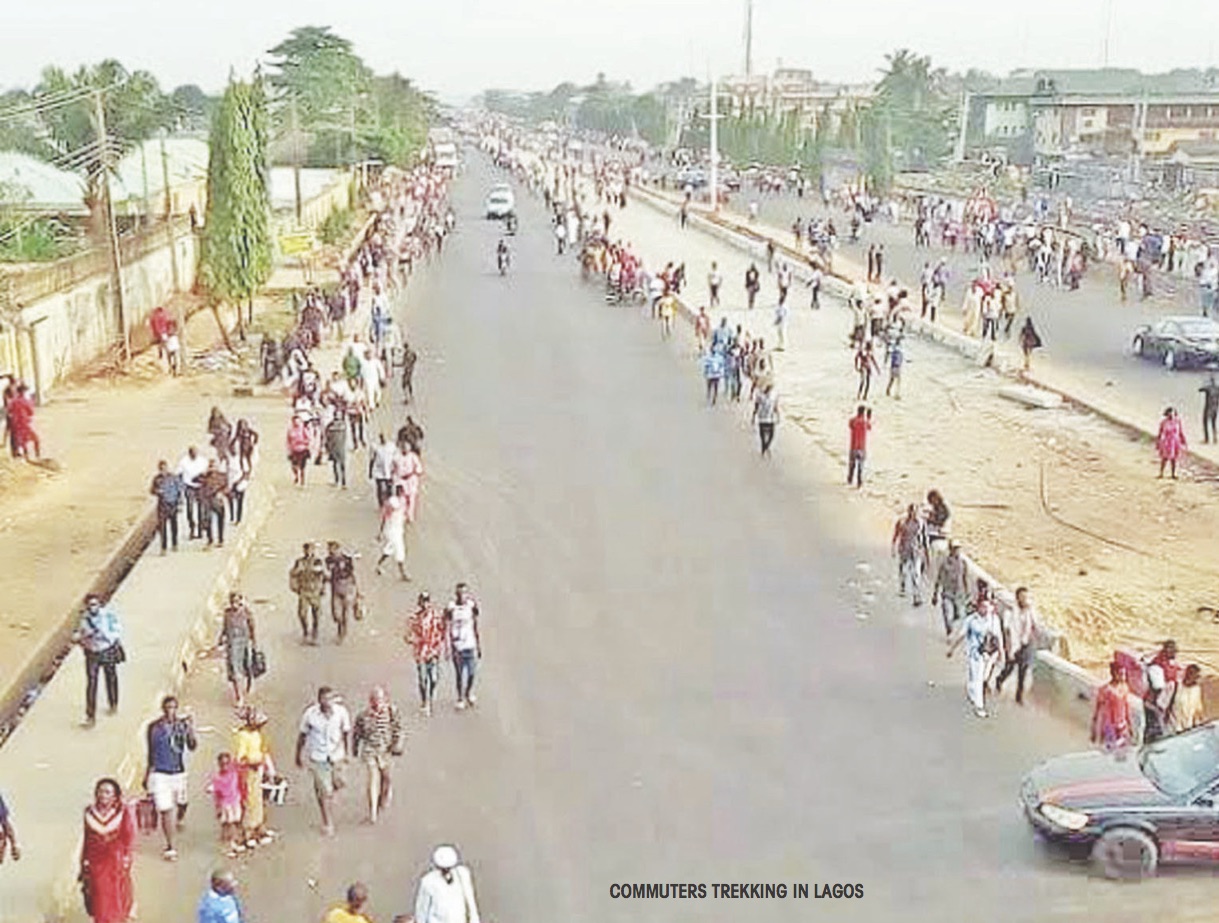
• Workers, others resort to trekking, as transport fares, prices of goods soar
By our reporters

Nigerians got out of their beds on Tuesday morning to the astonishing news that the pump prices of premium motor spirit (PMS), more popularly known as petrol, have been jacked up again.
It was another piece of shocking news for a people that were still coming to terms with the astronomical increase in petrol prices following the abrupt removal of petrol subsidy by President Bola Tinubu on his inauguration day. With the new increase, petrol now officially sells for betweenN568 and about N617 per litre in Lagos and Abuja respectively. People living in states in parts of the North would be buying for about N640 per litre.
Tuesday’s price increases seem to have worsened the plight of the people.
In Lagos, Vivian Onyebukwa reports that transporters have jerked up their prices, even as different fuel stations are dispensing petrol to motorists at different prices. Commercial bus operators have in most places doubled their fares.
For those boarding commercial buses, fares from Ijegun to Ikotun have increased from N100 to N150. Again, Jakande Gate to Ijegun, which used to be N150, is now N300. So also a trip from Ikotun to Egbeda, which hitherto cost N150, has increased to N300.
In Ilorin, Kwara State, Layi Olanrewaju reports that the overnight increment in the price of petroleum products has caused a lot of tension among residents.
The product which is sold between N595 and N612 in the Kwara State capital, has caused a sudden increase in transportation cost which invariably affect other products. For instance, a shuttle bus or tricycle that hitherto charged between N100 and N150 for short distances now charges between N200 and N300 per drop. The irony is that most of the vehicles are not available, as roads are empty while commuters were left stranded. Many have resorted to trekking short distances while others stay indoors. Marketers, shop owners were seeing discussing the ugly incident and urged the government to find a way of easing the already strained nerves of the poor masses who were hard hit by the government policy.
A visit to the major market showed that as of Thursday, prices of commodities were slightly increased above the prices in place before May 29. But on Friday, the prices of food items, especially farm products had increased.
Some of the traders said when they went to purchase the produce in the farms, the price of transportation was a little lower but while coming back, the cost had increased, adding that such increase in transportation costs would naturally affect the price of goods.
A trader told the reporter: “I paid N1500 while I was going. But when coming back, the transporter charged me N4100 without my goods.” She appealed to government to have the fear of God and stop punishing the poor masses, noting that the infliction of suffering on the masses was much.
Another trader wondered why government seemed to derive pleasure from seeing the downtrodden suffer, lamenting that every step of the government seems to target the poor.
He urged the government to see to the plight of Nigerians who don’t know how to cut corners to survive.
It was observed that virtually all the filling stations in most parts of Ilorin were dispensing fuel. However, most of the attendants were idle, as vehicle were not coming to buy fuel.
In Rivers, Tony John reports that the pump price has hit N620 per litre in Port Harcourt and environs.
Checks by Saturday Sun reports revealed that, while there was no scarcity of the product, most petrol stations in Port Harcourt, the capital of oil-rich Rivers State, were now dispensing fuel between N605 and N620 per litre.
At the NNPC mega station and its subsidiaries, the pump price is N591 per litre. Even with the margin with other fuel stations, there is no queue.
This latest development has astronomically affected intra and interstate transportation.
Reacting to the development, the Independent Petroleum Marketers Association of Nigeria (IPMAN), said the increment in the retail price was necessitated by the increase in ex depot price by NNPC Ltd.
IPMAN Chairman in Rivers State, Joseph Obele, disclosed that NNPCL being the sole importer of fuel in the country, has increased the ex depot price from N487.7 per litre to N567.7 per litre.
Obele lamented that the increment in fuel price would quadruple the sufferings of the masses, and urged President Bola Tinubu to declare a state of emergency on the nation’s four refineries.
He said, “We saw a new buying rate on the NNPC portal on Tuesday. The previous buying rate was N487.7 per litre. The new buying rate going forward is N567.7 per litre.
“The new selling rate shall be N600, N610, N620 and above.
“It is going to bring hardship to the citizens and marketers will need to source for additional trading capital in order to remain in the business. The Nigerian economy is going and the inflation index will further rise. Our solution is fixing Nigeria refineries. Mr President should declare a state of emergency on Nigeria refineries.”
Laide Raheem reports from Abeokuta in Ogun State that commuters and motorists have continued to groan and bemoan the pains caused by another increase in the pump price of the Premium Motor Spirit (PMS) otherwise known as petrol, to N617 per litre. Though, majority of the petrol stations, particularly, major marketers sell a litre between N580 and N600, because they are still selling the old stock, others have swiftly adjusted their metres, despite that they were still dispensing old stock in their underground tanks.
The increase in pump price of petrol has further exacerbated the already strained economy. The cost of transportation has soared to almost an unbearable stage, while prices of food items such as staple stuffs and beverages have gone astronomical.
For instance, the cost of transportation from Obada to Brewery Area of Abeokuta, which used to be N100 is now N300. Residents who live in Obantoko and work at Oke Ilewo Area, where commercial activities are concentrated in the metropolis, now have to pay N500 against N200 they used to pay before.
Observations by Saturday Sun revealed that commuters now trek and cover some distances before they board a taxi in order to reduce the cost.
Also, many private car owners now drop their vehicles at home and have embraced the use of public buses.
Lamenting the situation, a civil servant, Kayode Ekunola, blamed the successive governments for its failure to make the country’s refineries work despite many promises. He wondered why the people will continue to suffer for a commodity they can process locally.
He, therefore, said Nigerians are tired and on the edge as the effects of high price of petrol bite harder.
Buttressing Ekunola’s viewpoint, a student of the Moshood Abiola Polytechnic (MAPOLY), Abeokuta, Dada Elizabeth, said going for lectures at school was becoming more and more difficult due to hike in petrol price. She said asides the fact that few buses now ply the Panseke-Ojere route to convey students, the cost of transportation has quadrupled.
While informing Saturday Sun that many students have resorted to trekking to and fro school since the new pump price of petrol was announced, she stressed that if the situation failed to improve, more students of MAPOLY would be missing classes.
In Imo State, prices of fuel now oscillate between N640 and N650, according to Saturday Sun’s Stanley Uzoaru in Owerri.
The new price has forced most commercial bus drivers plying the metropolis to park their vehicles awaiting a reversal of the price. On routes where the normal fare was N200, the fare has been changed to N300.
As for the commercial motorcycles, the new price has also affected the fare they charge their customers. A place where the fare was N300 has increased to N400. But would be passengers have also resorted to walking.
One of the bus drivers who spoke to our correspondent in Owerri said: “How can they think we would be able to cope with such price? We were crying over the N517 increment, now they have jacked it up to N650.
“It’s really surprising to know that most passengers now trek some distances where the drivers would have ordinary collected N100.”
In Kaduna, the effect of fuel subsidy removal and subsequent increase of pump price from N195 to N620 is taking a toll on commercial transport business in several locations in the state, operators lamented to Saturday Sun.
Sola Ojo reports that in Kaduna, the state capital, those who operate intra-city as well as operators of inter-state commercial transport businessare feeling the social and economic impacts of the seemingly heartless decision of the Federal Government.
From Sabo (Chikun LG) to Kasua (Kaduna North LG), the fare used to be N100 for the Coaster bus. It is now N200 while the small Hiace bus which used to be N150 is now N300. This is usually non-negotiable during the pick hours.
The development has also drastically reduced heavy traffic at places like Command Junction and Ahmadu Bello Stadium Roundabout, as many private car owners adjusted to the new reality, parking their cars at home and riding in public buses.
Station Manager, Tarqba State Transport Corporation, Angwan Sanusi, Kaduna, Mr. Ezra Musa, lamented that buses are left in the park because there are no passengers due to the adjustment in transport fare.
According to him, “transport business is going down seriously because people are no longer travelling, except when they must do so. Before, people were travelling for weddings, burials, and all manners of celebrations.
“But now, they prefer calling the celebrants and transferring money to them instead of travelling. See our buses are just here. If it were to be before, by this time, you would see just a few buses in the park.
“The transport fare from Kaduna to Taraba used to be N9,500. But today as we speak, it is N14,000. Port Harcourt which used to be N18,000 from Kaduna is now N25,000, Lagos is N23,000 while Katsina which uses to be N2000 is now between N5,000 andN,6000.”
The situation is hardly different in Abia State. Reporting from Umuahia, the state capital, Okey Sampson writes that the new increase in fuel price has triggered off a hike in transport fares across Abia State, as the fuel pump price of petroleum has been jacked up to between N600 and N700 across the state.
Commercial vehicle drivers immediately increased their fares to as high as 100 per cent in some routes and 50 per cent in others.
For instance, in Umuahia, the state capital, where tricycle operators – the major mode of transportation in the city – formerly charged N50 as fare, it is now N100.
Where the fare used to be N100 before this week’s increase in fuel price, it has become N200. A journey from Golden Guinea Brewery on Aba Road, to the end of Bende Road, is now N200. Until Tuesday, it was N100.
The same is applicable in the commercial city of Aba where transport fares were said to have doubled as a result of the increase in the price of fuel.
However, there was a slight increase in transport fares by drivers plying the Umuahia to Aba route. The popular Ochendo buses, which used to collect N1,000 as fares, has increased it to N1,100, while small vehicle drivers collect from N1,700 to N2,000, as fares from the previous N1,500.
This has created untold hardship to commuters, most of now, on daily basis trek long distances to get to their places of work
In Kebbi State, especially in the state capital, Olanrewaju Lawal reports that prices of PMS have been increased to N620 since Tuesday, therefore forcing the transportation fares up by about 50 per cent.
A short distance ,which used to attract a N150 fare by commercial motorcycles is now N250 per drop. Similarly, from Birnin Kebbi to Jega which used to cost N700 when fuel was N515 and N520 is now N800.
A motorcyclist, Abbas Gulumbe described the new increment of prices of fuel as an act of wickedness. He noted that apart from schools hours, residents are staying in their homes.
“We are not getting enough customers again. So, if the schools close after their examinations, only God knows how we are going to survive it,” he said.
Also, a commercial driver along Jega -Birnin Kebbi Road noted that the number of Passengers along the route has reduced due to the increment in pump prices and transport fares.
“Now, people are not travelling home again, except if it is necessary. We transporters are not here to inflict pain on people but how can we make it, with the high cost of fuel, without increasing the transportation fares? If you have a car, you will understand what I’m telling you now,” he lamented.