Follow Us on Google
•Inside story of an acute water crisis
From Abel Leonard, Lafia
Over the years, access to potable water in Nasarawa State has been a perennial problem during the dry season. There is nothing on the ground to show that the same old, sad experience will not repeat itself in the coming months and years.
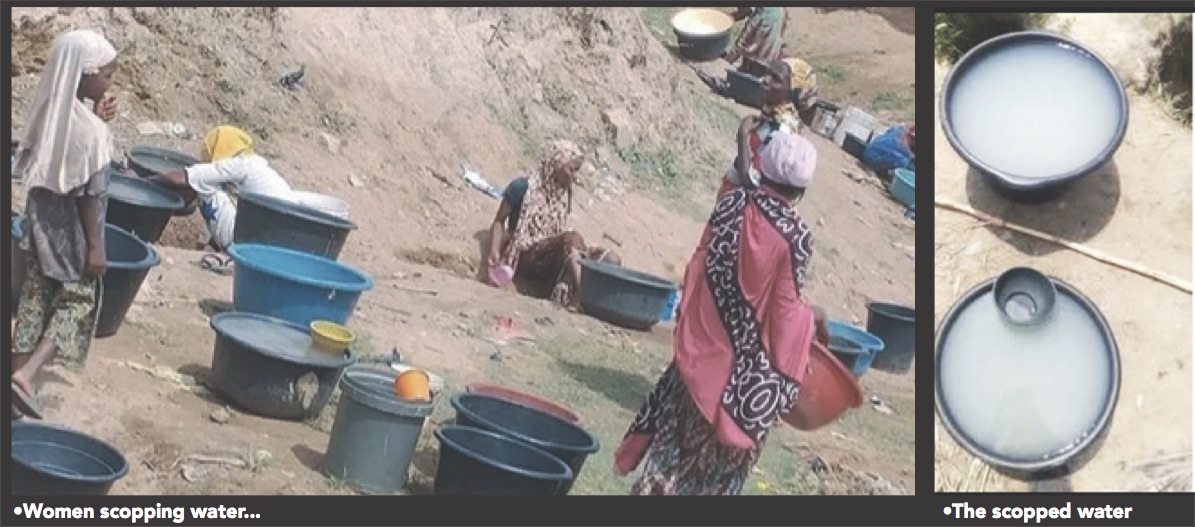
From Lafia to Nasarawa Eggon, Akwanga, Keffi, Doma, Awe and parts of Karu, pictures of dry, rusty taps highlight the deepening water crisis and misfortunes of residents. They depend on water from boreholes, streams and vendors.
Residents without nearby boreholes buy from water vendors at exorbitant prices during the dry season. Drinking water sourced from vendors could sometimes be unhealthy and hazardous.
In Tudun Kauri, a densely populated area in the state capital, residents disclosed that public taps stopped running several years ago: “There is no government water in Lafia. Everything depends on who has a borehole. If your neighbour’s borehole breaks down, you suffer. If you don’t have money to buy, you trek to fetch water to drink.”
Hospitals, schools and government offices are not exempted from the choking tragedy. Many of them have drilled multiple boreholes to meet their needs, but ended up with limited success.
In Nasarawa Eggon LG, water scarcity has become a daily ordeal that pushes the people to the brink. Residents depend on seasonal streams and shallow wells that evaporate up during the peak of the dry season. When this happens, families trek long distances to neighbouring settlements in search of water.
Salamatu Anzaku, a mother of five, said: “During the dry season, we wake up very early to fetch water. Sometimes we go to the stream, sometimes to someone’s borehole. It affects our health and our children’s schooling.”
In Doma, farmers complained that water scarcity affects not only domestic needs but also their irrigation activities. They linked the water scarcity during the dry season to poverty in the state. Sunday Gona, who resides in Akwanga, described the situation as a troubling generational neglect: “We grew up seeing water from public taps. Today, our children don’t even know that such a thing exists. Everyone now drills boreholes or fetches from streams when they dry up.”
Other News
Students of Nasarawa State University, Keffi, admitted that the water challenge on campus and surrounding communities has negative impacts on their studies. Michael James, a 300-level Computer Science student, told Daily Sun: “Sometimes we queue for hours to fetch water. During the dry season, some boreholes go completely dry.”
An environmental expert, Emmanuel Agbashi, expressed worry over the number of boreholes being dug, warning: “Lafia’s near-total dependence on boreholes is unsustainable and uncharitable. Unregulated drilling has the tendency to increase the risk of groundwater depletion, land subsidence and water contamination, especially as most of the boreholes are sunk without proper hydro-geological studies.”
Muhammed Bala works with the Federal University, Lafia: “When a state capital survives on boreholes, it is not just an infrastructural failure, it is a governance issue and a sad one at that. Water is about dignity, health and development. Nobody can deny that we lack potable water in the state.”
General manager, Nasarawa State Water Board, Dr. Ahmad Abubakar Kana, said: “The dry season is the most challenging time for water supply. Groundwater recharge drops sharply, while demand rises due to heat and increased domestic use.
“The board’s statutory responsibility is limited to supplying potable water to urban and semi-urban areas. Rural water supply falls under other agencies. Most of the water infrastructure we inherited was either obsolete or completely collapsed.
“When Governor Abdullahi Sule assumed office in 2019, assessments revealed a near-total breakdown of water infrastructure across the state. Treatment plants were outdated, transmission networks had collapsed and pumps were no longer functional.
“This reality prompted the creation of Water Sector Task Force to conduct a comprehensive diagnosis of infrastructure, funding, institutional capacity and legal gaps. One of its most critical findings was the absence of a binding legal framework regulating water resources in the state.
“For many years, water governance in Nasarawa operated without a strong legal foundation. That gap made regulation, planning and enforcement extremely weak. The passage of Water Regulation Law has now provided the legal framework needed for sector reforms, though implementation remains incomplete.
“The Task Force made far-reaching recommendations, but not all have been implemented. Funding constraints and the need for stronger political will are major challenges.”