Follow Us on Google
•Experts proffer compliance strategies
By Henry Uche, [email protected]
In line with its mandate to ensure adequate protection of strategic government assets and other properties; the National Insurance Commission (NAICOM) has enjoined The Federal and state governments to begin making provisions for insurance of public buildings and buildings under construction in their respective annual budgets.
This it said is in line with its goals to entrench effective and efficient service delivery; ensure safe, sound and stable insurance sector and adequately protect policyholders and public interest.
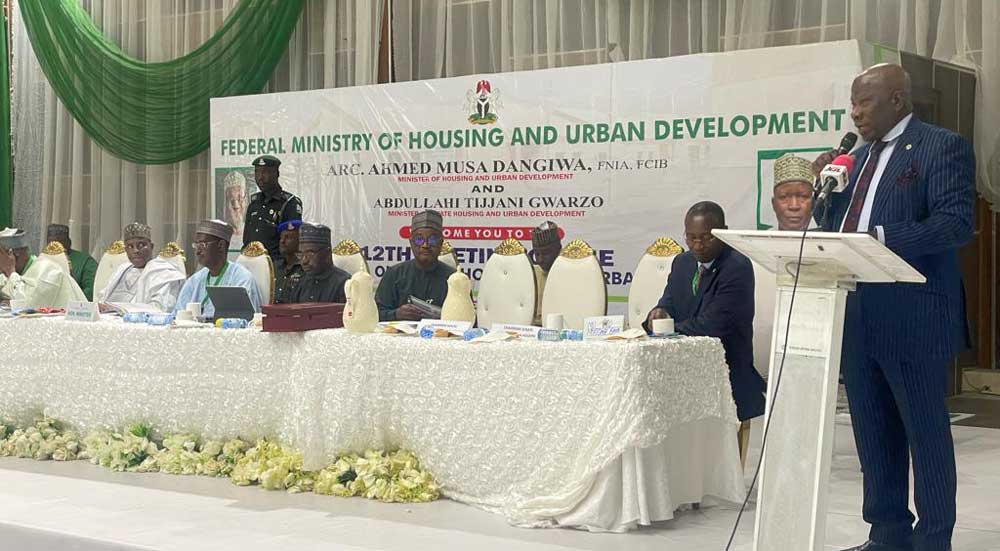
The Commissioner for Insurance/Chief Executive Officer of NAICOM, Mr Sunday Thomas, gave this charge at the 12th meeting of the National Council of Lands, Housing and Urban Development, held in Kaduna State recently.
Worried by the incessant and perennial building collapse across the country, particularly in the commercial hub of the country – Lagos state, and the resultant negative effects, NAICOM boss said it was high time all hands be on deck to halt such ugly incidents (building collapse) as lost of life and properties are getting out of hand.
Also mandated to act as adviser to the Federal Government on all insurance related matters, NAICOM had at different fora advised professional bodies like: Nigerian Institute of Building (NIOB), Association for Consulting Engineering in Nigeria (ACEN), Council of Registered Builders of Nigeria (CORBON), Nigerian Institute of Architects; Nigerian society of Engineers, including Structural Engineers, among others, to uphold the tenets and principle of professionalism and ethical practices in line with international best practices and standards in their professions.
Though some State governors have submitted their 2024 fiscal year budget to their respective Houses of Assembly for approval, however our investigation across states revealed that in the past decade, most State government had not made special budgetary provisions for insuring public building, the least we could find was a provision for unexpected circumstances (contingency budget) of a particular state which does not really represent budget for insurance of public properties in real time.
No doubt NAICOM’s charge to State governors in this regard was applauded by stakeholders in the insurance value chain as a bold steps to restore the values of professionalism, transparency, integrity, consistency, and effectiveness in construction of public structures for national development. An insurance expert said, “It’s a way forward for everyone of us. We shouldn’t be told that insurance especially for public properties is indispensable, because natural phenomena (the act of God) and human errors are inevitable, so we need to heed to this plea and make adequate budgets for public buildings and those under construction as spelt by the Insurance Act 2003, before we all perish under building collapse.”
According to the NAICOM helmsman, these categories of insurance are made compulsory by extant insurance laws in Nigeria and thus, must be complied with by all.
Thomas reiterated that Section 64 of the Insurance Act 2003 made it mandatory for individuals, governments and corporate organisations that undertake the construction of any building above two floors, to procure a builder’s liability insurance policy (building under construction) from any of the NAICOM’ licensed Insurer in Nigeria.
The insurance czar maintained that Section 65 of the Insurance Act 2003 also makes it compulsory for all public buildings in the country to be insured in order to protect innocent victims in the events of accidents and other disasters that may occur while they are within such premises.
He listed some of the benefits in compliance with these compulsory insurances to the federal and state governments to include: “reduction in the federal and state government expenditure in event of disaster that may affect citizens, by shifting the burden to the risk-bearers (insurance companies), hence restoration would not be settled from taxpayer’s money.”
Others include, “Creation of employment opportunities for citizens of the State, and opportunity for enhancing the Internally Generated Revenue (IGR) of the respective states amongst others.
Participants at the session includes the Minister of Housing and Urban Development, Ahmed Musa Dangiwa; Minister of State, Abdullah Tijjani Gwarzo; Chairman, Senate Committee on Housing and Urban Development, Senator Aminu Tambuwal; Chairman, House Committee on Housing and Habitat, Honourable Balele Aminu and chairman, House Committee on Urban Development and Regional Planning, Hon. Abiante Awaji.
Also at the event were the Permanent Secretary, Federal Ministry of Housing, Mahmuda Mamman; Commissioners, permanent secretaries, directors of lands and housing from the 36 states of the federation; managing directors of Federal Mortgage Bank of Nigeria, Nigeria Mortgage Refinancing Company, Shelter Afrique, among others.
Though some State governors (like governor Peter Mbah of Enugu State) of late, have promised to work with insurance companies to insure public properties, Thomas urged the various state governments to emulate the Lagos State government by domesticating the insurance laws in their respective states.
Responding, a former Chairman of Nigerian Insurers Association (NIA) Mr. Gus Wiggle commended NAICOM boss on this charge, however he expressed fear over NAICOM’s power to monitor states’ government budgets towards enforcing compliance.
“The CFI is doing it the right way by lobbying the states and federal government to make provisions for insurance of public building. I guess that’s where it stops. I’m not sure the constitution gives him or the FG that power to monitor the states’ government budgets towards enforcing compliance”
Wiggle maintained that FG has no power to take any disciplinary action against any state that fails to make insurance budgetary allocation for public properties since the Constitution (the grand norm) does not empower them to do such, but wished it was so.
He decried the rot in governance and administration of pension and how senior citizens are being treated in the country over the years, saying “Please remind me which state has been penalised for failing to pay pensions or provide for pensions in the budget for their civil servants, same for insurance.
“So what can happen is what he is doing, lobbying the states to make provisions and implement the provisions of the law by enacting a law at the state assemblies level. The state assembly must understand the implications of the laws in the state,” he stressed.
On her part the President, Africa Insurance Women Association (AIWA), Lady Margaret Nkechi Moore, suggested that submission of evidence of Insurance by State governments should be condition precedence to drawdown their monetary allocation.
Nkechi Moore said although enforcement is only one of the tools to achieve compliance, however better understanding of the importance and benefits of Insurance should be herald across every nooks and crannies of the state to inspire a conscious budgetary allocations for public building and buildings under construction.
“Naicom in the last National Insurance conference titled ‘Redefining Safety’ brought together stakeholders drawn from states and various sectors to hold discussion on Insurance of public buildings.
“However, conscious efforts by all levels of government to bridge the gender gap and ensure that women are included in governance will go a long way to deepen Insurance penetration as women are more safety conscious” she urged.
Similarly, the Head of Department (HOD) insurance department at Lagos State University (LASU) Mr Abass Olufemi, called for a committee that would involve all states governments commissioners of budget and planning as well as the federal minister of finance to monitor budgetary allocations
to ensure that funds are earmarked for insurance of public properties, ensure that Premiums are paid and are well managed and when any incident happen, appropriate claims are paid.
“Because the government is the largest spender of any economy, there should be a committee of states finance commissioners, the NAICOM, federal Minister of Finance and a mechanism to monitor compliance, just as we have committee on finance, we need to institute a compliance Committee involving personnel of not less than the rank of a Director (who must be tested and trusted) on. Financial integrity. This machinery in place would go a long way to boost confidence, transparency and accountability in the process.”