Follow Us on Google
Economic, management, and administrative experts have maintained that Nigeria’s journey to sustainable prosperity demands more than abundant resources as it were; it requires competent leadership, sound management, and strong institutions capable of turning knowledge, human capital, and natural wealth into tangible development.
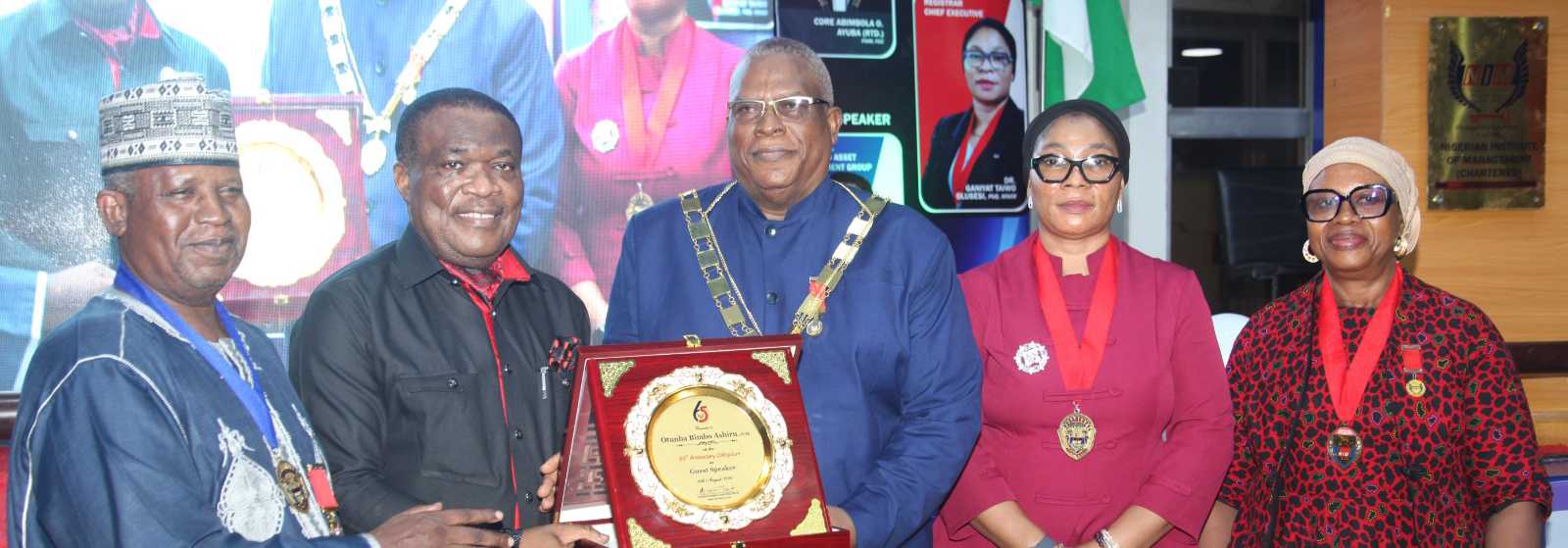
Speaking at the 65th Anniversary Colloquium of the Nigerian Institute of Management (Chartered), the keynote speaker, Otunba Ashiru, a former Chairman of Odu’a Investment Company Limited, said Nigeria does not lack intelligent, talented, and ambitious people; its challenge is how to organise human and material resources and institutions in ways that consistently convert talent into results.
Ashiru, who is the Managing Director of Blackcod Asset Management Limited, believes that people drive change, systems sustain change, while management connects the two.
Speaking on the ‘Role of Sound Management Practices in Driving Sustainable Economic Growth, Institutional Excellence, and National Transformation’, he noted that the question is no longer ‘How far have we come’, but “what more can we do with the knowledge, experience and influence that we have accumulated?”
“Clear corporate governance helps minimise mismanagement. It identifies and manages conflicts of interest. It establishes segregation of duties. It provides checks and balances. And it ensures that institutions do not become dependent on the personality, preferences or discretion of one individual.
“Good governance therefore protects institutions from the weaknesses of individuals. But there is an even bigger issue. Governance creates trust. For an economy to grow sustainably, people must trust the institutions around them. Businesses must trust that contracts will be honoured. Investors must trust that rules will be applied fairly.
“Citizens must trust that public institutions will deliver the services for which they exist. Entrepreneurs must trust that their investments will be protected. And society must trust that those who exercise power will be accountable for how they use it. Without trust, the cost of doing business rises. Without trust, investment becomes more difficult. Without trust, institutions become weaker.
“And without strong institutions, sustainable economic transformation becomes much harder to achieve. So, corporate governance is not merely about compliance. It is about building institutions that people can trust.”
He advocated for capacity building, not merely as an investment in employees, but as an investment in institutional resilience. He noted, “We can build a more productive and efficient society if individuals, businesses, governments, and institutions continually invest in developing the capabilities required for the future.
Other News
“We can learn from other countries. We can adopt systems that have worked elsewhere. We can deploy technology. We can attract global expertise. We can encourage knowledge transfer. We can engage our diaspora. And we can create opportunities for reverse migration that bring global experience and expertise back into our institutions.”
On sustainability, the management expert posited that Nigeria must learn to manage today’s resources without compromising tomorrow’s opportunities. Sustainability is fundamentally about responsible management. How efficiently do we use our energy? How do we deploy our natural resources whilst protecting the environment? How do we build infrastructure for the future? How do we ensure economic growth creates broad-based value rather than short-term gains for a few?
“When we reduce waste, we improve productivity. When we improve productivity, we increase competitiveness. And when we increase competitiveness, we create the foundation for sustainable growth. That is why sustainability must be understood not as a constraint on economic development, but as a management strategy for long-term economic development.”
He called for a full embrace of technology, saying, “Good governance creates trust. Capacity building creates capability. Technology creates leverage. Sustainability creates continuity. And when these come together, institutions become stronger. This is where the Nigerian Institute of Management has a unique role to play. Therefore, its responsibility goes beyond teaching people how to manage organisations. It is about building better organisations, better institutions and ultimately a better Nigeria.
“The Nigeria of the future will not be built by government alone. It will not be built by business alone. It will not be built by technology alone. And it certainly will not be built by good intentions alone.
“Nations are built by people. People work through institutions. Institutions succeed through sound management. Let us recommit to Nigeria’s future. Let us build managers who can build institutions. Let us build institutions that can build economies. And let us build an economy that creates opportunity, dignity and prosperity for generations to come,” he implored.
In an address, the President and Chairman of Council of the Institute, Commodore Abimbola Ayuba (rtd), assured members and Nigerians at large that his administration and, hopefully, his successors would not abuse or take for granted the sacrifices and mandate of its founding fathers.
“The Institute was established in 1961 by a group of management professionals to bridge perceived gap in management of the nation’s public and private sectors. We recognize the sacrifices of our founding fathers, both living and dead, who devoted their time, thinking, talent and treasure to establish and nurture the Institute to the enviable height, image and recognition it is enjoying today. We don’t take it for granted,” he averred.