Follow Us on Google

To tackle the menace of the invasive fall armyworm in Nigeria
By Damilola Fatunmise
The fall armyworm (FAW) is native to tropical and subtropical regions of the Americas. It is a serious pest which has invaded Africa since 2016 and has been adjudged the most dreaded insect pest of maize in Africa and in many regions of the world. Efforts to control its menace utilize synthetic chemicals, many times with attendant environmental damage and health risks.
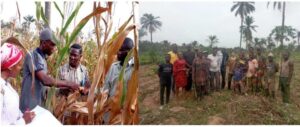
Farmers and other drivers of food production in the developing nation have adopted several ways to tackle infestation by FAW, but with no end in sight. In his carefully planned research on farmers’ fields in multiple cropping seasons in Nigeria, Dr M. D. Akinbuluma, a Senior Lecturer in Entomology in the Department of Crop Protection & Environmental Biology, University of Ibadan (UI), Nigeria through the research award from the competitive Ekhagastiftelsen, a Swedish Foundation, promoting ecological agriculture, trailed multiple tillage practices and cropping systems to conflict the invasive FAW.
This was the first comprehensive study of its kind in Nigeria that employs agro-ecological solutions to tackle FAW menace. Deriving some protocols from the Agro-ecological Technical Working Group for the FAW Global Action Plan (FAO) on FAW, the project was carried out in multiple seasons on farmers’ field under different farming landscapes identified by varying tree covers.
Interestingly, through the project, several maize resource-poor maize farmers and research assistants were trained on how agro-practices could tackle FAW attack.
From his interdisciplinary research including other entomologists, ecologist and physiologist, from UI and Swedish University of Agricultural Sciences, Sweden, Dr Akinbuluma advocated that intercropping maize with cowpea or vegetable will not only help to reduce the population and damage caused by FAW on maize, but will give supplementary benefits to the farmers because they have additional crops (cowpea and vegetables) from their farms.
Another prowess in the project execution involved staging of community outreaches and workshops where issues relating to the control of FAW were thoroughly discussed. The event, which featured presentations, talk-shows, questions and answers and informative and educative group discussions, had in attendance the members of the university community, led by the Deputy Vice Chancellor, Research Innovation and Strategic Partnership, representative of research institutes, extension agents, farmers, students and other relevant stakeholders involved in plant protection practices. Driven by his education, training, skills and passion and inspiration from spouse and family members, he is deeply committed to engaging with smallholder farmers, who often face significant challenges from insect pest infestations and concomitant economic losses.
Hence, his dedication to developing sustainable solutions through the application of Integrated Pest Management (IPM) strategies, particularly agroecological approaches with minimal harm to the environment. “Our reports beam light on a critical aspect of Nigerian agriculture. We are pioneering pragmatic and innovative methodical solutions whose effect could yield far-reaching benefits to farmers and our jealously-guided environment’.
We are resolute to expand research activities that prioritize biodiversity conservation, aiming to mitigate the impact of invasive and other destructive insect pests; we invite farmers, agricultural professionals, and policymakers to join us in this crucial voyage towards global food security and environmental sustainability’. “To unmask this agricultural monster (FAW) and sustainably produce maize without the use of expensive chemicals on farmers’ fields in Nigeria, employ agro-ecological approach,”says Dr. Akinbuluma.