Follow Us on Google
From Felix Ikem, Nsukka
The Minister of Innovation, Science and Technology, Dr Kingsley Udeh, has commended Nigerian Engineers for always being the backbone of national development and key drivers of infrastructure, sustainability, and economic growth.
Udeh gave the commendation in Nsukka at the weekend while making the keynote address during the 21st Herbert Macaulay Memorial Lecture (HMML), held at the Princess Alexander Auditorium Hall, University of Nigeria, Nsukka (UNN).
Udeh who spoke on the theme “Sustainable Engineering Practice for National Development: Innovative Solution and Technological Advancement in an AI Era,” said that engineering transforms ideas into tangible solutions that fuel economic growth, social well-being, industrial and national advancement.
“Engineering has always been the backbone of national development, building roads, powering homes, and connecting cities. However, in today’s dynamic global landscape engineering must evolve beyond concrete and steel.
“It must embrace Innovation by harnessing emerging technologies to solve complex challenges, and as such, it must remain people-centered delivering solutions that are inclusive, affordable, and responsive to our unique national context,” he said.
The Minister, who was represented by Dr Peter Ogbobe, Director General/ Chief Executive Officer (CEO) of the Project Development Institute (PRODA), Enugu State, urged engineers in the country to harness the immense potential of Artificial Intelligence.
“AI is reshaping agriculture, healthcare, manufacturing, finance, and education, the task before us is therefore to harness AI responsibly, ensuring that its benefits are inclusive and aligned with our natural development priorities.
“Our ministry has continued to implement strategic initiative aim at strengthening Nigeria’s engineering and innovation ecosystem, particularly in the context of AI and other frontiers of emerging technologies,” he said.
In a remark, Prof Ikechukwu Ike-Eze, Dean, Faculty of Engineering, UNN said that HMML is a flagship of the faculty, which according to him started with the resolution of the Faculty Board on October 5th, 1968 and its maiden edition was held in 1980 and has since continued.
“Today, we gather not only to celebrate the legacy of Herbert Macaulay the father of Nigerian nationalism and a man of vision, but also to reflect on the role of engineering in shaping the destiny of our nation,” he said.
The dean who said that the faculty is rich in talent and ideas, but faces infrastructural challenges which according to him limits their ability to nurture and prepare the next generation of engineers.
He listed some of the challenges of the faculty to include; a one-storey faculty building that will serve as the dean’s administrative hub and symbol of leadership for the faculty, Storey buildings for the five departments that would provide modern classrooms, staff offices, laboratory and collaborative spaces for teaching and learning, A 1000 capacity lecture theatre/auditorium, among others.
“We humbly seek the support of donors, alumni and partners in these critical areas,” he appealed.
In a speech by the UNN Vice-Chancellor, Prof Simon Ortuanya, delivered by the Dean (Ike-Eze), applauded Maculay’s resistance to colonial policies that helped lay the foundation for the eventual independence of Nigeria.
“In 1944, alongside Nnamdi Azikiwe, he co-founded the National Council of Nigeria and the Cameroon (NCNC) and served as its first president.
“The University of Nigeria has consistently recognized Maculay’s immense contributions, though, the faculty of engineering instituted the biennial lecture series in order to advance this recognition.
Other News
“I’m confident that this forum will generate clear, practical pathways for achieving sustainable engineering practices to support national development through the effective application of AI tools,” he said.
Delivering the 21 HMML Lecture, Mr Alex Onyia, an Engineer, and Chief Executive Officer of Educate Technologies Ltd, urged Nigerian universities to embrace AI and digital learning as a way to move the country forward and to enable our students to compete favourably with their counterparts globally.
Onyia alleged that most PhD theses in Nigeria are only good for the shelves because they have not been deployed to solve societal problems, this was even as he urged lecturers and education stakeholders to discourage rote learning and place much emphasis on certificates.
“The era of prioritizing rote learning and mere certificate acquisition over practical skill is rapidly ending, driven by the digital revolution, AI automation, and a shift toward skills-based hiring.
“Modern employers increasingly demand demonstrable problem-solving abilities, critical thinking, and applied knowledge over formal credentials, which often struggle to keep pace with industry changes.
“If we can not produce in Nigeria, we can design and produce in China, remember the concept of dual SIM card phone was simply, designed in Nigeria and produced in China.
“I believe that this 21st HMML will give birth to the greatest transformation that has ever happened in the faculty,” he said.
Also, Dr Mustapha Abdullahi (FNSE, C. Eng, MIMechE,) Director General/CEO, Energy Commission of Nigeria (ECN), ably represented by Prof. I. F. Okafor, at the HMML, presented a keynote address on “Integrating AI in Sustainable Engineering Practice for National Development: Innovative Solutions Approach and Technological Advancement in Nigeria.”
He noted that (ECN), as the apex government organ for strategic energy planning, recognizes that Nigeria is at a pivotal junction where traditional engineering practice must fuse with Artificial Intelligence to transition from manual to predictive, and self-optimizing systems that drive massive industrial and economic growth.
He further stated that ECN had integrated AI in the ongoing Implementation of the Renewed Hope Solarization Project for the provision of a 2 MW solar hybrid system in the 37 Universities and 37 Tertiary Hospitals across the 36 States and Abuja.
He concluded that ECN is committed to lighting the way by making AI a central pillar in its strategic energy planning and policy making and called on the stakeholders to join hands to build a resilient, smart, and sustainable Nigeria together.
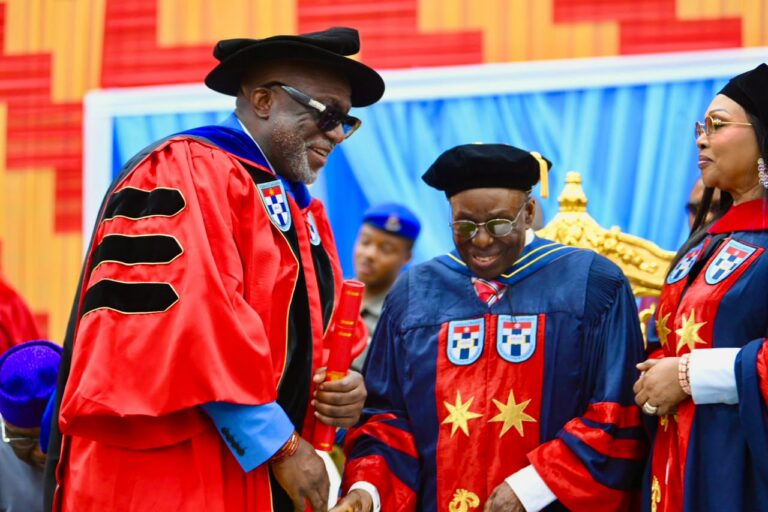
Abdullahi was presented with an Award of Excellence for his contributions to the HMML.
Earlier, Chief Ikechukwu Ugwuegede, an alumnus of the Faculty of Engineering, who chaired the occasion, said that the biennial lecture bears the name of a man whose contribution to Nigeria transcends engineering, stressing that Macaulay was not only an engineer but a surveyor, an architect, a nationalist and a political pioneer who is rightly celebrated as the father of Nigeria Nationalism.
“His life reminds us that engineering is not merely a technical discipline, but a tool for societal transformation,” he said.
Speaking further Ugwuegede, who is a Special Adviser to the President of the Senate, and Non-Executive Commissioner at the Nigerian Communications Commission, Abuja, said “the true value of today’s gathering will not lie in fine speeches or captivating discussion, but lies in the emergence of implementable actionable ideas that could be incorporated into the national plan of action.
“To remain relevant, the faculty must embrace a culture of continuous reinvention, I’m aware that the faculty has already begun this process by expanding its departments and updating its offerings in response to the needs of the day.”
The highlight of occasion was given awards by the faculty to some Nigerians who distinguished themselves in their professions.