Follow Us on Google
By Fred Itua, Abuja
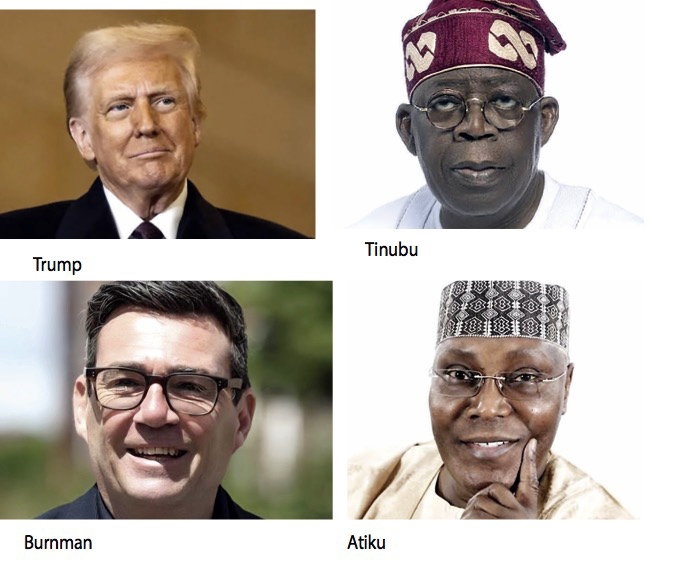
As Nigeria edges closer to the 2027 general election, a curious pattern has emerged. The contest for Aso Rock is no longer being fought solely on the streets of Lagos, in the town halls of Kano or across the creeks of the Niger Delta. Increasingly, it is being waged in the corridors of Washington, in the diaspora halls of Stockholm and Toronto, and in the diplomatic back channels of European capitals. President Bola Ahmed Tinubu’s principal challengers, Atiku Abubakar and Peter Obi, have both concluded, whether by calculation or necessity, that the road to the presidency now runs partly through foreign capitals. Whether this internationalisation of Nigerian politics will alter the arithmetic of the 2027 contest or merely provide theatre for a fractured opposition is one of the questions hanging over Nigeria’s democratic future.

Atiku Abubakar, now standing under the banner of the African Democratic Congress (ADC) after his latest political realignment, has taken his opposition to President Tinubu further afield than any Nigerian politician in recent memory. Rather than confining his campaign to town hall meetings and party congresses at home, Atiku has engaged a Washington-based lobbying firm, Von Batten Montague York, reportedly under a 12-month contract valued at around $1.2 million. The firm’s brief, according to its own disclosures, includes advocacy, diplomatic outreach and the presentation of Atiku’s perspective on matters touching Nigeria and the United States.
In practical terms, this has meant the circulation of decades-old American forfeiture records, drawn from a 1993 civil case in the United States District Court for the Northern District of Illinois, to officials within President Donald Trump administration, members of Congress and senior congressional staff.
The documents in question relate to a historical investigation into an alleged heroin trafficking organisation said to have operated between Nigeria and the United States between 1988 and 1991, in which Tinubu’s name appeared alongside two other individuals. The matter is not new. It featured prominently in the petitions filed by both Atiku and Peter Obi after the 2023 presidential election, when the pair argued before the Presidential Election Petition Court that Tinubu ought to have been disqualified over the forfeiture.
That court, and subsequently the Supreme Court, dismissed the argument, holding that the case was civil rather than criminal in nature and that the petitioners had failed to establish that Tinubu had ever been convicted of any offence. The President has consistently denied any wrongdoing. Yet, the resurrection of this old dossier, now delivered directly into the hands of American lawmakers and administration officials, signals a shift in strategy. Atiku appears to have concluded that, if domestic courts would not entertain the matter, international pressure might yet keep it alive in the public imagination.
There is a broader logic to the recent manoeuvre. Nigeria’s relationship with Washington has grown increasingly complicated in recent years, evolving from ambivalence into public friction. President Tinubu has not undertaken an official visit to Washington since assuming office in 2023, despite having met then President Joe Biden briefly on the margins of the G20 summit in India that same year. That solitary encounter aside, there has been no state visit, no Oval Office meeting and, by several accounts, a noticeable diplomatic distance between Abuja and the current occupant of the White House.
Nigeria went without a substantive ambassador in Washington for an extended period following the recall of envoys in 2023, a vacancy filled only recently with the appointment of Ambassador Kayode Are, who has himself expressed hope that a meeting between Tinubu and Trump might eventually be arranged.
Into this vacuum has stepped a more combative American posture towards Nigeria. President Trump has, on more than one occasion, spoken sharply about insecurity in Nigeria, and his remarks have found an eager audience among sections of the American political establishment already inclined to view the country through the lens of religious persecution. Nigeria was redesignated a Country of Particular Concern over religious freedom, a decision that reversed an earlier policy position and drew a bill from a prominent United States senator calling for sanctions against Nigerian officials linked to the enforcement of blasphemy and sharia related laws.
The presidency has pushed back firmly against this characterisation, insisting that religious tolerance remains a foundational pillar of the country’s constitutional order and that the administration has maintained consistent engagement with leaders of both major faiths. Nonetheless, the optics of an American government increasingly vocal about Nigerian governance, at precisely the moment when Tinubu’s fiercest domestic rival is actively lobbying that same government, have not been lost on observers in Abuja or Washington.
It is against this backdrop that Atiku’s American campaign takes on its full significance. By placing historical allegations before American legislators and administration officials at a moment when Nigeria’s standing in Washington is already under strain, and amid persistent reports that Tinubu has sought, without success, to secure a substantive meeting with Trump, Atiku appears to be betting that international scrutiny can achieve what domestic litigation could not. Whether this strategy will resonate with ordinary Nigerian voters, most of whom are considerably more concerned with the price of rice, the state of the naira and the security of their communities than with decades old American court filings, remains an open and rather doubtful question. Nigerian elections have rarely been decided by foreign dossiers, and there is little evidence yet that 2027 will prove the exception.
Peter Obi, for his part, has pursued a different but complementary internationalisation strategy. Where Atiku has focused his energies on Washington’s institutions of power, Obi has cultivated a more diffuse network among Nigeria’s vast diaspora community, particularly across Europe. Coordinators for his campaign, now conducted under the platform of the Nigeria Democratic Congress (NDC), following his own political realignment, have been active in countries from Sweden to Germany, urging Nigerians abroad to mobilise funding, advocacy and voter education efforts aimed at unseating Tinubu.
The appeal to the diaspora is not only sentimental; Nigerians abroad remit billions of dollars home each year, wield considerable influence over relatives who still hold permanent voter cards, and increasingly see themselves as stakeholders in a political outcome that shapes whether they might one day return home to invest, work or retire.
Obi’s international outreach has, however, occasionally proved double edged. Photographs of him sharing a lighter moment with President Tinubu and former Ekiti State Governor Kayode Fayemi at the installation mass for Pope Leo the Fourteenth in Rome caused considerable disquiet among his most committed supporters, who had grown accustomed to viewing their candidate as an unbending adversary of the President. Obi’s explanation, that he attended purely as a devout Catholic and had never previously sought an audience with the President since Tinubu assumed office, appeared calculated to reassure a base that prizes moral consistency above almost every other political virtue. The episode illustrated a genuine hazard of internationalising one’s opposition.
The same global stages that offer visibility and legitimacy can also produce awkward proximity to the very figure one is seeking to unseat, at a cost that falls disproportionately on the challenger rather than the incumbent.
Obi has also used his international platform to sustain a relentless critique of Tinubu’s own travel habits, turning the President’s frequent foreign engagements into a recurring theme of his opposition. He has repeatedly highlighted the sheer volume of days Tinubu has spent outside Nigeria, citing a figure of 196 days abroad in 2025 alone, and pointedly questioning what tangible economic benefits, in terms of factories, industrial partnerships or technology transfer, have flowed from such extensive travel.
Other News
The Presidency has responded to such criticism by pointing to a substantial catalogue of foreign visits, spanning some 24 countries across Europe, Africa, the Middle East, the Americas and Asia since 2023, framed consistently as part of a strategy to reposition Nigeria diplomatically and attract foreign investment. Officials point to agreements struck on the margins of summits in Abu Dhabi and elsewhere, alongside a state visit to the United Kingdom that included a sizeable delegation of governors, ministers and National Assembly members, as evidence of a foreign policy oriented towards tangible economic returns rather than mere ceremony.
Critics, Obi chief among them, remain unconvinced, arguing that the scale of these delegations and the frequency of the travel sit uneasily against a domestic backdrop of worsening poverty, insecurity and unemployment, with independent estimates suggesting that close to 140 million Nigerians could be living in extreme poverty by the close of 2026.
What makes the international dimension of this contest so relevant is not that two prominent opposition figures have chosen to look outward, but that they have done so at a moment when their domestic coalition is anything but united. Far from consolidating into the formidable anti-Tinubu alliance that many observers once anticipated, the opposition landscape has fragmented further over the past year.
Rival ambitions, unexpected defections and deepening mutual suspicion have unsettled what was meant to be Nigeria’s most potent challenge yet to APC dominance. The defection of prominent businessman and socialite Obi Cubana to the Tinubu camp delivered a big setback to Obi in the South East, a region long regarded as his most reliable base. Meanwhile, an emerging partnership between Obi, the NDC and Kano’s Rabiu Kwankwaso has been presented as a serious threat to APC’s hold on the North West, even as questions persist about how durable such an alliance can prove once the horse trading over tickets and running mates begins in earnest.
Atiku’s own position within this shifting landscape is scarcely more settled. His departure from the Peoples Democratic Party (PDP), the platform under which he contested and narrowly lost in both 2019 and 2023, to the ADC represents his latest attempt to find a vehicle capable of delivering the presidency that has eluded him across six previous attempts. Whether his American lobbying campaign strengthens or complicates that effort is a matter of genuine debate among political observers.
Supporters argue that keeping historical allegations against Tinubu alive in Washington maintains international pressure and preserves a narrative of accountability that domestic courts refused to entertain. Critics, including within the wider opposition, contend that the strategy smacks of desperation, an admission that Atiku’s path to victory through conventional Nigerian politics has narrowed considerably, leaving him to seek in Washington what he could not secure at the ballot box or in the courts.
There is also a delicate question of national sentiment that both Atiku and Obi must navigate carefully. Nigerians are, by long tradition, deeply protective of their sovereignty and profoundly suspicious of any suggestion that a fellow citizen might be inviting foreign interference in the country’s internal affairs. The recollection of colonial rule remains close enough to the surface that accusations of running to Washington or courting European sympathy can as easily backfire as succeed, particularly if framed by APC strategists as unpatriotic or as evidence that the opposition lacks confidence in its own domestic appeal.
President Tinubu’s allies have already begun to make this argument, suggesting that a genuine alternative to his leadership ought to be built on the strength of grassroots structures across Nigeria’s 36 states rather than on documents circulated among American congressional staff or sympathetic gatherings in European conference halls.
Yet, it would be a mistake to dismiss the international dimension entirely as a sideshow. Nigeria’s relationship with the United States carries strategic weight, spanning security cooperation against groups such as Boko Haram and the Islamic State of West Africa Province, counterterrorism assistance, and a complex web of trade and investment ties that any Nigerian government, whether led by Tinubu or a successor, must eventually manage.
A sustained campaign by Atiku’s lobbyists to keep unflattering historical records before American policymakers, combined with an already fraught bilateral relationship marked by the Country of Particular Concern designation and congressional agitation over religious freedom, could complicate whatever diplomatic thaw Nigeria might hope to engineer ahead of the election. Should the Trump administration choose to lean further into criticism of Tinubu’s government, whether over religious freedom, insecurity or governance more broadly, the opposition may find itself handed a narrative it did not have to construct on its own.
Equally, Obi’s diaspora mobilisation, though it will not translate into ballots under Nigeria’s current electoral framework, which does not permit diaspora voting, could still shape the contest indirectly. Remittances, campaign financing, and above all the pressure that diaspora communities can exert on relatives at home to register, collect their permanent voter cards and actually turn out on election day, represent a genuine, if difficult to quantify, political resource.
If Obi’s European campaign succeeds in converting enthusiasm into concrete voter mobilisation efforts back home, the effect could be felt beyond the drawing rooms of Stockholm or Berlin.
For President Tinubu, the calculus is somewhat different. His government, pundits argue, must balance the need to manage an increasingly assertive American administration, one prepared to publicly criticise Nigerian governance and security policy, against the political cost of appearing to chase a White House meeting that has, so far, proved elusive.
The absence of a Washington visit since taking office, now well into its fourth year, has become a talking point that his opponents are unlikely to abandon, particularly as Ambassador Are continues to express public optimism about an eventual meeting that has yet to materialise. Should such a meeting finally occur before the 2027 polls, it would likely be presented by the presidency as vindication of its broader diplomatic strategy. Should it continue to elude Tinubu, expect Atiku, Obi and their respective camps to make considerably more of the omission than they have already.
What emerges from this survey of the international dimension is a contest being fought on two distinct planes simultaneously. At home, the traditional calculus of zoning, party structures, grassroots mobilisation and economic grievance continues to dominate, with an opposition still struggling to present a coherent, unified front against an APC machine that, whatever its internal frictions, retains formidable advantages of incumbency.
Abroad, a parallel contest unfolds in lobbying offices, diaspora halls and increasingly testy diplomatic exchanges, one in which historical allegations, foreign sympathy and international pressure are being marshalled as substitutes for the domestic unity that has so far proved elusive.
Whether this global gambit pays dividends for either Atiku or Obi remains uncertain. History offers little comfort to those who would place too much faith in foreign intervention as a route to Nigerian political power. International pressure has, on occasion, shaped the margins of Nigerian politics, influencing sanctions, visa policies or diplomatic tone, but it has rarely, if ever, determined who occupies Aso Rock. That decision has always rested, and will very likely continue to rest, with the tens of millions of Nigerian voters who must ultimately weigh competence, credibility and the promise of tangible change against the noise of foreign capitals.
As 2027 approaches, the question facing Atiku, Obi and indeed Tinubu himself is not simply who can command attention in Washington or sympathy in Europe, but who can convert whatever advantage such attention yields into a coherent, united and ultimately persuasive case before the Nigerian electorate. On present evidence, with the opposition still visibly divided and horse trading over alliances far from resolved, that remains the far harder battle, and the one that will, in the end, decide the outcome.