Follow Us on Google
Kaduna watermelon traders lament: ‘When rain falls, our sales fall too’
From Sola Ojo, Abuja
As temperatures soar and hydration becomes crucial due to climate change realities across the world, nutrition experts are turning attention to one of nature’s most refreshing and nutrient-packed gifts: watermelon.
Beyond its sweet taste and high water content, studies show that watermelon offers a variety of health benefits, ranging from improved heart function to faster post-exercise recovery.
In Nigeria, it’s not just a fruit, it’s a growing economic commodity. To a Zaria, Kaduna State-based nutrition and agricultural development expert, Dr. Halima Musa, “Watermelon is not just a fruit, it is a pathway to better health and rural prosperity.”
Composed of over 90% water, watermelon helps the body stay hydrated in hot climates like northern Nigeria and during physical activity. It is rich in lycopene, a powerful antioxidant linked to reduced risk of heart disease and certain cancers.
In addition to these benefits, the fruit is a good source of essential nutrients such as vitamin C, vitamin A, potassium and vitamin B6, all of which contribute to immunity, skin repair and metabolic function, according to the National Institute of Health Office of Dietary Supplements.
Watermelon thrives in Nigeria’s northern and Middle-Belt regions, where dry weather and well-drained sandy soils offer ideal growing conditions. Kano, Jigawa, Katsina, Benue and Niger states have become major producers, with seasonal harvests fuelling local consumption and inter-state trade.
It is mostly cultivated during the dry season using irrigation and, in some areas, two planting cycles are possible in a year. According to field reports from local markets, many smallholder farmers prefer watermelon due to its fast maturity cycle, typically ready for harvest within 70 to 90 days.
A market survey by agricultural economists estimated that the national watermelon market is worth several billions of naira annually, with strong demand in both wet and dry seasons. Experts say, with proper storage, processing (e.g. into juice, dried snacks, or pulp) and market organisation, watermelon could become one of Nigeria’s biggest non-oil export earners.
Although many watermelon lovers don’t know much of its nutritional and economic importance, it is the cheapest and most nourishing fruit readily available all year round.
Again, it is pocket-friendly. For instance, while a family of four may spend N5,000 on other fruits like apples, with N1,500 or less, a ball of watermelon is accessible and serves the same number of people better for their daily nutritional needs.
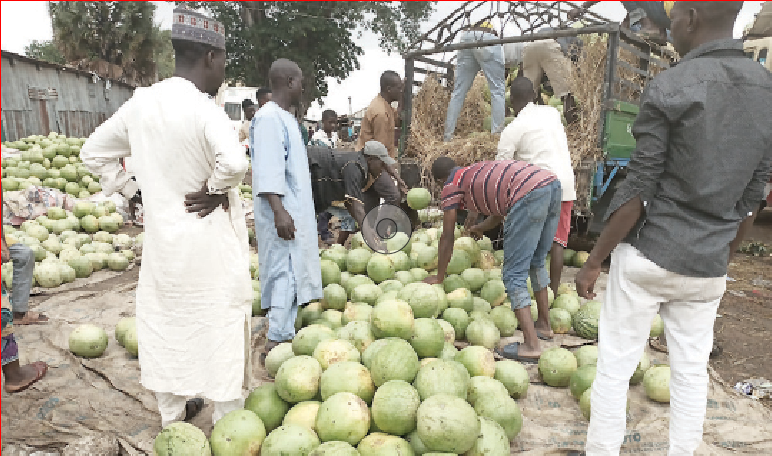
Gambo Ibrahim sells watermelon at the Kaduna Railway Station Fruit Market, the largest in the state. To him, the rainy season is a big deal for them.
It is also the time when buyers have a bargaining advantage due to low sales compared with the dry season. So, while the produce is fresh and abundant, the weather brings with it challenges that are as persistent as the downpour.
“The market is manageable now because it is the rainy season. We do have good sales during this period, but the heavy rains also make things difficult. The produce spoils quickly, so I’m just managing for now,” he said.
Despite lower farm gate prices, especially for watermelons and oranges, the final cost to the consumer is often higher due to increased transportation expenses.
“It’s cheaper at the farm. But by the time you factor in the cost of bringing it here, it goes up again. So, to me, transport is the real problem,” he added.
He said the produce is sourced from far places such as Kano, Jigawa, Yobe, Sokoto, Zamfara, Kebbi and Ekiti in the southwest when the northern rains come early.
“Trucks haul in fruit from across the country, creating a temporary but fragile supply chain that rains can easily disrupt,” he said.
For traders like Rabil Adam, who has been in the market for seven years, the biggest challenge is not the rain itself, but what it does to his customers’ wallets.
Other News
“During the dry season or fasting period, things move quickly. If someone buys on credit today, they return the next day with the money.
“But now, during the rainy season, it can take up to five days. They say they haven’t sold because of the rain. And, you must sell to them because we deal in perishable goods,” he explained.
Still, Rabil was grateful and hopeful. “I thank God, I’m managing. Even with N100,000 or less, someone can start this kind of business. It depends on how you handle it.
“For me, if I get more money, I will invest it in the watermelon business. Like today now, I’ve sold all my watermelon and this is just 11am,” he said.
Another trader, who once sold textile materials in Kaduna Central Market, Alhaji Jafaru Aliyu, shared how shifting circumstances pushed him into the fruit business.
“When things changed for me, I had to change too. Selling watermelon allows me to keep feeding my family”, he said.
Now, he operates in Railway Fruit Market alongside nearly 300 other traders. Together, they form a network of resilience, adapting daily to the rhythms of the weather and the current economic realities in the country.
Umar Ibrahim is the financial secretary of the traders’ association in this market. He painted a similar picture.
“We don’t have too many challenges with the rainy season except the timing. The rain usually falls in the evening, when our customers are still out trying to sell in town as people close from work and head home.
“If it rains, then they don’t sell. And if they don’t sell, they don’t come to pay and buy from us. That means a lot to us in the value chain,” he said.
He noted that watermelons and oranges, the two most prominent fruits in the market, follow seasonal migration routes across Nigeria.
“Sometimes we get them from Jigawa, sometimes from Yobe. Even the South like Ekiti State, brings in produce. It all depends on the time and the season.
“For example, during Ramadan, orange sellers struggled because the fruit isn’t in good condition.
“But now, the oranges are sweet, juicy, and fresh, with prices ranging from N27,000 to N30,000 per bag, depending on the quality.
“At the same time, watermelons are readily available now and the price depends on the size, distance and general market forces. For example, those who bring in trucks sell big ones like N800 to the retailers.
“We thank God for everything. We keep going, no matter the challenge because this is the only trade we have mastered,” Umar said.
Rainy season for Kaduna’s fruit traders is more than just a matter of wet clothes and muddy roads, it is a delicate dance of risk, resilience, and resourcefulness.
Every delay in repayment, every truck caught in a storm, and every rotten watermelon reminds them of how unpredictable their livelihoods are.