Follow Us on Google
By Joe Apu
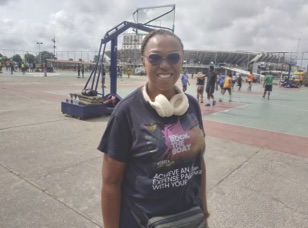
Nsima Ogedi-Alakwe, a respected marketing professional and passionate advocate for youth development, is calling attention to what she describes as the “shameful abandonment” of Nigeria’s National Stadium in Surulere, Lagos, the broader neglect of sports infrastructure and grassroots talent development in the country.
Alakwe, who has spent over two decades in the marketing industry and currently works with Lagos Business School, is also a mother of many, a self-proclaimed “awesome mom” and “fantastic wife.” But beyond her professional and personal roles, she is also a former student-athlete with vivid memories of her days playing basketball, handball, badminton, and long-distance races at her secondary school, Federal Government College, Ikot Akpene.
Yet despite her early passion, she never pursued a career in sports — not by choice, but by circumstance.
“Looking back, I think it was a lack of guidance,” Alakwe recalled in a recent interview with Sunday Sun. “My parents were teachers, and their focus was on academics. The priority was simple: go to university, get a degree, and find a job. Sports was never really considered a career path then.”
Alakwe now channels her athletic passion into wellness and fitness. She enjoys walking and brings her children regularly to the National Stadium for basketball training. But every visit reminds her of how much has been lost — and how little has been done.
“The National Stadium is not just under-maintained — it’s abandoned,” she said bluntly. “You see young people coming here every day, you see coaches doing their best with nothing. The structures are skeletal. There’s no functioning lighting, the tracks are gone, most of the restrooms are unusable. Yet, there’s talent everywhere — it’s painful to watch.”
Built in 1972 and once the pride of Nigeria, the National Stadium in Lagos was once a venue that hosted world-class athletic events, including the 1980 African Cup of Nations. Today, it stands as a shell of its former self — overgrown, crumbling, and largely deserted except for pockets of youth training on makeshift courts and fields.
Alakwe, who drives from Isheri to bring her children to the stadium, said many families make similar sacrifices just to provide their children with a space to train.
“My children have learned to come here on their own because I work. I’m only here today because I’m on leave. But every time I come in, I ask myself — why do we allow national treasures to rot? Why can’t we maintain what we already have?”
Alakwe believes the decay of the National Stadium is symptomatic of a broader failure — a lack of investment in grassroots sports development at the local government level.
“Let’s even say we don’t have the money to build new stadiums but what about maintaining the ones we have?” she asked. “Every local government should have a functioning youth development center. You don’t need to walk more than five minutes in New York to find a basketball court. Why not here in Lagos, in Koshofe, or Isheri,” she asked.
Her call is not limited to Lagos. Alakwe, a native of Akwa Ibom State, insists the issue cuts across all 36 states.
“We’re seeing wins from our women in basketball and football and that’s great. But what’s happening at the grassroots? Who’s nurturing the next generation of talents,” she queried
She pointed to the rising youth crime rate and drug abuse as issues that can be mitigated through structured sports programs.
“Sports give young people a purpose,” she explained. “It’s not just about physical health. When a teenager wakes up in the morning to go play football or train in martial arts, they’re less likely to get involved in crime. They go home tired, they sleep. That’s how you build discipline.”
Other News
Alakwe didn’t hold back in criticizing educational institutions either. She decried the widespread disappearance of sports spaces in schools — especially private ones that prioritize buildings over playgrounds.
“Many schools are now just two or three-storey buildings with tiny or no fields. Children don’t even have space to kick a ball in their schools. That’s not education — that’s imprisonment.”
She called on both state and federal governments to revamp public primary schools — not just academically, but as community hubs for sports and wellness.
“We’ve abandoned public schools, and that’s where the space is. Let’s convert them into functional sports grounds. Use local government allocations for real development. Not every child is going to be a professor. Some will be champions.”
For Alakwe, sports development is not just about athletics — it’s a viable economic engine.
“If the stadium works, it activates an entire value chain,” she argued. “Merchandise, refreshments, coaching, security — people will earn a living. Look at how everyone wears foreign jerseys. Why can’t we produce ours locally? That’s jobs. That’s dignity.”
She also criticized some private sector sponsors for focusing more on visibility than impact.
“It’s not just about branding the stadium in your company colors on game day,” she said. “Are you actually investing in development? Are you checking if that sponsorship money is reaching the kids?”
In an emotional close, Alakwe urged leaders at federal, state, and local levels to rethink their priorities.
“We keep screaming about crime, unemployment, hopelessness. But what are we doing about it? Sports is one way to address it. This isn’t about politics. It’s about people. It’s about the future.”
She also challenged communities, estates, and even school boards to be part of the change.
“Children must play. They learn through play. Every community, every estate, every LGA must be held accountable for creating space for that.”
“If you’re in leadership today be it government, business, school — ask yourself: when I’m gone, what legacy will I leave? Did I build a future? Or did I ignore it?”
Nsima Ogedi Alakwe’s voice is a reminder of what’s at stake: the wasted potential of millions of young Nigerians, the decay of national assets, and the dangerous consequences of neglect. Her story is one of passion but also of frustration with a system that overlooks the power of sports to transform lives.
And as she stands on the cracked pavement of the National Stadium, watching her children play on outdoor courts of the National Institute for Sports, she’s not just reminiscing about lost glory — she’s demanding that Nigeria do better.