Follow Us on Google

By Steve Agbota
With a few days to the end of 2025, maritime stakeholders are unanimous in their submission that the industry experienced a rollercoaster of highs and lows and remains one of the toughest in recent memory. The sector grappled with a mix of exogenous challenges, including policy reforms, transformative initiatives, operational bottlenecks, safety concerns, and wider economic uncertainties.
Despite persistent issues such as port congestion, bureaucratic inefficiencies, outdated infrastructure and security threats, the industry recorded notable achievements, particularly in trade volumes across both exports and imports.
High hopes were dashed. Promises broken. But hopes remained strong as many look forward to what 2026 has in store.
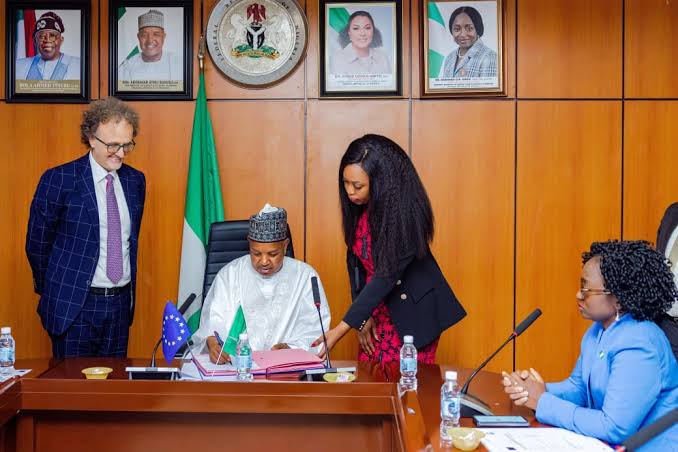
In April 2025, the Federal Government, through the Minister of Marine and Blue Economy, Adegboyega Oyetola, instructed the Nigerian Maritime Administration and Safety Agency (NIMASA) to immediately commence disbursement of the long-awaited Cabotage Vessel Financing Fund (CVFF). The initiative is aimed at empowering indigenous shipowners to compete more effectively with international operators, who have historically dominated Nigeria’s coastal and inland shipping sectors.
The CVFF, established under the Coastal and Inland Shipping (Cabotage) Act of 2003, was designed to provide structured financing for Nigerian shipping companies to acquire vessels. However, the fund remained largely inaccessible for more than two decades. Oyetola’s directive signals a renewed commitment to realizing the fund’s original purpose and unlocking its potential for national economic growth.
“This is more than just the release of funds; it is the dawn of a new era for Nigerian maritime. For too long, the promise of the CVFF has remained unfulfilled. Today, under the leadership of President Bola Ahmed Tinubu, we are breaking that barrier. We are initiating a transparent and strategic disbursement process that will inject vital capital into the hands of our hardworking indigenous operators, allowing them to build capacity, create jobs, and contribute significantly to our national economy,” Oyetola declared.
Following the Minister’s directive, NIMASA pledged to commence the long-awaited CVFF disbursement by August 2025, a move widely seen as a critical step toward revitalizing Nigeria’s maritime industry.
The Director General of NIMASA, Dr. Dayo Mobereola, made this commitment during an oversight visit by the House of Representatives Committee on Maritime Safety, Education, and Administration on Wednesday, April 23, 2025. Mobereola confirmed that the process has reached an advanced stage, in strict compliance with the Minister’s order to accelerate disbursement.
“We are acting in accordance with the directive of the Minister to ensure indigenous shipowners finally have access to this critical funding. The guidelines have been streamlined based on the Minister’s approval, so beneficiaries can access the funds within three to four months,”
By the end of August 2025, there was still no indication that the long-awaited Cabotage Vessel Financing Fund (CVFF) would be disbursed, and as of this moment, the fund remains untouched. The continued delay has further eroded confidence among indigenous shipowners, many of whom now express little or no interest in the scheme, even if the Federal Government were to announce an immediate release.
Several indigenous operators who spoke to Daily Sun said years of unfulfilled promises have made the CVFF largely irrelevant to their current business realities. According to them, the prolonged uncertainty has forced many local shipping firms to either scale down operations or exit the sector entirely.
Today, Nigeria does not own a single vessel capable of lifting its own international cargo. Despite being Africa’s largest economy and one of the continent’s biggest trading nations, Nigeria relies almost entirely on foreign vessels to transport its imports and exports. Industry estimates put the cost of this dependence at about $10 billion annually in freight charges paid to foreign shipping companies.
Stakeholders argue that the failure to operationalise the CVFF has played a major role in weakening indigenous capacity, leaving Nigeria perpetually disadvantaged in global maritime trade and vulnerable to external shocks.
Stowaway incidents threaten maritime security and national image
Nigeria’s ports have increasingly become synonymous with stowaway incidents, with more than 2,300 cases recorded annually. At several maritime industry forums in 2025, stakeholders raised concerns over the rising number of stowaways, warning that the trend poses serious security risks and continues to damage Nigeria’s reputation among maritime nations.
Maritime security in Nigeria has faced persistent challenges over the years, but stowaway cases have emerged as one of the most troubling threats. The incidents have reached alarming levels, exposing significant vulnerabilities in port access control, vessel security and inter-agency coordination.
As a major maritime hub in West Africa, Nigeria’s strategic location and high vessel traffic, particularly at Apapa and Tin Can Island ports, make it an attractive target for stowaways seeking illegal passage to Europe, the Americas and other destinations. The International Maritime Organization defines stowaways as persons who secretly board a ship to gain unauthorised transportation, usually to evade immigration laws or in search of better economic opportunities.
In Nigeria’s case, worsening economic conditions, high unemployment and limited opportunities for young people have contributed to the growing desperation that drives individuals to risk their lives by hiding aboard vessels.
Confirming the scale of the problem, the Chairman of the Shipping Association of Nigeria, Boma Alabi, said Nigerian ports record over 2,300 stowaway cases every year through shipping lines operating in the country.
According to her, shipping companies are mandated to pay $2,000 to the Nigerian Immigration Service for every stowaway that is repatriated, stressing that the stowaway problem is uniquely associated with Nigerian ports globally.
She said neighbouring ports in Ghana, Togo and Benin Republic do not face similar challenges, noting that those countries are taking advantage of inefficiencies and security lapses in Nigeria’s port system.
Providing a breakdown of the figures, Alabi explained that a minimum of two to three stowaways are arrested weekly on each vessel calling at Nigerian ports.
“And we have about 15 ships coming to Nigeria. So if you multiply three stowaways into 52 weeks, making up a year, by 15 ships that come to the country, you will have 2,340 stowaways every year. And for each stowaway that is repatriated, we pay $2,000,” she said.
Alabi, who also serves as President of the Shipping Agencies Clearing and Forwarding Employers Association, described stowaway incidents as a persistent and widespread problem within Nigeria’s maritime domain.
She lamented that despite shipping lines paying various government agencies in foreign currency to secure vessels and port environments, stowaways still find their way onboard.
“Meanwhile, we are paying these agencies for the safety of the vessels and they are collecting their payment in U.S. dollars. Again, dollarising the economy and yet, you are not providing the service. You are putting Nigerians at risk because these stowaways, some of them lose their lives in the process. And it’s out of ignorance,” Alabi stated.
She described stowaways as a national emergency that requires decisive and coordinated action.
Port infrastructure under strain as congestion worsens
Nigeria has seven major seaports: Lagos Port Complex, Tin Can Island Port, Calabar Port, Onne Port, Port Harcourt Port, Delta Ports and the Lekki Deep Sea Port, the newest addition. Lagos ports, particularly Apapa, remain the largest in terms of landmass and cargo throughput.
With multiple ports spread across its coastline, Nigeria should be a dominant maritime force in West Africa. Instead, years of policy neglect, political interests and infrastructure decay have concentrated the bulk of maritime trade in Lagos, resulting in chronic congestion, high logistics costs and declining competitiveness.
The over-reliance on Lagos ports has placed immense pressure on infrastructure that is already ageing and overstretched. Stakeholders argue that government’s failure to fully open and revitalise eastern and central ports has worsened the situation.
Findings show that about 85 per cent of Nigeria’s port infrastructure is over 40 years old and requires urgent rehabilitation. While the Nigerian Ports Authority has undertaken various remedial and palliative works over the years, industry players say these measures are no longer effective.
In response to the growing infrastructure crisis, the NPA secured approval in 2025 to increase port tariffs by 15 per cent, the first adjustment since 1993. The move was aimed at generating revenue to modernise facilities, upgrade equipment and improve efficiency.
Announcing the decision at a stakeholders’ meeting in Lagos, the Managing Director of NPA, Abubakar Dantsoho, said the adjustment was long overdue.
According to him, Nigerian ports have suffered years of underinvestment, resulting in weakened infrastructure, obsolete equipment and limited expansion capacity.
He explained that port authorities globally depend on internally generated revenue to dredge channels, procure marine crafts, maintain infrastructure and invest in technology.
Trade volumes dip, then rebound
In the early months of 2025, Nigeria’s maritime sector recorded a decline in trade volumes, particularly in imports, with exports also affected. The situation was largely driven by the depreciation of the naira and persistent exchange rate volatility, which significantly increased import costs and disrupted supply chains.
Importation of luxury goods reportedly fell by nearly 70 per cent, while essential goods dropped by about 50 per cent. Vehicle imports declined to roughly 25 per cent of previous levels.
Since the floating of the exchange rate in 2023, the naira has lost over 300 per cent of its value, with the dollar rising from N455 to as high as N1,766. This foreign exchange crisis created severe financial strain for importers, shipping companies and logistics operators, threatening the overall growth of the sector.
However, the narrative changed in the third and fourth quarters of 2025, as trade volumes rebounded by about 50 per cent, according to the Shipping Lines Association of Nigeria.
The association attributed the recovery to relative currency stability and gradual improvements in economic conditions.
Boma Alabi confirmed that 2025 performed better than 2024 in terms of trade volumes.
“We have seen an increase in volume of trade, both coming in and going out, which shows that it is because of the stability of the currency and other factors that the economy is improving. Obviously, we are coming from a very long way. So although we’re seeing an improvement, we still have a very long way to go,” she said.
She estimated the increase at between 40 and 50 per cent, based on vessel calls and cargo movements, but stressed that efficiency remains tied to the performance of government agencies.
Nigeria returns to IMO Council after 14 years
One of the high points of 2025 was Nigeria’s election into Category C of the International Maritime Organization Council for the 2026–2027 biennium. The election, held on November 28 in London, marked Nigeria’s return to the Council after 14 years.
The Minister of Marine and Blue Economy, Dr Adegboyega Oyetola, who led Nigeria’s campaign, said the victory followed over a year of intensive diplomatic engagements.
“This victory is not just for Nigeria; it is a vote of confidence in our maritime reforms, our security efforts in the Gulf of Guinea, and the bold vision of His Excellency President Bola Ahmed Tinubu to unlock the full potential of the blue economy,” he said.
Stakeholders expect the development to strengthen Nigeria’s global maritime standing, attract investment and enhance access to technical support.
Stakeholders speak
Despite the gains, industry leaders offered mixed assessments of the year.
Alabi said inefficiencies continue to drive cargo to neighbouring ports.
“One terminal in Ghana is doing the entire tonnage of all our ports together in Nigeria,” she said, warning that administrative red tape is making even new investments like Lekki Port uncompetitive.
Similarly, Chief Executive Officer of Wealthy Honey Investment, Dr Kayode Farinto, said there was little to celebrate.
“Policies are churned out but not implemented. Does election into IMO add value to people’s lives? The answer is no,” he said, lamenting cargo losses to foreign countries.
Maritime expert Charles Okerefe described 2025 as average, noting improvements in security but weak policy implementation.
“We have a roadmap, but if you don’t follow it, you go nowhere,” he said.
Expectations for 2026
For next year, stakeholders want urgent action on port rehabilitation, CVFF disbursement, development of marine tourism, fisheries, and the revival of a national carrier.
Alabi urged agencies to understand and discharge their statutory responsibilities efficiently, while Farinto called for better coordination between the presidency and industry players.
Despite lingering challenges, most stakeholders expressed cautious optimism that 2026 could deliver better outcomes if reforms move from rhetoric to execution.