Follow Us on Google
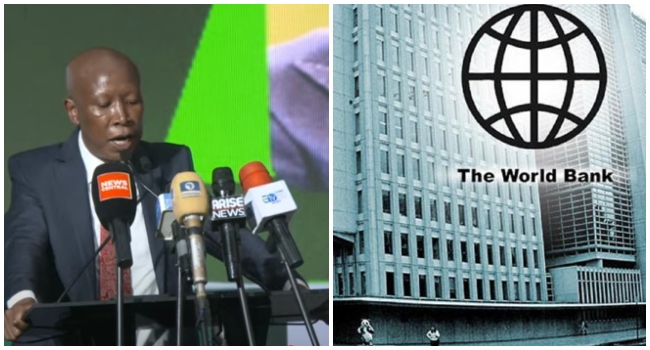
Julius Malema’s recent warning to African leaders to shun Bretton Woods institutions’ loans is timely and commendable. According to the South African opposition leader, taking World Bank/International Monetary Fund (IMF) loans is a debt trap which amounts to mortgaging the future of the continent.
At the recent Nigerian Bar Association (NBA) Annual General Conference in Enugu, Malema said, “The debt trap of Africa to our foreign colonisers must be stopped, and that begins by regulating these loans that our leaders commit future generations to, because they will not be there when the colonisers come to collect.”
The IMF offers loan to cater to crises and emergency situations only. It does not offer loan for development. Forty-seven African countries account for 52 per cent of the 91 countries owing the institution. At $8.67 billion, Egypt happens to be the highest external debtor to the IMF in 2025. It is followed by Kenya ($3.02 billion) and Angola ($2.90 billion).
Some other African countries owing the IMF the most in 2025 include Cote D’Ivoire ($2.74 billion), and Ghana ($2.51 billion). Botswana, Eritrea and Libya have never taken the IMF loan. Mauritius is also not listed on the IMF’s debtors list. Nigeria cleared its $3.4 billion IMF loan in April 2025.
Nevertheless, at approximately $17.32 billion, Nigeria owes the World Bank the most, particularly the International Development Association (IDA). Following Nigeria is Ethiopia, Kenya, Tanzania and Zambia.
The UN’s Unpacking Africa’s Debt report indicated that Africa’s external debt reached $656 billion in 2022. This was as a result of reduced export revenues and sluggish growth. Total external debts for sub-Saharan African countries were estimated to be $805.51bilion in 2023. The IMF projects that it may reach $867.67billion by 2025. Twenty African countries are at risk of debt crisis due to these foreign loans.
In 2023, developing countries reportedly paid $1.4 trillion to service foreign debt. According to the World Bank’s International Debt Report in 2024, interest rates surged by almost a third to $406 billion.
It will take African countries about $89 billion to service their loans this year. Though it is a decrease from the 2024 figure, it is slavish and unsustainable.
The Boston University Global Development Policy Centre and Institute for Economic Justice stated in a new working paper that Africa’s high debt cost was eroding fiscal space and reducing the capacity to import. It noted, for instance, that 16.7 per cent of African government revenues went to debt servicing in 2023. This was the largest increase among developing regions. Interest payments alone accounted for 4.7 per cent of exports in the same year. Many African countries allocate more funds to servicing debts interest than to education and public health.
IMF loans have not been beneficial to Africans. Most of these loans are used for conspicuous consumption and to fund worthless projects. Africa has enough resources to be great. But its leaders have exhibited myopic tendencies over the years.
Malema’s warning is indeed a wake-up call on African leaders to sit up and look inwards. To checkmate unregulated borrowing of money by the South African government from these institutions, the opposition leader said his party, Economic Freedom Fighters, had introduced the Public Finance Management Amendment Bill. The bill, he added, required that the National Treasury in the country should first seek approval from the parliament to source foreign loans and establish transparency regarding such loans and their conditionalities.
A country like Mauritius is doing something right. It is not listed among the debtor countries in Africa. That country remains Africa’s highest-ranked country for a fifth consecutive year in the Chandler Good Governance Index. African countries that emerged as the five regional performers in the 2025 rankings are Mauritius (51), Rwanda (59), Botswana (61), Morocco (75), and South Africa (77). Even with this, the average score for countries in Africa was said to be the lowest among all the regions.
This notwithstanding, the performance of these top five African countries shows dividend of good leadership. Other African leaders should understudy what these leaders are doing right and emulate them.
African countries should also unite socially, economically and even politically to make the continent great. There is need for increased inter-African trade and tourism.
Xenophobic attacks in some countries on fellow Africans must stop. It diminishes the humanity in us when Africans attack fellow Africans and shut down their businesses in the name of protecting local interests.
Let Africa develop its agriculture and manufacturing sector. The continent reportedly has about 60 per cent of the world’s solar resources, enough mineral reserves and wind potential to provide more than enough electricity to the entire continent. It also has a large population that could be beneficial to any workforce and patronize the products of companies. This population is projected to reach 2.5 billion by 2050.
What this means is that Africa has the human and material resources to make the continent self-sufficient. Only the leaders of the continent will liberate it from the stranglehold of foreign debts and underdevelopment.