Follow Us on Google
• City People pays him visit as wife, Bukola turns 70
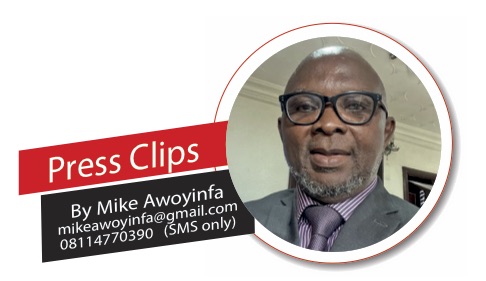
What has been happening to veteran journalist and award-winning Editor, Mike Awoyinfa? That is the big question many have been asking these days.
The reason is pretty obvious.
They no longer get to hear much about this media superstar. Of course, age has mellowed him a bit. He is no longer a small boy. He is now in his 70s. But he has not given up. He is still active. He is still writing.
He still publishes books. He still maintains his regular column at the back page of Saturday Sun newspaper, where he writes about everything and anything, with his distinctive approach and unusual catchy headlines. He writes well. He is a prose stylist. But he no longer reports.
In his younger days as a journalist, Mike Awoyinfa was always in the news. He and his late “twin brother”, Dimgba Igwe, were big stars in the world of print journalism. They were damn good journalists who understood the trade. They believed in human-interest journalism. They would always reference their reports with human stories. They wrote good stories and churned out exclusive stories, one after the other.
Mike and Dimgba revolutionised human-interest journalism in Nigeria when they pioneered the highly successful Weekend Concord in 1989. So successful was it that it soon became the highest-circulating newspaper in Nigeria for over 10 years, as the figures kept climbing.
They became the founding MD and DMD of The SUN Publishing Limited in 2002.
In terms of books, they have written quite a lot. They wrote the journalism classic, The Art of Feature Writing in 1990, and the business bestseller, 50 Nigeria’s Corporate Strategists: Top CEOs State Their Experiences in Managing Companies in Nigeria, in 1999, followed later in 2005 by Nigeria’s Marketing Memoirs: 50 Case Studies, then Mike Adenuga: Africa’s Business Guru, among other great books.
They also wrote a book, FASHOLA, The Nigerian Dream: A Political Biography, in 2018. They went on to publish Segun Osoba: The Newspaper Years, then 50 World Editors: Conversations With Journalism Masters on Trends & Best Practices (2014).
They revolutionised journalism practice with trailblazing human-interest stories. From journalism, they expanded to publishing books and biographies. They were soon to become celebrated authors who wrote tonnes and tonnes of books. Although Dimgba has since passed on, Mike has continued with their legacy of book writing.
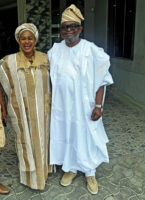
So, what has Mike Awoyinfa been up to in the last few years? Why has he been quiet? City People reporters visited him and his lovely wife a few days back, at their Lagos home, to talk to his wife, Bukola, who turned 70 recently and celebrated it in Cancun, Mexico, with their kids and spouses.
After interviewing his wife, we went on to talk to the man who many love to describe as the King of Tabloid. He has a big study in his Lagos home full of books and rare publications. In recent years, he has been busy writing books. He recently completed work on a book on the IBRU family. It is now on sale at The Sheraton Hotel, Ikeja bookshop.
The IBRU Story: An Account of a Pioneering Nigerian Business Family is a sweeping, deeply researched chronicle of one of Nigeria’s most influential business dynasties and the extraordinary individuals who shaped it. Anchored by the towering legacy of Olorogun Michael Ibru, the book traces how a family of five brothers and two sisters rose from modest beginnings to national and international prominence.
Other News
We asked Mike if he misses the excitement of the newsroom and journalism practice of old. His answer was an obvious yes. But he is not happy at the degenerating state of journalism practice today. He misses the good old days of investigative journalism. He is unhappy that professional journalists gave up too soon to social media. He feels journalists are to blame for killing journalism.
How does he see the new journalism practice, the digital age, emergence of AI and other technological advancement?
“I feel happy about it. Technology is good, but we journalists are the ones who have killed the profession because of our laziness. We have stopped digging up and investigating stories. The hard job of those days is no longer done these days.
“Social media is good and it has come to stay, but the deep work of journalism has been jettisoned by the practitioners simply out of laziness. The standards you had during the time of Alhaji Jose, Chief Segun Osoba, Uncle Sam and the likes aren’t there anymore. Now, we have lazy journalists. For instance, what is the essence of a journalist who has not written a book in his or her lifetime? At least, write about yourself, your experience on the job. That’s what makes you a force in your field.
“You asked me what I have been up to lately. I have been writing books. My latest book is The Ibru Story, which I wrote for the family. You know the Ibrus are one of Nigeria’s prominent families. They are into a lot of things. One of them pioneered the ice fish business in Nigeria in those days, what people call “Oku-Eko”. He is Olorogun Michael Ibru. Another one was the publisher of The Guardian, Alex, and the third one is Goodie of Sheraton Hotel. You also had Felix and Bernard.
“The family approached me and they said they had gone round and asked who could do their story for them, and they said people mentioned my name. Thereafter, we discussed.”
Where can we get the book? “I think it’s at their hotel in Lagos, at the Sheraton bookshop.”
Awoyinfa’s biggest regret in life remains the death of his best friend and “twin brother”, Dimgba Igwe, on September 6, 2014. He recalled how he heard the news of Dimgba’s death.
“I was in the UK for my son’s graduation ceremony. At first, I didn’t want to attend because I was so busy with work. I wanted his mum to go. I was somehow reluctant, but Dimgba beckoned on me to go. He said, what would people say, that after spending and toiling so much on the boy, then it’s time for me to just honour him with my presence as a father, and I am not there? Dimgba was my best friend and a sort of spiritual guide to me. Whatever he said, I did. So I eventually travelled. It was while abroad that I heard of his death.
“He was jogging along the Okota Road here in Isolo when a reckless driver hit him and fled. That day remains the saddest day of my life. Dimgba and I come way back, and very many know our story in Nigeria. We wrote books together. Our first book, 50 Nigeria Corporate Strategists, sold out. We went all out to interview corporate managers, the likes of Cadbury MD, Christopher Kolade and co. at the time. We didn’t write small books. They were voluminous books which sold for at least ₦100,000.”
“The money we made from the book is what we used in building our houses,” he said, gesturing. “Dimgba’s house is just beside mine. So you can imagine the shock when I heard of it.”
Mike is not one of those who believe that social media will kill traditional media. Yes, the format of doing things may change, but with the right leadership, a lot can still be done. You can’t go wrong with human-interest journalism. There are stories out there waiting to be written.
“In those days, we sold huge numbers. Our print run was high. It’s because of our choice of stories and headlines. When the late Alaafin was stopped at the airport back then, we did a story about it and used a creative headline: ‘Not A Laafin Matter’.
“The feeling then was that people don’t read papers on Saturdays. We broke that myth. With the right kind of leadership, we can recreate those days. We can publish interesting human-interest stories with creative headlines and use good, bold pictures. You can’t go wrong.
“The stories are still there. What remains is for us as journalists to go out there, dig up those stories and get the right headlines for them. We did it at Weekend Concord, and we repeated the same feat at The Sun. My appeal to our leaders in the various newsrooms is to go back to human-interest stories. Let us wake up the media. As professionals, let us take back the media from those who have hijacked it. Many of them are not professionals.”