Follow Us on Google
By Bianca Iboma-Emefu
The Catholic Archbishop of Lagos, Most Rev. Alfred Adewale Martins, has warned against what he described as the growing culture of temporary love and disposable relationships. He urged Nigerians, especially the younger generation, to return to God-centred, enduring love as insecurity, divorce and moral decline continue to threaten the fabric of society.
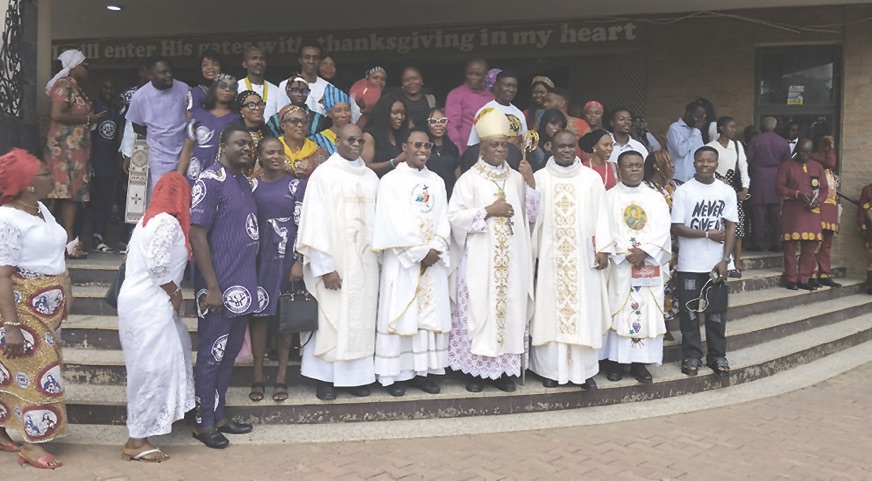
Archbishop Martins made this call during the 2026 Valentine’s Day celebration organized by the Young Catholic Professionals (YCP), Catholic Archdiocese of Lagos, held at the Catholic Lay Apostolate Centre, Lagos. The event’s theme was “God’s love, the foundation of our love story with the subtitle: Love that endures in a changing World.”
The clergyman emphasized that love, as understood by the Church, must transcend fleeting emotions and modern conveniences, drawing its strength from God, the source of love itself.
“The world we live in today is fast-changing – phones change, cars change, applications change – but God’s love is enduring. It spans our good times and our bad times, our health and our sickness,” he stated.
According to him, the Church deliberately celebrates Valentine’s Day to give it a Christian face, reminding the faithful that love did not originate from commercial culture but from God Himself.
“Yes, the world celebrates Valentine’s Day with chocolates and gifts, and that is good. But we must not forget that God is the ultimate cause of love and relationships. Human love only survives when it imitates the love of God,” he added.
He explained that the annual gathering provides an opportunity for Catholics to reflect on love as a covenant, not a convenience – especially at a time when many marriages are collapsing under pressure.
Addressing the rising rate of divorce, even among Christians, Archbishop Martins acknowledged that conflicts are inevitable in marriage, but he insisted that perseverance and peace-seeking must remain central.
“Marriage promises are made for better or for worse, for richer or for poorer, in sickness and in health. These are covenants made before God and must not be taken lightly,” he stated.
However, he strongly condemns domestic abuse, stressing that violence within marriage is unacceptable.
“Any form of spousal abuse cannot be tolerated. Victims must speak out so they can receive the help they need. Where situations are irredeemable, the Church has tribunals to examine the validity of such marriages,” he noted.
Beyond family life, Archbishop Martins also spoke forcefully on Nigeria’s worsening insecurity, describing it as a crisis that has spread across all regions of the country.
“The level of insecurity we experience today is beyond words. The government must do more than it has done so far,” he states.
While acknowledging some renewed efforts by authorities, he maintained that these efforts are insufficient, calling for structural reforms, including the establishment of state police.
“Those who live in localities understand their terrain better. If discussions around state policing are carried forward, we may gradually overcome these security challenges,” he further said.
In a direct message to young people, Archbishop Martins warnef against building relationships based on temporary attractions and material benefits.
“Do not be distracted by passing faces. Look beyond the present life and remember that love is not based on what is convenient at any moment but on endurance,” he said. He emphasized that enduring love is rooted in selflessness and faith, not sentiment.
Chairman of the event, Sir Nosa Ehigiator, a Metropolitan Grand Knight of the Knights of St. Mulumba, admonished Nigerian youths against reducing Valentine’s Day to sex, fleeting pleasure and material pursuits. He insisted that true love is rooted in sacrifice, charity, and God-centered values.
The Metropolitan Grand Knight lamented what he describes as the moral decadence that has overtaken the modern understanding of Valentine’s Day, noting that many young people now equate the celebration solely with sexual gratification.
“Historically, Valentine is synonymous with love and is as old as human nature itself,” he stated. “But today, most young men and women believe Valentine’s Day is all about sex. Everywhere you go in Lagos, it’s about hooking up. That is not love.”
He explaind that the Church’s intervention through platforms such as Valentine with the Archbishop aims to reclaim the original meaning of love and to offer a counter-narrative to societal promotion.
Other News
“The Church’s perspective of Valentine’s Day is sacrificial love,” Ehigiator explaind. “It is not about what I can take from another person, but what I can give. Love is charity.”
He links the erosion of this understanding to the alarming rise in divorce and broken homes, arguing that many marriages collapse because they are founded on wrong motives such as wealth, physical appearance, and social status.
“People now marry for the wrong reasons. Someone marries because the man works in a bank, has a car, or money. If that job disappears, the marriage ends. Others marry because of looks – six-packs, a fine face, long hair. These are just superficial. What sustains marriage is character, humility, values, and a genuine relationship with God.”
The Grand Knight stressed that love rooted in self-giving rather than self-interest remains the only antidote to rising marital instability.
“If you enter marriage believing it is about what you can give, you will never be disappointed. But if your definition of love is based on what you can get, disappointment will be inevitable.”
On moral lessons for young people, he urged them to see Valentine’s Day as a call to charity and selflessness, not promiscuity.
“Love is not about sex; it is about giving. Once people understand this, the rate of divorce will drastically reduce.”
He commended the Catholic Church for its structured approach to marriage through canon law and mandatory marriage classes but expressed concern that many intending couples now neglect to take these classes seriously.
“I attended marriage classes 32 years ago, and I am still with my wife. These classes matter, but many people attend them today with their minds elsewhere.”
He also cautioni families against imposing marriage choices on their children, stressing that it is the couples who will live with the consequences of their marriage.
The acting Deanery Coordinator of Ikeja Deanery, CMO Ekpem Bassey, stated that the Mother Church is currently under attack, prompting the scheduling of various programmes aimed at strengthening faith and addressing emerging challenges.
He noted that numerous issues confront the Church, particularly amid changing societal values, emphasizing the urgent need to guide and reposition the younger generation.
According to him, the nuclear family system has proved ineffective in many Western societies, and the Church must learn from these realities to avoid similar pitfalls.
Bassey observed that many young people are in too much of a hurry, stressing that growth requires patience and proper process. He urged parents and guardians to intentionally teach young ones, encouraging them to read the Bible regularly and to return to the family unit, which he describes as the first Church.
He warned that failing to strengthen the family structure could result in the loss of an entire generation, calling for collective responsibility to safeguard the spiritual and moral future of the youth.
Facilitators at the event, Mr. Henry Onukwuba of Lagos Business School (LBS) and Mrs. Uche Ibeh, share their life stories, encouraging young people and married couples to seek counseling before embarking on marriage. They also highlight key factors that help strengthen relationships and sustain healthy marriages.
The Valentine’s Day with the Archbishop brought together young Catholic professionals to reflect on God’s love as the foundation of human relationships, reinforcing the Church’s message that enduring love can only thrive when rooted in faith, sacrifice, and moral responsibility.
The chairman of the local organizing committee, Mr. Christopher Amata, said the event deliberately brings together people from different backgrounds and generations to reinforce the message that love remains the strongest force in society.
> “This event is not about elites; it is about the Church carrying everyone along – the high and mighty, the low and humble – reminding them that love still reigns,” he stated.
While President of LAYCP, Azi Ogbeide, urged Nigerians to take responsibility for the nation’s future by voting wisely, based on character and track records, not ethnic or religious sentiments.
The event concluded with a unified message: in a nation grappling with insecurity, broken homes, and moral uncertainty, only love rooted in God can endure – and only such love can heal families, communities, and the country at large.