Follow Us on Google
From Noah Ebije, Kaduna
For decades, Kangimi Dam has stood quietly in Igabi Local Government Area of Kaduna State, holding back millions of cubic metres of water and supporting a web of economic activities that stretches from farming and fishing to livestock production and domestic water supply.
But in recent days, the nearly 50-year-old facility has found itself at the centre of an alarming social media narrative that the dam is on the verge of collapse.
The reports, accompanied by photographs purporting to show cracks and structural defects on the facility, generated concerns among residents, particularly communities located downstream.
The Kaduna State Government has, however, dismissed the reports as misleading, insisting that there is no evidence of an active structural failure at the dam.
The government said the photographs being circulated were not evidence of a new deterioration but related to structural concerns observed at the facility in 2015 and 2016, following the combined effects of ageing and pressure from heavy rainfall.
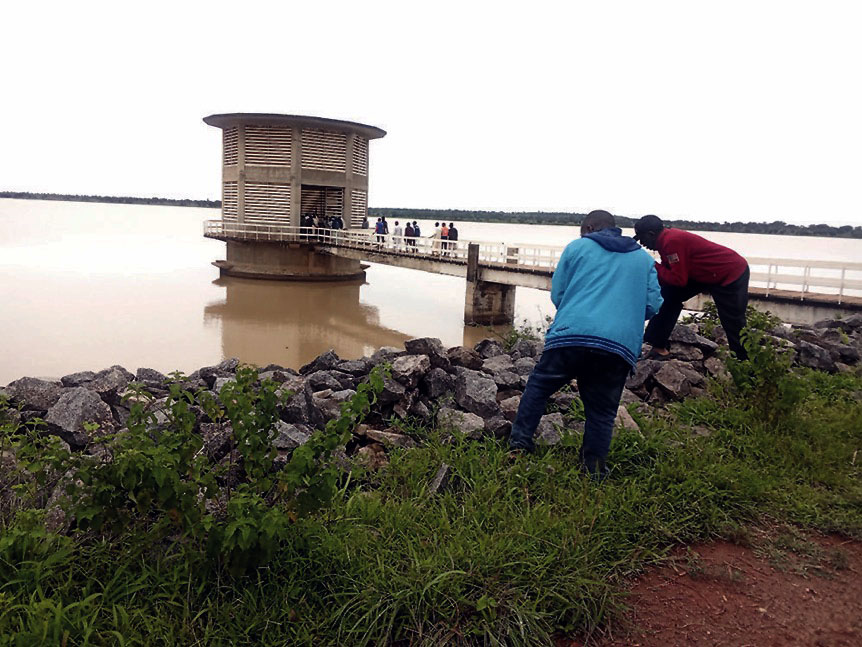
But following an assessment visit recently by dam safety specialists from the World Bank, alongside officials of the Kaduna State Government, the frightening story of an imminent collapse appeared to have little basis.
Our correspondent who was on the visit observed at the dam site that there were no visible signs suggesting that the structure was on the verge of giving way.
Rather, the assessment visit provided an opportunity to examine the condition of the facility, while also bringing into sharp focus the challenges confronting the communities that depend on it.
The State Project Coordinator of the Sustainable Power and Irrigation for Nigeria Project (SPIN), Engr. Hashim Jafaru Usman, who led the state delegation, dismissed the collapse claim as a rumour.
“I’m sure with what you people have seen today, it’s not true that the dam has collapsed. The dam is stable and it is okay,” Usman said.
He added that, from what the officials knew at the time of the visit, “we have not yet seen anything wrong with the structure of the dam.”
The reassurance was significant for residents who had watched the social media reports circulate with anxiety.
One of them, Rabiu Jibrin, a community member from Dadin Kowa, a neighborhood village, was visibly relieved after the inspection.
“This dam, which people are saying has cracked, there is nothing like that, it’s a mere rumour,” he said.
According to him, visitors had come to inspect the facility and found no indication of the alleged danger.
“The dam is very, very good. There is nothing wrong with it, there is no crack,” he said, expressing appreciation to the officials and specialists for coming to see the situation for themselves.
While the assessment may have calmed fears about an imminent collapse, the visit revealed another reality: the people living around Kangimi Dam have challenges that are perhaps less dramatic than a collapsing dam, but are far more immediate and persistent.
The journey to the dam from the Mararaban Jos area of Kaduna is a difficult one. The approximately 14-kilometre access road is in such poor condition that residents said it has become a major obstacle to economic activity and access to essential services.
For farmers, the bad road means greater difficulty transporting harvested crops to markets. For health workers, it has become one of the reasons cited for reluctance to work in the area.
For residents, it turns what should be a relatively straightforward journey into a painstaking experience. The community leader Malam Husaini Zubairu also drew attention to the sorry condition of the road leading to the dam.
He appealed to the Kaduna State Government to urgently intervene, stressing that improved infrastructure would accelerate development in the area.
The message from the community was therefore clear: the rumour of a collapsing Kangimi Dam may have been dispelled, but the people themselves are still waiting for long-standing problems to be addressed.
They want a road that vehicles can travel on without difficulty. They want health workers who will remain in their communities. They want enough teachers for their children. They want improved security.
They want better maintenance of the dam and its irrigation infrastructure.
And they want an environment where farming, fishing and livestock activities can flourish.
Ibrahim Galadima, another resident, described the condition of the road as “very critical.”
“When we harvest our farm produce, and we need to go to the market to sell them, we suffer. We suffer to take these crops to the market to sell,” he said.
The road problem becomes even more serious in emergencies. Another resident, Musa Zubairu recounted how, for years, seriously ill patients have had to be transported by motorcycle because of the poor state of the road.
“If we have a patient, or somebody died, we take such persons on motorcycle to go to the hospital,” he said.
In the event of death, he said, even corpses sometimes had to be transported on motorcycles because of the difficulty of moving vehicles along the road.
The residents say the road is not merely an infrastructure problem, it affects virtually every aspect of life in the community.
The communities around the dam also face a severe shortage of health personnel.
Although there is a health facility in the area, residents said the clinic is inadequately staffed.
“We have the hospital, but we don’t have the doctor and sometimes, only one woman attending to our patient,” Zubairu added.
Another person, Hussaini Galadima painted a similar picture, saying the community has only a small clinic and that health workers posted there are sometimes reluctant to report for duty.
“The condition of our hospital is very critical. We have a small clinic,” he said.
He attributed part of the problem to the poor road and insecurity.
“Sometimes they complain about the road, sometimes they complain about the insecurity issue. So, this is one of the reasons why, in our clinic, we have only one staff,” he said.
The residents are, therefore, appealing to the Kaduna State Government to renovate the health facility and provide adequate personnel.
“We are expecting the State government to repair our hospitals, to renovate it, and to post new workers,” Galadima said.
Education is another major concern.
Residents said there are primary and secondary schools in the area, but the shortage of teachers is undermining effective learning.
“We have the primary school and secondary, but we don’t have the teachers. Now, our problem is lack of teachers,” one resident said.
He appealed directly to the state government to deploy more teachers to the community.
“I will call on the Kaduna State government to help us with more teachers in our village, to teach in our primary and secondary schools”, he said.
Galadima said the problem persists despite teacher postings, with some teachers reportedly seeking transfers or being moved to other locations.
“We are facing problem. Lack of enough teachers,” he added.
His appeal was simple: “We are begging the State governor, Uba Sani to post enough teachers to make our school better for learning.”
For all its challenges, the Kangimi Dam area is a community built around productive possibilities.
The majority of the inhabitants are farmers, while fishing is also an important livelihood for residents living around the water body.
Malam Rabiu Jibrin described himself as a farmer, while pointing out that others in the community engage in fishing.
The dam therefore represents much more than a piece of water infrastructure. It is central to the economic life of the people.
Engineer Usman said the Kaduna State component of the SPIN project is expected to significantly expand agricultural activity around the scheme.
According to him, the irrigation scheme currently has about 87 hectares of existing cultivated land, but the plan is to develop it to approximately 1,500 hectares.
“This scheme has an existing land that is being cultivated of about 87 hectares, but now we want to increase it to develop up to 1,500,” he said.
The expansion, he explained, could allow farmers to cultivate throughout the year.
“What will happen if we can get up to 1,500 hectares of land that will be cultivated all year round here, during the rainy season and dry season?” he asked.
For Kaduna State and Nigeria generally, such expansion could have implications for food security and agricultural production.
“Really, it will improve, boost the agricultural production in the country, not only the state,” Usman said.
Perhaps one of the most striking sights during the visit was the women moving along the rough road on motorcycles, carrying raw cattle milk towards Mararaban Jos on Kaduna /Zaria highway for sale.
The scene offered a glimpse into another layer of the rural economy around Kangimi.
The women, navigating the difficult road with their precious produce, embody the determination of residents whose livelihoods depend on getting agricultural and livestock products to market despite the infrastructure deficit.
For them, a better road is not simply about convenience. It means getting milk to buyers faster, taking farm produce to market with less risk of damage, accessing healthcare when necessary and connecting the community more easily with the rest of Kaduna.
Although residents rejected the collapse rumour, some said the dam itself still requires maintenance.
Galadima said the facility is in good condition but called for rehabilitation and removal of vegetation and sediment around the dam.
“The dam is in good condition, but what we need for this dam is to dredge it, to remove grasses and dig it deep,” he said.
He called for work that would “repair the dam, and “renew it.”
The concerns align, in part, with the broader intervention being contemplated under the SPIN project.
Usman said the immediate priority was dam safety and that the state was preparing to engage consultants for a comprehensive safety assessment and management plan.
“We are to do some kind of rehabilitation regarding the safety of the dam because the most important thing is to have safety,” he explained.
“For now, we are preparing to engage some consultants to prepare dam safety assessment. Then, also, we want to engage another consultant to prepare dam safety management.”
He said the documents would guide efforts to ensure that the dam remains safe.
“These are the documents that we’ll be using to see that the dams have been kept safe,” he said.
The Sustainable Power and Irrigation for Nigeria Project is not limited to Kaduna State.
Usman explained that the programme covers all 36 states and is designed to improve water resources management and dam safety.
“SPIN is here… it’s not only for Kaduna State, it’s for the whole country, for the whole 36 states,” he said.
According to him, the project aims “to improve the water resources management and to improve the dam safety for the people of the state.”
For Kangimi, however, the success of such an intervention will ultimately be judged not only by the condition of the dam itself, but also by how much it improves the lives of the people living around it.