Follow Us on Google
From Aloysius Attah, Onitsha
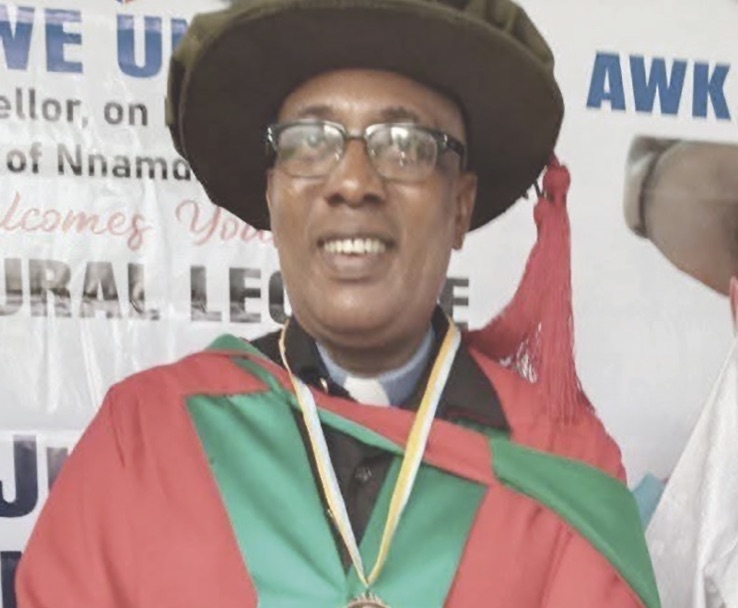
Prof. Ikenga Kenneth Emeka Oraegbunam is a man of many parts. He is a Catholic priest of Onitsha Archdiocese, university lecturer and seasoned lawyer.
He recently spoke about how the vices of corruption, unnecessary delay in trials, wrongful conviction and other vices perpetrated in the judicial arm of government fuels what he described as “judicial injustice” in Nigeria.
Fr. Ikenga, a triple Ph.D holder, professor of law and applied jurisprudence, Faculty of Law, Nnamdi Azikiwe University, Awka held the audience spellbound while delivering his inaugural lecture, the 116th of the university. Speaking on the lecture topic, “The ‘Justice’ of Judicial Injustice in Nigeria: Any way out of the paradox, Fr. Ikenga noted that in pursuit of justice, the law seeks to balance competing interests, protect vulnerable individuals and promotes the common goal.
He pointed out instances where the application of law has led to outcomes or perceptions that justice was not fully achieved. He listed some reasons for this situation to include perceived bias or influence, a situation where some judicial decisions are influenced by external factors like politics or powerful individuals.
Gaps in law enforcement, which he noted poses a challenge in effectively enforcing laws, leading to impunity for some and lack of accountability. Others included lack of access to justice, actual bias in treatment of high profile cases, tension between security and human rights, corruption and impunity.
Ikenga, who is also a member of the University’s Governing Council, pointed out that judicial injustice is a reality in Nigeria, noting that such occurs when the legal system fails to deliver fair and impartial justice, often due to corruption, bias, or procedural irregularities. This situation, he said, can lead to miscarriage of justice, erosion of public trust and undermining the rule of law.
Judicial injustice, he said, can be in the form of: “Wrongful convictions – convicting innocent individuals due to faulty evidence, coerced confessions, or other forms of investigative misconduct. Unfair trials – denying defendants fair hearing, manipulating evidence or allowing external interference in the judicial process. Corruption – judges or court officials accepting bribes, showing favouritism, or engaging in other corrupt practices. Delayed justice – failing to conduct trails or deliver judgments in a timely manner, causing undue hardship or uncertainty for parties involved.
He listed causes of judicial injustice to include corruption, lack of independence and inefficiency.
“Bribery and graft are widespread within the judiciary with 61% of survey respondents believing that judges are likely to accept bribes to influence rulings. The judiciary is often subject to political interference, with judges facing pressure to make decisions that align with the interest of those in power. The judiciary is also plagued by bureaucratic hurdles, inadequate infrastructure and outdated laws, leading to significant delays in the adjudication of cases,” he stated.
He gave three instant examples of ‘judicial injustice’ in Nigeria seen in scenarios like the annulment of June 12, 1993 Presidential Election, the 2007 Presidential Election Ruling and the 2023 Presidential Election Tribunal Ruling.
“The Supreme Court’s silence during the annulment of the presidential election of 1993 widely regarded as Nigeria’s most credible electoral process, marked a dark chapter in the nation’s history. The Supreme Court’s decision to uphold Umaru Musa Yar’Adua ‘s victory in 2007 despite substantial evidence of electoral malpractice underscored the judiciary’s vulnerability to political influence while the Supreme Court’s dismissal of petitions challenging Bola Ahmed Tinubu’s victory in 2023 general election despite evidence of electoral irregularities further dented the court’s credibility,” he maintained.
He listed consequences of judicial injustice in Nigeria to include erosion of public trust, hindered economic development, social inequality, miscarriage of justice and social unrest.
Fr. Ikenga also listed indices of judicial injustice in Nigeria to include over reliance on technicalities, undue delays in adjudication and awaiting trail monster in Nigeria judicial systems. He said that in Nigeria, the relationship between reliance on technicalities and doing substantial justice is multifaceted.
He lamented the negative effects of delay in justice delivery system in Nigerian courts on the overall justice system and the people seeking justice.
“Unnecessary delay is a monster wrecking silent havoc in the nation’s temple of justice. The popular maxim ‘justice delayed is justice denied’ is quite ad rem. It is the duty of a good judge to cause judgment to be executed without delay. The delay in justice delivery that has characterized the judiciary in Nigeria has not only frustrated litigants and denied many people justice, it also eroded confidence in the courts. People who waited for years without justice now describe the courts as the lost hope of the common man,” he lamented.
Fr Ikenga faulted the current creation of only one Supreme Court in Nigeria and small number of Supreme Court judges, noting that the current structure of the judiciary in Nigeria promotes delay in justice delivery.
“We have many high courts in Nigeria, and the other courts of coordinate jurisdiction, including Court Martials, that feed the Court of Appeal, and all the divisions of the Court of Appeal feed the one and only Supreme Court. The constitution says the Supreme Court could have 31 justices but for years they never had their full complement. That means there are cases at the Supreme Court that can last for eight to nine years. How can that be justice? So, what is the remedy? It is to restructure the judiciary. Unfortunately, most people appointed into political offices do not want to shed power,” he lamented.
Dwelling more on the issue of corruption in the temple of justice in Nigeria, Fr. Ikenga said there have been allegations that some judicial officers involved in corruption, often in cahoots with some lawyers, frustrate cases, ultimately denying people justice. He cited Independent Corrupt Practices and other Related Offences Commission which reported in December 2020 that a survey it conducted between 2018 and 2020 indicated that a whopping N9.4bn was paid as bribes for justice
“The commission reported that the money involved in the high –level corruption in this sector was categorized into money demanded, offered or paid. Demands are made by court officials, while bribery offers and payments are made by lawyers and litigants.”
In establishing the paradox of judicial injustice in Nigeria, Fr. Ikenga expressed regret that despite the country’s constitution guaranteeing access to justice, many Nigerians find it difficult to access justice due to financial barriers, delays and inefficiencies, corruption and limited access to legal aid.
The consequences of this paradox, he noted, are far reaching, which include lack of public trust, injustice and inequality on the system leading to a credibility crisis in the judiciary which ultimately threatens the foundation of democracy.
On the way forward, he pointed out that judicial reforms remains crucial in Nigeria to ensure the delivery of justice that is efficient, timely and accessible. He pointed out several measures to address the situation which he said includes working for legal and judicial reforms through judicial activism .He said there is a compelling need for our judges to embrace the growing trend towards judicial activism, which prioritizes substantial justice over technicalities.
“Judicial activism entails that judges take an active role in interpreting laws to promote justice, protect rights, or address societal issues.”
According to him, other measures to address the malaise include streamlining procedural rules, enhancing judicial competence and promoting transparency and accountability. Also included are appointment of more judges, reforming the court structures, upgrading of infrastructure, periodical review of emolument of judicial officers and strengthening the independence of the judiciary.
“I challenge our governments, National Judicial Council, Judicial Service Commission, Code of Conduct Bureau, judicial officers, legal practitioners, universities, law teachers and indeed all that are connected with legal and judicial systems to live up to their various roles. It will be disastrous if the Nigerian judiciary is not positioned to instill law, order, harmony and justice,” he stressed.
Pro-Chancellor and Chairman of UNIZIK Governing Council, Monsur Olugbenga Kukoyi, also a lawyer, in a remark shortly after the inaugural lecturer was decorated with a medal of honour, praised Prof. Ikenga for delivering an incisive, well researched and timely lecture. He said he was extremely proud of Fr. Ikenga not just because he is a council member of the university but his dexterity in the legal profession and jurisprudence which both of them happened to belong to.
The pro-chancellor prayed that as Fr. Ikenga journeys on, he will continue to do more exploits having proved his mettle over and again even as he praised the brilliance and dexterity he brought into the lecture. While congratulating him for a splendid outing, Kukoyi noted that both the external and internal governing council members of the university turned out to witness the inaugural lecture.
The immediate past acting vice chancellor of Nnamdi Azikiwe University, Prof. Carol Arinze -Umobi, described Prof Ikenga as her “son in whom she is well pleased.”
Umobi recalled having supervised Fr. Ikenga’s first degree and Ph.D and their journeys over the years in the university. She remarked that only professors who have delivered their inaugural lectures are qualified to be initiated into the ranking of academic masquerades, enjoining others who have not done so to prepare.
The inaugural lecture was witnessed by Catholic Archbishop of Onitsha, Most Rev. Valerian Okeke represented by Rev. Prof. Dom Obielosi, Catholic Bishop of Awka, Most Rev. Paulinus Ezeokafor, legal luminaries, traditional rulers, friends and associates of the inaugural lecturer, among others.