Follow Us on Google
• Sir Mike Okiro’s 2012 proactive security plan gained ministerial backing but stalled in bureaucratic red tape
• As student abductions escalate nationwide, stakeholders demand the recall of ex-police chief to spearhead emergency school defence framework
By Sunny Osa Irabor
As Nigeria battles a devastating wave of school abductions and rising insecurity, a pioneering, decade-old blueprint designed to shield the nation’s youth from terrorist attacks has resurfaced at the center of national discourse.
The “Save Our Children Project”—originally conceived in 2012 by former Inspector-General of Police (IGP), Sir Mike Okiro—is facing renewed scrutiny following a direct mandate from President Bola Ahmed Tinubu ordering emergency interventions across the federation’s vulnerable educational institutions.
The visionary and the catalyst
The architect of the initiative, Sir Mike Okiro, possesses a unique vantage point shaped by decades in top-tier law enforcement, including playing a pivotal role in the disarmament of Niger Delta militants.
“Many of these tragedies could have been prevented if the victims possessed basic security consciousness and if government had implemented a proactive strategy,” said Sir Mike Okiro, the former Inspector-General of Police
Okiro conceived the strategy in 2012, deeply disturbed by the initial spike in civil strife, sectarian violence, and the early, traumatizing waves of mass student abductions across the North-East. Recognising that conventional, reactive military operations were not enough, Okiro sought a preventative approach. He envisioned a “soft” or non-kinetic security management strategy to stop the slaughter and kidnap of innocent teenagers before crises could escalate.
A two-pronged defence strategy
The core objectives of the “Save Our Children Project” are engineered to transform defenceless schools into hard targets through a structured, two-pronged approach:
1. The Human Firewall (Train-the-Trainer)
The project aims to bring school principals and teachers into intensive, expert-led security awareness workshops. Utilising a globally recognised “train-the-trainer” model, educators learn personal safety protocols and crisis management, returning to their respective institutions to pass the vital knowledge down to teenagers.
2. Specialised Elite School Policing
Modelled directly after the United States Department of Homeland Security, the initiative outlines the creation and deployment of a specialized police squad dedicated strictly to school security. This unit’s primary objective is to deter opportunistic bandits and guarantee rapid response times to distress calls.
The blueprint’s core objectives
Other News
• Educate teenagers on real-time security awareness and personal safety during active crises.
• Reduce high casualty rates directly resulting from a lack of safety awareness during breaches.
• Instil a lifelong culture of security consciousness and civic patriotism within the youth demographic.
• Establish a nationwide early-warning network of security-conscious youths to gather critical local intelligence.
Federal endorsement and bureaucratic stagnation
Given its heavy educational focus, Okiro’s NGO, the Security Awareness and Justice Foundation, formally presented the proposal to the Federal Ministry of Education. While initially designed to launch as a pilot programme across the nation’s 103 elite Unity Schools before a nationwide rollout, the project was immediately bogged down by intense administrative bureaucracy, clearance delays, and systemic inertia throughout successive administrations.
Timeline of the project and key milestones
September 2012: Filed by Sir Mike Okiro under President Goodluck Jonathan, stalled by administrative hurdles
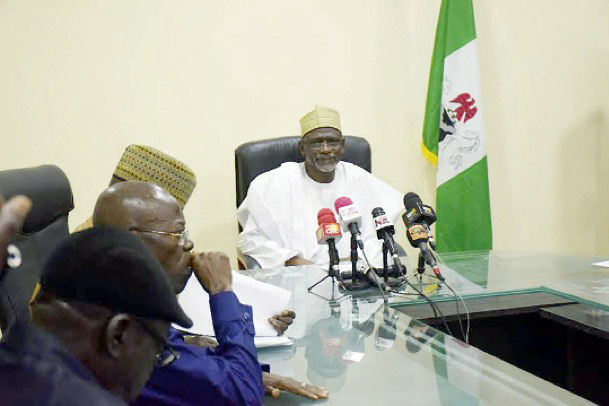
April 2018: Formally revitalised and endorsed by Minister of Education, Mallam Adamu, Central Working Committee inaugurated
Post 2018: Stalled again due to ministry funding shortages and internal resistance from sidelined officials.
During the high-profile 2018 inauguration of the project’s committee, the Education Minister explicitly endorsed the initiative, validating Okiro’s warnings. The Minister acknowledged that intense parental fear had already triggered massive school closures, declining attendance, and a severe reluctance by teachers to accept postings to high-risk regions. Despite this high-level political backing, the project was archived due to a lack of immediate funding and internal friction within the ministry’s bureaucratic ranks.
The call for action
Today, the security landscape has rapidly degenerated far beyond the geographic borders of the North-East, with recent mass abductions of students and teachers striking deep into Oyo State.
With President Tinubu now forcefully ordering the Ministry of Education and state governments to deepen the implementation of the Safe Schools Framework, the archived 2012 blueprint has transitioned from a historical footnote to a critical asset.
As the original copies sit waiting within the Security Awareness and Justice Foundation, prominent stakeholders are making a resounding call to the Federal Government: bring back the original mastermind, Sir Mike Okiro, to officially spearhead, fund, and mobilise this vital national defence strategy before more classrooms are emptied by bandits.