Follow Us on Google
…Pushes Skills-to-Jobs agenda
The International Labour Organization (ILO) has stepped up support for African countries to translate the African Union’s Continental Technical and Vocational Education and Training (TVET) Strategy 2025–2034 into practical reforms aimed at strengthening skills systems, improving labour-market linkages and expanding pathways to decent work.
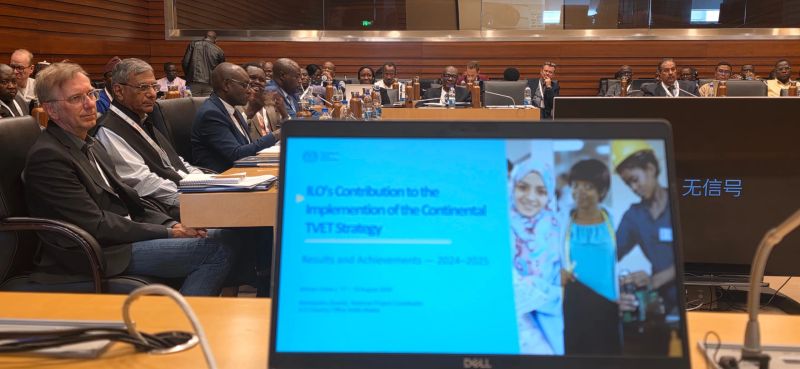
The ILO’s role was highlighted at a recent Conference on Accelerating Domestication of the Continental TVET Strategy 2025–2034, held at the African Union Headquarters in Addis Ababa, Ethiopia.
The conference brought together governments, technical and vocational education and training (TVET) authorities, social partners, development partners and training institutions to move beyond continental policy commitments and develop practical approaches for national implementation.
The ILO, which provided technical support during the development of the Continental TVET Strategy, is also contributing to its implementation through policy and governance reforms, quality apprenticeships, recognition of prior learning, green and core skills, labour-market information, institutional capacity building and regional knowledge exchange.
The scale of the organisation’s intervention is reflected in its recent figures. Across Africa, ILO-supported skills and lifelong-learning initiatives reached more than 250,000 people in 2024–25, with support provided in 30 countries. Twelve countries also updated their skills or TVET policies, while 10 advanced apprenticeship reforms.
For participating countries, the ILO’s comparative advantage lies in helping governments connect skills development policies with the realities of labour markets and the needs of employers and workers.
“From Tanzania’s perspective, we see the ILO’s support as critical in translating the Continental TVET Strategy into practical national reforms,” said Twaha Adam Twaha of Tanzania’s National Council for Technical and Vocational Education and Training, NACTVET.
Twaha stressed the need to align TVET policies and programmes with sectors capable of generating employment, boosting productivity and driving economic transformation. He also called for stronger collaboration between training institutions and employers, alongside improved quality assurance, recognition of prior learning and certification for workers who acquired skills in the informal economy.
Other News
“The ILO should play a facilitating and convening role,” Twaha said, emphasising the importance of social dialogue involving government, employers, workers and TVET institutions. He described the organisation as a potential “bridge between policy and practice” as countries develop practical roadmaps for implementing the continental strategy.
In Malawi, participants cited the ILO’s support for recognition of prior learning (RPL) as an example of how international technical assistance can be translated into national systems. A Malawian participant said the organisation had been a key actor in championing RPL and the Decent Work Agenda, while urging greater attention to quality apprenticeships and green skills.
The ILO is also supporting the development of Malawi’s Labour Market Information System, designed to centralise labour-market statistics for evidence-based policymaking and workforce planning. More than 200 national labour-market indicators covering employment, unemployment, wages, education and skills are being developed and populated with verified national data.
The Malawian participant further called for greater awareness of the Continental TVET Strategy and closer alignment between national policies, TVET programmes and continental priorities, with the ILO playing a facilitating role among regulators, training providers and social partners.
A delegate of the Sub-Saharan Africa Skills and Apprenticeship Stakeholders Network (SASASNET) described the ILO’s contribution as “strategic and transformative,” citing its work on policy and governance reform, financing, quality apprenticeships, recognition of prior learning, work-based learning, green and core skills and labour-market information systems.
The delegate also highlighted the ILO’s role in promoting international labour standards, providing policy guidance and supporting regional and national programmes that link skills development with decent work and sustainable economic growth. The Continental TVET Strategy itself is built around four foundations: policy, governance and finance; quality and inclusion; partnerships and knowledge; and institutional development and innovation.
The task ahead, participants said, is to turn the continental vision into effective country-level implementation, sustained investment and coherent skills systems that respond to the needs of workers, enterprises and rapidly changing labour markets. Through its tripartite mandate, the ILO said it would continue working with governments, employers’ and workers’ organisations and TVET institutions to build inclusive and responsive skills systems capable of equipping Africa’s growing youth population for productive employment and decent work.