Follow Us on Google
Challenge stakeholders on closing the $2.3 trillion infrastructural gap
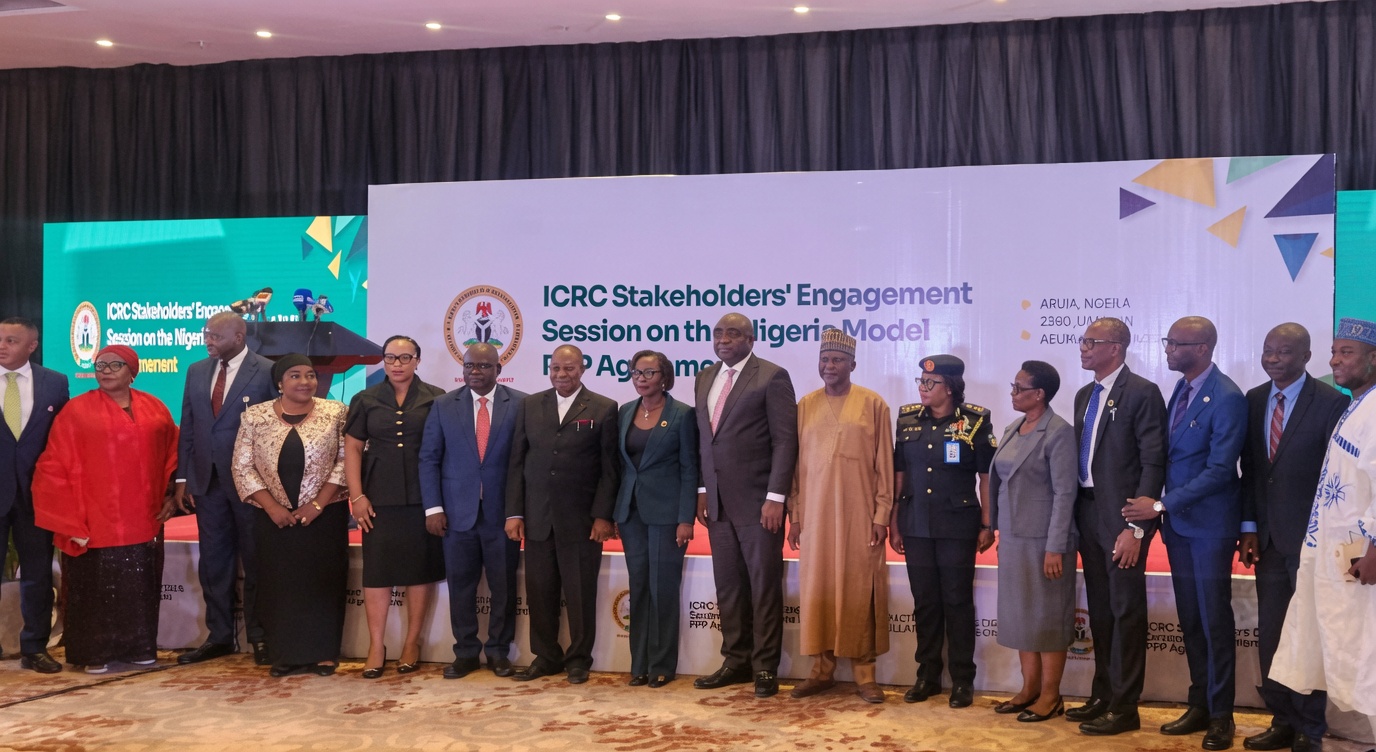
The Infrastructure Concession Regulatory Commission (ICRC), in collaboration with the Federal Ministry of Justice, has reiterated the need for stakeholders to comply with the Public–Private Partnership (PPP) Model Agreement as a prerequisite for economic development.
The Director-General of the ICRC, Dr Jobson Ewalefo, and the Solicitor-General of the Federation, Mrs Beatrice Jedy-Agba, jointly made the call in Abuja on Tuesday during the unveiling of the Nigeria Model Public-Private Partnership (PPP) Arrangement.
In an opening speech, Dr Ewalefo highlighted the scale of Nigeria’s infrastructure deficit, describing the estimated $2.3 trillion gap—covering roads, power, railways, hospitals, water systems and digital infrastructure—as a critical national challenge for a country of over 230 million people.
He stated that bridging the gap by 2043 would require mobilising approximately $100 billion annually, adding that government revenue alone, even under disciplined fiscal management, would not be sufficient.
“No federal budget, however ambitious, was ever designed to finance a nation’s entire infrastructure programme from the treasury alone. This is not an admission of weakness; it is simply a matter of arithmetic,” he said.
He added that the administration of President Bola Ahmed Tinubu had made clear that the Renewed Hope Agenda would depend significantly on private capital, expertise and innovation aligned with public purpose, with PPPs now central to Nigeria’s development strategy.
Ewalefo said Nigeria had, for nearly two decades, under the ICRC Establishment Act of 2005, implemented PPPs on a project-by-project basis, often leading to inconsistent negotiations, duplicated frameworks and investor uncertainty.
He noted that this approach resulted in prolonged negotiations, weak risk allocation structures, litigation in disputes and hesitation from lenders due to inconsistent protections such as step-in rights and termination compensation clauses.
According to him, the Model PPP Agreement was developed to eliminate the need for MDAs to “start from a blank page”, instead providing a standardised, legally grounded framework aligned with Nigerian law and global best practices.
He explained that the framework was developed through consultations with legal experts, transaction advisers, MDAs, investors and international partners and was refined into “Version 1.0” as a living document subject to periodic review.
Ewalefo stressed that the model agreement is not a one-size-fits-all template but a reference framework to guide project-specific negotiations and reduce transaction costs, delays and disputes.
Other News
He said key provisions include structured risk allocation, balanced default and termination regimes, lender protection through direct agreements and step-in rights, and a graduated dispute resolution mechanism culminating in arbitration in Abuja under the Arbitration and Mediation Act, 2023.
He further noted that the agreement establishes insurance frameworks, distinguishes between force majeure and changes in law, and embeds anti-corruption safeguards and performance monitoring systems, including KPIs and periodic reviews overseen by the ICRC.
According to him, the goal is to ensure predictability for government, protection for investors and performance delivery for the public.
He added that MDAs would still be required to engage competent advisers and submit adapted agreements for statutory review by the ICRC as part of governance safeguards rather than bureaucratic delay.
Speaking at the event, the Solicitor-General of the Federation and Permanent Secretary, Federal Ministry of Justice, Mrs Beatrice Jedy-Agba, said the Model PPP Agreement represents a shared vision for efficient governance and sustainable development.
She said the document was developed through collaborative engagements, including PPP lawyers’ retreats in Uyo and Lagos, which brought together legal experts to refine contractual frameworks and strengthen transparency, accountability and value-for-money principles.
Jedy-Agba noted that PPP contracts carry complex long-term legal and financial risks, requiring strong legal oversight to protect government interests and prevent unfavourable risk allocation or litigation exposure.
She said the Ministry of Justice had strengthened its internal capacity, with law officers undergoing specialised training in infrastructure law, commercial risk analysis and project finance to ensure robust legal due diligence.
She added that the Model PPP Agreement would help standardise contractual expectations, balance investor protection with public interest and reduce costly contractual failures.
Former Director-General of the ICRC, Dr Mike Ohiani, said the development of the model agreement had been a complex but necessary process aimed at improving Nigeria’s PPP framework.
He said the model is expected to reduce bottlenecks in doing business and strengthen investor confidence, thereby attracting both local and foreign investment into the economy.