Follow Us on Google
By Lukman Olabiyi
In the labyrinthine corridors of Nigerian public service, a technocrat’s journey is a precarious tightrope walk. Balancing the intricate interplay between politics, law, media pressure and public perception requires more than just expertise, it demands resilience, strategic acumen and an unyielding commitment to integrity.
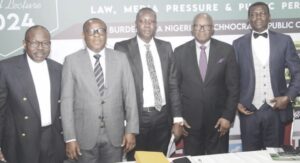
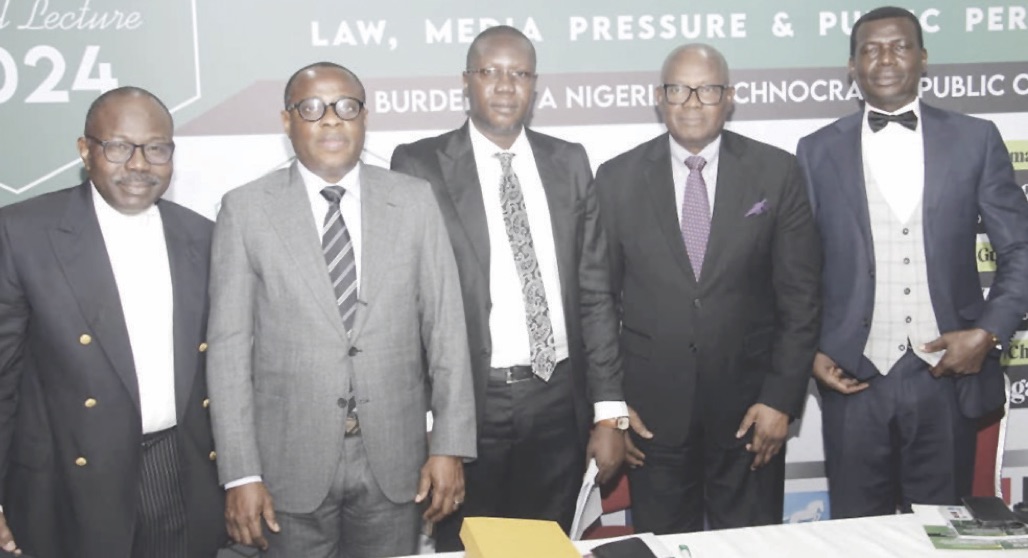
These were the submissions of experts, scholars and journalists at a recent public lecture organized by the National Association of Judiciary Correspondents (NAJUC) in Lagos.
The event, titled “Navigating the delicate balance between politics, law, media pressure and public perception: The burden of a Nigerian technocrat in public office,” featured insights from stakeholders across the economy and public service.
The public lecture, an annual event of NAJUC, attracted many stakeholders and dignitaries from different sectors of the economy and public service.
Various speakers and contributors at the event reiterated that, for technocrats to survive the muddy water of politics in the country, they must develop a keen understanding of political dynamics and cultivate alliances that will enable them advance their objectives without compromising their principles.
The lead speaker at the event, a former chairman of the Asset Management Corporation of Nigeria (AMCON), Dr. Muiz Banire, a senior advocate of Nigeria, called on technocrats in the public service to persistently interact with the legal community if they are to survive the muddy water of politics. He emphasized the importance of understanding political dynamics and building strategic alliances.
According to Banire, technocrats must engage actively with the legal community to navigate political waters successfully.
Enumerating several factors that constitute burden on technocrats in public offices and inhibit their performances, Banire, a former commissioner of environment and transport in Lagos State, said technocrats must be conscious of the environmental and legal restrictions that limits their ability while in office.
According to him, some of these include due process, redtapisim, administrative bottleneck, cultural and religious considerations, public perception, legislative interference and media pressure. He said all these factors place great burden on technocrats in public office in Nigeria.
Citing the case of in-house technocrats (civil servants), Banire said these species of technocrats are now in more precarious situation.
He said: “ln-house technocrats are now in more precarious situation. They are not only demoralised by insecurity of tenure, terminal growth for them is becoming an illusion. They therefore hardly have much to look up to again. Worse still, their renumeration package has pushed them into penury.
“Politicians treat them as dregs, affording them no serious recognition.
Consequently, not the best in recent times is derivable from the in-house technocrats who now have joined the bandwagons of politicians to scoop whatever they can access while in office. This is the country’s story.”
To overcome these challenges, Banire said technocrats in public offices must be vigilant and make sure that they put in their best and ensure that they make inputs when laws concerning their areas/offices are being enacted.
“In doing this, technocrats must work and collaborate with the legal community, be above board and ensure that their dealings in office are ethical and transparent,” he added.
Other News
Earlier in his remarks, the chairman of the occasion, George Etomi, said for democracy to thrive, the country needs strong and vibrant media and the judiciary. He said that looking at Nigeria, the level of patriotism is very low, adding that hardly can you see an American/European running down their countries in the social media, while the contrary is the case in Nigeria.
He added that “it is we, Nigerians, that can build the country and we can’t build it by running it down in the media.”
He said media, politics and the judiciary are interwoven in the building of a strong democracy.
In his own contribution, a journalist turned lawyer, Ola Agbaje said media wields significant influence in shaping public perception and can be a formidable ally or adversary.
He said: “For technocrats, media scrutiny is an ever-present reality. Positive media coverage can bolster their initiatives and enhance public trust, while negative press can swiftly undermine their efforts and credibility.
“Technocrats must engage proactively with the media, ensuring transparent communication and providing accurate information. Building relationships with journalists and media houses can help in navigating the often volatile media landscape.
“However, they must also be prepared to handle misinformation and negative press with poise, addressing concerns head-on while maintaining focus on their objectives.”
In his welcome address, the NAJUC’s chairman, Olugbenga Soyele, said for the past 34 years, the association has remain dedicated to ensuring that the administration of justice is accessible to all, regardless of their background, social status and economic circumstances.
Soyele said its agenda is being executed through the association’s lecture series, news reports, commentaries and other activities.
“NAJUC’s inaugural lecture was delivered in 1990 by the late legal luminary, Justice Augustine Nnamani, a Justice of the Supreme Court of Nigeria.
“We are proud to say that the calibre of judges, lawyers and journalists that have delivered this annual lecture, such as the late Justice Akinola Aguda, late Chief Richard Akinjide, late Chief Gani Fewehinmi and Professor Itse Sagay, to mention a few, have greatly enriched and deepened national discuss and conversation through their well-researched papers.
“We had intended to publish these papers in a book for posterity, but unfortunately, we lost the entire collection of papers, along with other valuable documents and properties, to the callous destruction of our secretariat at the then-oldest court in Nigeria, the Lagos State High Court in Igbosere, during the #Endsars 2020 protest.
“As with previous years, our topic for this year’s lecture was carefully selected. It aims to interrogate and suggest solutions to some of the many problems facing Nigerian society, particularly in the wake of the 2023 general elections, which turned into a tribal and religious contestation instead of what it should have been: recruiting capable leaders,” he said.
At the event, human rights lawyer, Ebun-Olu Adegboruwa, a senior advocate of Nigeria, received an award of excellence for his outstanding contributions and dedication to legal practice, media freedom and human rights enforcement in Nigeria.
Also, at the event , two versatile journalists, Joseph Jibueze of The Nation Newspaper and Joseph Onyekwere of The Guardian Newspaper, who have since become editors in their respective organisations, were also honoured for their contributions to the media profession and the association.