Follow Us on Google
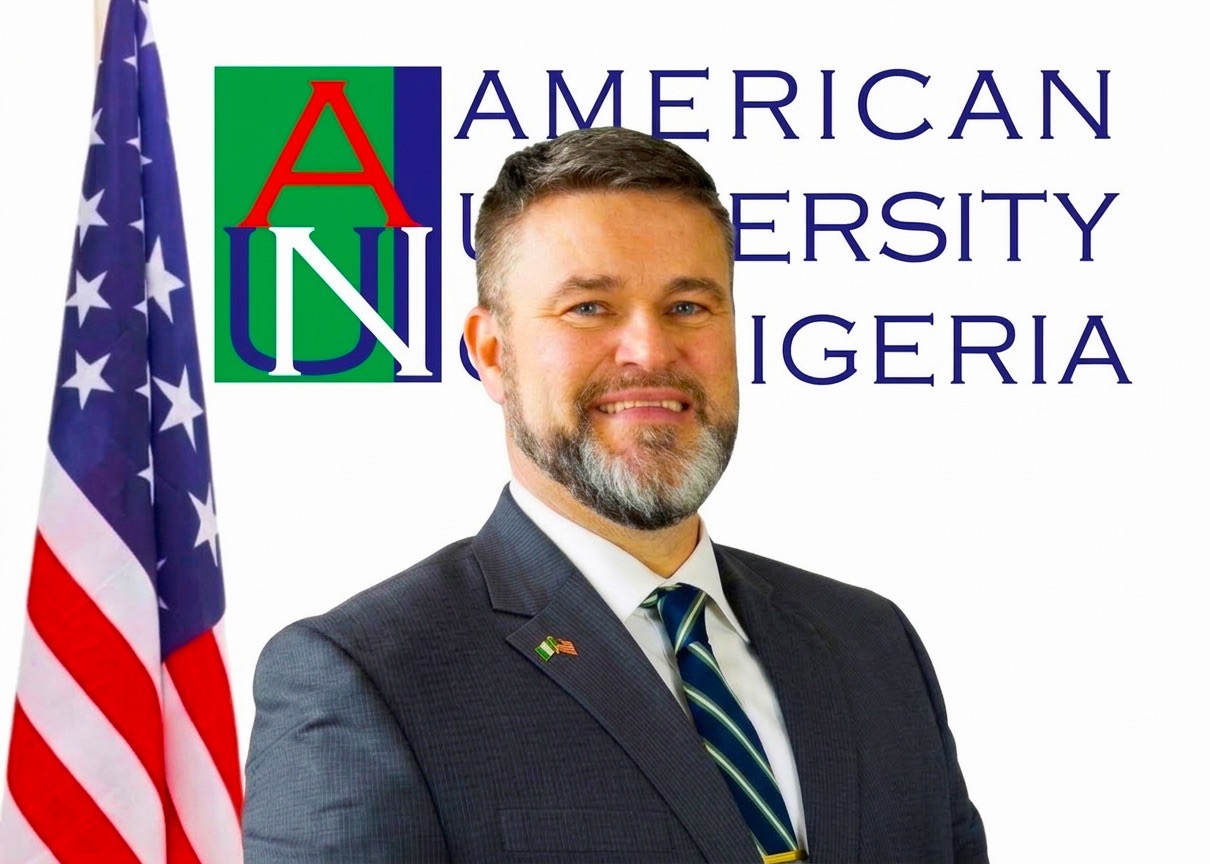
By Calvin Anadio Lawan
In 2023, Prof. DeWayne Frazier assumed leadership of AUN in2023 as its sixth president. The choice was significant. AUN is not simply another private university competing for students inNigeria’s increasingly
crowded higher-education market. Founded in 2003, it was conceived as Africa’s first Development University and one ofthe continent’s earliest American-style universities. That distinction imposes a different responsibility. A conventionaluniversity can measure success largely through enrolment, graduation rates, academic programs, rankings and financial
sustainability. A development university has to ask anotherquestion: what difference does all this knowledge makeoutside the university? Frazier appears to have embracedprecisely that question. From his earliest statements as president, he placed students at the center of the institution whilerepeatedly emphasizing service, leadership, critical thinking andengagement with society. He has described AUN as a place where students should not simply acquire
qualifications but develop the capacity to become problem-solvers and responsible citizens. That distinction is important.
Nigeria does not suffer from a complete absence of educated people. It suffers, among other things, from a deficit of institutions capable of converting education into social and economic value. The difference between education anddevelopment is therefore not knowledge alone. It is application. And that is where AUN’s experiment becomes particularly fascinating. Frazier himself has described AUN as “a private university with a public mission.” That may be one of the most revealing descriptions of his presidency. The institution has continued to expand its
academic and physical infrastructure while strengthening itsstudent experience. During the 2025/26 academic year, AUN reported record enrolment, expanded academic programs,
stronger financial performance and improvements ranging fromdigital learning infrastructure to its health clinic, housing, dining, security and energy efficiency.
It launched the AUN 360 mobile application and continued developing partnerships with institutions and organizationsincluding Purdue University, the Tony Elumelu Foundation, the
U.S. Department of State, UNFPA, UNESCO and ActionAid. These developments matter because development is not produced by goodwill alone. It requires institutions. It requires systems. It requires academic capacity, technology, partnerships, financing, infrastructure and people capable of converting ideasinto programs. This is the administrative side of Frazier’spresidency. But there is another side. The human one.
Perhaps this is where the recent story of Frazier’s personal community service becomes most compelling. According to theaccount compiled by AUN’s Marketing and Communications team,
Frazier personally funded a remarkable range of interventionsacross communities in and around Adamawa. He paid schoolfees for 25 children in Wuro Modibo. He financed solar
improvements for a community water borehole. He supported graduating Chibok girls with preparations for their graduation. Heorganized free haircuts for graduating students. He spent personal funds providing food and snacks to Almajiri children. He participated in Ramadan
feeding initiatives. He supported Easter outreach to Christian communities. He provided food, clothing and essentials to orphanage communities. He supported healthcare initiatives. He donated footballs for youth development. He pursued skills-development partnerships. And he did something else that mayultimately be more consequential than any individual donation: He allowed students to see him doing it.
Because there is a profound difference between telling a youngperson that service matters and allowing that young person to watch the president of his or her university spend his own time, money and energy serving people. One is instruction. The other is example. This may be the most important dimension of Frazier’s leadership. Universities teach through curricula. They also teach through culture. A student may forget a lecture. Astudent may forget an examination question. A student may even forget the exact content of a course. But students rarely forget the culture of an institution. They remember what the institution celebrated. They remember what its leaders consideredimportant. They remember whether service was merely printedin a prospectus or actually lived. And AUN appears to be making service increasingly experiential. In 2026, the university reported that 496 students participated in community-service activities
during one semester, recording more than 1,000 hours of serviceand directly reaching 2,536 beneficiaries.
The significance is not merely numerical. It suggests a cultural movement. Freshmen are introduced to service early in theirAUN experience. Students participate in education, health, advocacy, legal assistance, orphanage support, infrastructure projects and other community initiatives. Even the university’s Law Students Society has connected legal education with
community advocacy. This is what happens when the classroombegins to leak into the
community. The student does not merely learn about society.The student encounters it. There is a phrase that captures what AUN under Frazier increasingly represents: the university
without walls. The wall separating campus from communitybecomes less important. An engineering student can encounterinfrastructure problems. A law student can encounter
access-to-justice challenges. A business student can encounterentrepreneurship and livelihood constraints. A health student can encounter communities where healthcare remains
inaccessible. A political science student can encounter therealities behind statistics about poverty, inequality and social exclusion. And suddenly education becomes different.
It becomes tactile. It becomes human. It becomes difficult to remain indifferent. This is particularly important in Adamawa,where the challenges confronting communities are not theoretical. Poverty, displacement, educational exclusion, inadequate infrastructure,
unemployment, insecurity and weak access to services are lived realities. A university that positions itself within such anenvironment cannot afford to be an island of privilege. It has to become part of the solution. This is perhaps where the story becomes larger than one man.
Frazier did not invent AUN’s development-universityphilosophy. But his biography seems unusually compatible with it. He grew up understanding poverty. He experienced the
transformative power of education. He built a career aroundeducational access, international engagement and institutional leadership. He believes strongly in service. And he now leads a university whose founding idea is that education should contribute to development. The
convergence is almost perfect. His personal history givesemotional meaning to the institutional mission. The institutionalmission, in turn, gives scale to his personal philosophy. That iswhy his community interventions should not be viewed merelyas philanthropy. They are expressions of a worldview.
There is also an important distinction to make. Giving someone food is charity. Helping a child remain in school is aninvestment. Repairing a water system is infrastructure. Creatingaccess to skills training is capability building. Connecting students to communities through service learning is human-capital development. Building partnerships between a university and public institutions is institutional development. This is why the most interesting part of Frazier’s approach is not the generosity itself. It is the apparent attempt to move between immediate
relief and longer-term capability. The school fees help today. The education can change tomorrow. The food addressesimmediate hunger. The university experience that teaches
students to confront the causes of depr ivation addressessomething deeper. The football may appear trivial. But youth engagement, belonging and positive social activity are part of
community development too. Development is rarely one grandintervention. It is accumulated through hundreds of seemingly modest acts that expand people’s choices.