Follow Us on Google
…Don dissects country’s economy, proffers solutions at Ojukwu varsity’s 11th inaugural lecture
By Agatha Emeadi

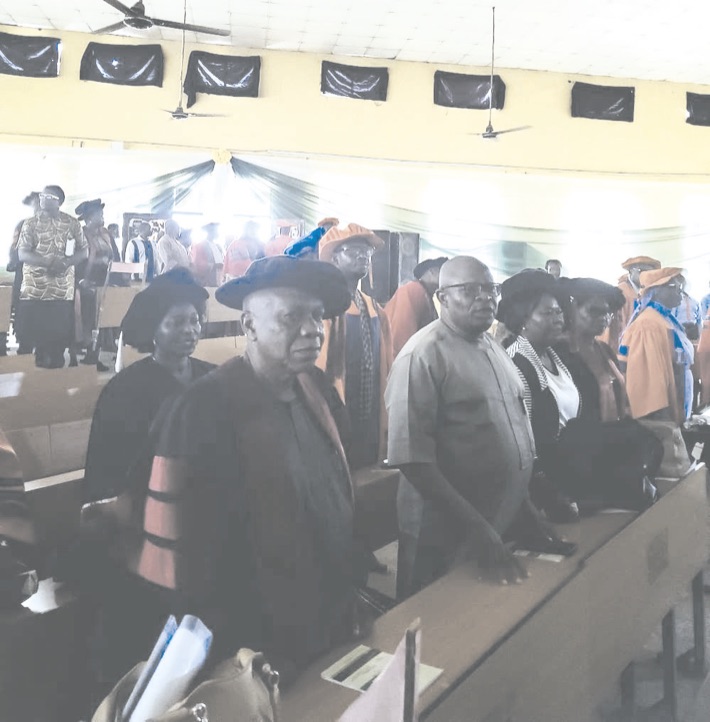
Participants at the inaugural lecture
A don at the Chukwuemeka Odumegwu Ojukwu University (COOU), Prof Ellis I. Idemobi, recently gave the country so much to ponder about. After years of rigorous studies, Idemobi of the Department of Business Administration of the university came out with what he considered a recipe for saving the Nigerian economy currently in the doldrums.

* Prof. Idemobi during the presentation of his inaugural lecture
It was Idemobi’s view and verdict that Nigeria can rebound if only the leaders accept to implement some radical recommendations he rendered. A professor of Business Management and Entrepreneurship, he spoke recently at the 11th inaugural lecture series of the former Anambra State University, now Chukwuemeka Odumegwu Ojukwu University (COOU), Igbariam.
According to University of Nigeria Nsukka (UNN) website, an inaugural lecture “is a way of letting people know what academic/research activities a professor has carried out over the years and what his/her future research interests are.” Therefore, it was Idemobi’s day in the sun and he dazzled brilliantly, showing the stuff he was made of.
The title of his lecture on the occasion was, ‘Sustainable development pursuit with entrepreneurship and wealth creation on the run: the paradox of Nigeria.’ And he proceeded to break down the Nigerian economy, examining what went wrong and proffering professorial solutions.
According to him, “national development usually refers to the ability of a nation to improve the lives of its citizens.” He noted that this “includes all aspects of the life of an individual and the nation, full-growth and expansion of industries, agriculture, education, social, religious and cultural institutions.”
He maintained that “researchers have long referred to the phrase ‘wealth of nations,’ originally linked to Adam Smith’s legendary socioeconomic work published in 1776,” wherein he, “Smith, had argued that by giving everyone freedom to produce and exchange goods as they pleased (free trade) and opening the markets up to domestic and foreign competition, people’s natural self-interest would promote greater individual prosperity and national development.”
Idemobi went on to pose the question: ‘How then do we measure national development?’ He answered it by himself, saying: “Measures of national development, may be material, such as an increase in the Gross Domestic Product of a nation. It can also be social such as literacy rates and availability of quality healthcare services.”
Citing the legendary British economist Dudley Seers he posited: “The questions to be asked about a country’s national development are the following: what has become of poverty? What has happened to unemployment?What is the state of socio-economic inequality?”
According to Idemobi, “if all three have declined from high levels, then development has occurred; but if one or two of these central questions have grown worse, especially if all three have, it would be wrong to call the result ‘development’ even if Gross Domestic Product (GDP) has improved.”
Idemobi was emphatic that “in the Nigerian situation, all three factors have been on the increase, meaning that real national development has not occurred.
“Nigerian state with current population put at 216,139,589 that is equivalent to 2.64% of the total world population and the country ranking number seven in the world list of countries by population has long been fraught with a lot of paradoxes of development.”
He lamented that “many writers have opined that Nigeria since independence in 1960 has had a catalogue of wasted dreams, bungled opportunities and deferred hopes. Majority of Nigerian citizens became impoverished,” recalling that his previous works in (Idemobi 2012) “Rich nation with poor citizens: the paradox of Nigeria,” has long been in public discourse.
He is unhappy that “theoretically, the abundance of natural resources in Nigeria is expected to promote long-run economic growth, but on the contrary, we have seen that resource-abundant countries perform poorly in terms of economic growth and prosperity compared to resource poor countries.”
Dwelling on what he called ‘The resource curse hypothesis,” he informed that “indeed researchers over the years have wondered if the discovery of oil in Nigeria has become a curse rather than a blessing.
“As it has frequently been underlined by some poverty theories, Nigeria seems to be a prime example of the curse syndrome that natural resources can bring to nations.”
He recalled how “a few years ago, the Economist Magazine based in London referred to this phenomenon as the ‘resource curse syndrome.’
“This hypothesis holds that developed countries with great natural wealth fail to diversify their industrial base or invest in education, agriculture, health and infrastructure leading to long-term economic decline and poverty.
“Some countries with valuable mineral resources such as oil in Nigeria, Angola and Venezuela, diamond in Democratic Republic of Congo and Sierra Leone, are today among the poorest in the world. And there seems to be a negative relationship between natural resource abundance and a nation’s output and prosperity.”
His conclusion on this is that “clearly the wealth of a nation is not only under the ground but above it.”
Looking at Nigeria, what he sees over the years is that “its development indices have remained bleak because the country has been unable to maintain a trajectory of improving economic development through creating more jobs for the ever expanding workforce and providing basic infrastructure and services, such as electricity, good roads, bridges, water supplies and stable agricultural supplies.”
He further said: “There is no doubt that Nigeria has been badly affected by decades of wrong choices for its development actions,” adding that Nigeria was better that China and Singapore in 1960, but now both have long shot ahead.
Then dropping another bombshell, he declared: “Material success has very little or nothing to do with God or miracles.”
Touching at the heart of the matter, Idemobi said: “Looking at the countries that are doing well in the world, one will see that national prosperity has nothing to do with religious beliefs or special favours from God but putting in place right public policies that encourage hard work, ingenuity, resourcefulness and innovation.”
His view is that unlike these other countries that witnessed unprecedented economic growth over the past decades, Nigeria has not placed a great deal of store on hard work, discipline, education, innovation and growth.
“Nigeria has almost only seen several years of a monolithic oil economy and misplacement of growth objectives and policies that have combined to put entrepreneurship, wealth creation and innovation on the run.”
He see the challenges of doing business in Nigeria as a major drawback to the country’s march to progress. He listed five major challenges as “huge infrastructural gap, general insecurity, corruption and poor governance system, and the Nigerian factor syndrome.”
According to him, “these growth challenges have for long put entrepreneurship and wealth creation on the run and impeded economic development.”
He noted that it is our contention in this work that Nigeria can reverse some of these negative trends and factors that have so impeded her economic advancement.
“Our analysis pinpoints areas in which reforms are urgently needed in this country to enhance entrepreneurship pursuits and economic development objectives. They include dealing with infrastructure deficit that is stifling competition and killing businesses; finding a solution to the spate of insecurity that has paralyzed entrepreneurial activities in Nigeria; engaging in massive ethical re-orientation of Nigerians and promoting made-in-Nigeria products with import substitution strategy. He posited that our unemployment problem will be gone with these policies.
Idemobi is of the opinion that “we can close our economy to external goods and services for the next 20 years so as to get the Nigerian economy fully back on its feet and even lead the world, recalling that China did so for 30 years to get to where it is today.
According to Idemobi “the attitude of Nigerians to hard work in general and to made-in-Nigeria products in particular may be part of the problem; Nigerians should wake up and stop looking for external enemies and realize that they themselves may be part of Nigeria’s problems.
“It is like what the famous political thinker Plato called ‘like the people like the state’. ‘Leaders and the people together make a nation. It is like you cannot have a good firm with only a wonderful chief executive officer (CEO) and bad employees’.
He spoke harshly against the wind of ritualism sweeping through the country.
He said: “Imagine the alarming rise in ritualism among young ones, especially students, in the past few years. Ritualism is emerging as a major social problem in Nigeria; so many people believe money rituals are caused by the problems of the society. Many point at the ‘get-rich syndrome and the influence of the social media and Nollywood.
“What many do not know is that good things will not just happen, they will only happen if you make the effort. The high number of youth in Nigeria means that many are exposed to a mired of social problems and challenges.
“But why should a 17-year old that is expected to still live under their parents’ go into money rituals? It means the reason is far beyond unemployment.
“Some writers have posited clearly that success in life is nearly 80 percent personal effort and 20 percent luck. They say so because research evidence has shown that God has given everyone almost everything needed to succeed in life.
“I enjoin people to go and work hard as there are no other means of success. If you apply the 80/20 Rule you find that success is scarcely by luck. In life pursuits as it is in business, the goal of the 80/20 rule is to identify inputs that are potentially the most productive and make them the priorities.”
He added: “We are yet to learn that ‘wealth and success’ have principles and these are-product, services and hard work.
“If indeed you want to be successful in life, you have got to work hard to achieve it. The only equation we know about success is hard work + opportunity. Education is not just the learning of facts but the interpretation of facts to improve one’s life.”
Then turning to the youth, he said: “Your degree certificate is only a means to an end and not an end in itself. Unless you keep your degree certificate in a safe place for future opportunities and then engage in entrepreneurial activities, chances are that you will die poor.
“You have got to venture to succeed. Entrepreneurs are great at dealing with uncertainty and also very good at minimizing risk. That is the classic great entrepreneur.
“The rich and poor are always separated by ideas. What ideas do you have for a new product or service? Can you develop and offer something new that makes the existing one obsolete?
“Your degree can only help you think better than someone without a degree. Be prepared to get your hands dirty and work like an OX to build your business and build the nation. With the support of our leaders and the government, your hard work will pay off.
“Think success! Think entrepreneurially! Every family has a person who breaks the chain of poverty. You may be the huge blessing to your family.”
He gave recommendations that can make Nigeria rebound. He says: “We need regional co-operation in infrastructure provision because a strong relationship exists between the quality of the business environment, investment climate and long-term national economic performance, including the pace of employment generation and poverty reduction.
“Need for ethical re-orientation; Nigerians in general need to be mobilized behind the cause of saving our country in the form of a new ethical re-orientation. We must all begin to see the common good in our country’s survival.
“Government must take the lead in reducing social, political, religious, economic tensions and increasing confidence in the nation’s leadership.”
He also spoke about increased attention on improving security nationwide, and greater focus on local production.
He urged Nigerians to deemphasize leaving so much to natural selection.
According to him, “National prosperity has nothing to do with religious beliefs or special favours from God, rather it has everything to do with putting in place right public policies that encourage hard work, ingenuity, resourcefulness and innovation.
“A society is prosperous only to the degree to which it rewards and encourages entrepreneurial activities because entrepreneurs and their activities are the critical determinants of the level of success, prosperity, growth and opportunities in any economy.
He called for urgent “implementation of institutional and policy reforms to deal with the largely unfavorable business environment that have long militated against the growth of private enterprises.