Follow Us on Google
By Maduka Nweke, [email protected]
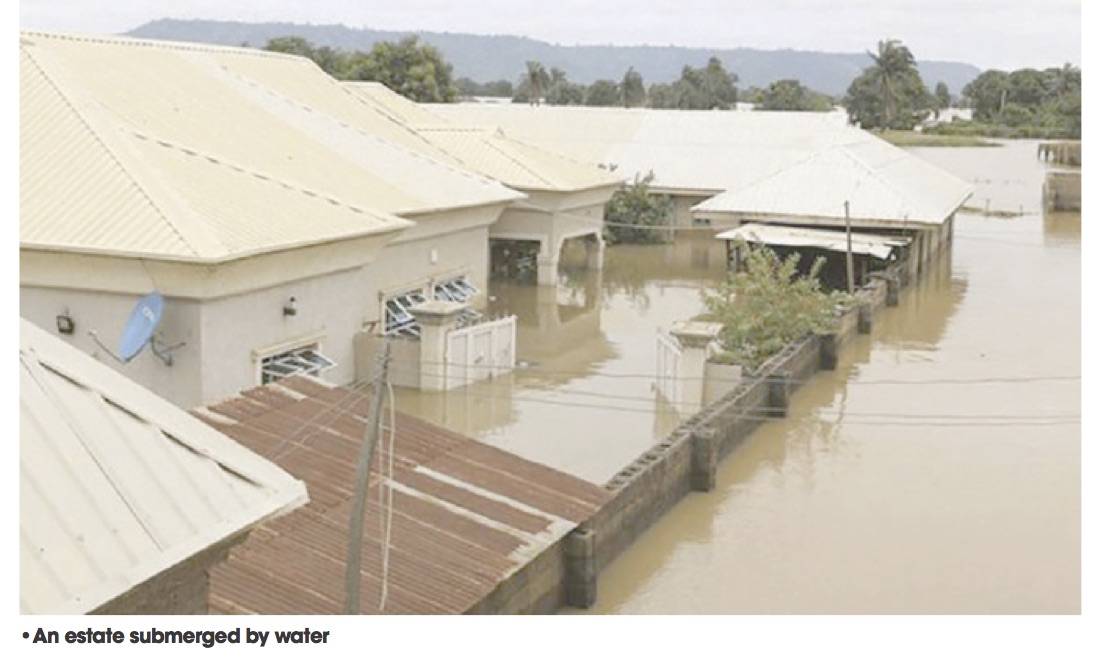
As Nigerians worm up for another round of flooding, the National Emergency Management Agency (NEMA), recently warned of worse flooding in 2023 if necessary precautionary measures are not taken and on time too.
The National Emergency Management Agency is an agency in Nigeria that focuses on disaster management in all parts of the country. The agency was established in 1999, and functions to formulate policies relating to disaster management in Nigeria. NEMA carries out its job in collaboration with the meteorological department.
The meteorological department collects data; provide weather advice and guidance to federal, state, and local agencies; conduct research; and develop methods for integrating new science and technology into the forecast process. For one to fight flooding to a square, one must be able to understand the texture of the soil in the area and then plan the suitable landscaping. It takes a turn in one’s saving but if it is done best the first time, it saves worries.
Recently, the Director-General of NEMA, Mustapha Mohammed, gave the flood warning when he appeared before the Senate Committee on Special Duties to defend the agency’s 2023 budget. He lamented that early warnings given to states this year by NEMA were ignored. According to him, “Let me also use this opportunity to prevail on the committee to intervene on our behalf. We have written to states several times. This flood is still coming in 2023,” he said.
The NEMA DG, who gave the warning at a two-day Experts’ Technical Meeting on 2023 Climate-Related Disaster Preparedness and Mitigation Strategies recently in Abuja, said there had been seasonal climate predictions and annual flood outlooks by the Nigerian Meteorological Agency (NiMet) and the Nigeria Hydrological Services Agency (NIHSA). He said last year’s flood disaster in the country was an eye-opener for NEMA and warned that the agency would disseminate early warning messages and signals to states, local government areas and Federal Capital Territory (FCT).
Ahmed said: “We have started early this year, as we are ready for early warning and early action. We will bombard every citizen, state and local government areas with this information as we want them to know that it is serious. We will not keep quiet. We want them to know that there will be flood this year”. He urged Nigerians living around water channels and flood plains to relocate to safer grounds. “This time, we came out early with this prediction and we expect that relevant actors, governments and individuals will go to work. We expect that actions should be taken, especially at the sub-national levels, early enough, to mitigate the impact of flooding in the country,” the NEMA boss added.
But, no matter the information, Nigerians who live along coastal areas will always have stories to tell as far as flooding is concerned. Whenever the rains come, a lot of people change their life style to suit their environments. Many states in Nigeria have become so vulnerable to flooding damages such that whenever rain starts consistently, being helpless, such states become apprehensive about the results of its outcome. But property and environment could be protected from sever flooding damages if precautionary measures are taken before the rains start to come. It was in this regards that NEMA advised early about setting up of SEMA and local emergency committee and fund them adequately.
NEMA said they gave similar warning last year, but such pieces of advice were ignored and not adhered to. Mohammed confirmed that the Federal Government had ordered distribution of 12,000 tonnes of grains to the 36 states, advising that state governments needed to do more in disaster management. But one would ask, what could these tones of grains do to the number of people targeted? So the solution is not the number of grains one has but how to check the system to avoid the damages that have become an annual ritual and nightmare to some citizens to reoccur.
We can understand that the storms have been worse lately and we are not imagining it. According to an American National Climate Assessment, there has been a dramatic increase in severe rainfall over the past thirty years. Therefore we will be getting less of the steady rain plants love, and more flash floods and hurricanes. As a result, homeowners and builders should focus on making landscapes more resilient to extremes. But Nigerians would wave scenarios like the hurricane by mere hands because such according to them is exclusive to foreign countries since Nigerias have not been experiencing it in our clime. But that we have not experienced it in the past does not take away the fact that since we cannot control nature, we should also not rule out the possibility of having it in our clime. That is why we should look for measures to checkmate the occurrence wherever the potentials exist.
With a few simple landscaping additions, one can mitigate damaging soil erosion and manage stormwater runoff. As a result, you will save thousands on property damage when the next deluge hits. It is obvious that without significant vegetation or porous surfaces to sink into, rain quickly sweeps across yards and streets. As a result of that, the water carries pesticides and sediment into the water system. Urban stormwater runoff is the leading contributor of water resource pollution, along with causing residential flooding. Because of the increasing strain on infrastructure and ecosystems, many cities are now charging homeowners with stormwater runoff fees in America and in other first world countries. Diverting drainage and reducing impervious surface areas will significantly lower the utilities bill.
As a result, using more eco-friendly options can lead to an abatement in many municipalities. Also, alternative options don’t have to be expensive for every one to assess.
Although there are no 100 percent guarantees to stop water from rising dangerously close to homes, some experts have offered some tips to aid in combating the problem. According to Mr. Malachi Muchika, an environmental expert based in Abuja, one should create a strong garden to soak up the rain water. He added that one should plant rain gardens using native plants, trees and shrubs. According to him,” One should update one’s home with anti-flood technologies, including permeable pavers and dry wells, disconnect downspouts, install sump pumps and rain barrels. One should also keep natural vegetative buffers between the lawn and any water and one should not mow lawns to the edge of rivers and streams,”he noted. Another environmentalist, Mr. Chike Obodoeze stated that in the event of looking for flood solutions, one should find peace with wet grasses. “Many Rouge neighborhoods were built on wetlands, and will always be wet. One should speak up in his neighborhoods when it matters on checking flooding and erosion. One should also understand how new developments can impact on property in terms of water.
Recently some indigenes of Anambra State made a frantic call to their Governor, Professor Charles Chukwuma Soludo to drop whatever plans for his smart city status for Awka if such efforts will not first tackle flooding. Some of the indigenes asked the governor to attract the Federal Government to dredge river Niger so that the bowel will be wide and deep enough to accommodate both flood and dam water.
Some of the indigenes who spoke to PropertyMart said that tackling flooding in the state will be a laudable project compared to projecting smart city status when majority of the towns are sailing on water. Speaking of the smart city in the pipeline for the government, Mr. Chidiume Okechukwu said that government should consider people’s priorities before taking or flagging off projects. “It is true we can have a city on water, but I don’t think Anambra State has got to that level of development where elitist projects like smart city will be top priority now. Governor should look for solutions to tackle flooding, erosion and things like that otherwise after the smart city, erosion will erode it down,”he said. He noted that if river Niger is dredged, it will not only save Anambra State from the ravaging flood. “All the coastal cities lying along river Niger and all the tributaries will be saved because the river Niger will have enough space to stomach the water (flood),”he pointed.
Another indigene, Mrs Akaluka Nwora, a cement dealer said that flooding has superseded other natural disasters in the state and unless something urgent is done before the rains come, the experience of the yesteryears will be a tip of the iceberg. She said, “a stitch in time they say, saves nine. If the government fails to make hay while the sun is shining, sorry will become the nickname of many families,”she said. She stated that when governments and affluent shots in the society keep reclaiming lands from the sea, they think the water was swallowed, they don’t know they are pushing the water to other areas. This is why dredging is the best option because you don’t push the water anywhere rather, you create space that can accommodate it,” she suggested.
An authority from New York Times in the environmental sector noted that to mitigate flooding, one could add drainage on the sides of the pavement. A more effective solution is to ditch the asphalt or concrete pad altogether. Gravel, spaced paving, and even grass can be used in making a driveway an asset in the rain. Designing with storm-water in mind will keep your wallet, yard, and environment a little greener in the long run and take your worries out of rainy days.
It will maximize their use by lining the lowest point with rocks and adding deep-rooting plants to the slopes. This results in slowing the water’s path to the drain. Because a swale directs flow, rather than stopping it, make sure that it’s channeling to somewhere excess water will be released safely. An area with frequent flooding should be directed into a dry well, or a garden bed with very good drainage and high water tolerance. To avoid utility charges, never have a swale draining straight off a property.
When building a rain garden, place plants with the highest wet-soil tolerance in the center. Those at the edge will drain fairly, quickly while the middle remains submerged. Using native plants is best whenever possible. They require little to no watering in between rainfall, making a more low-maintenance yard and cutting down on the need for harmful pesticides. Although similar to swales, rain gardens don’t redirect water. Instead, they provide a place for it to pool during a downpour. Hence, this allows it to slowly percolate back into the soil. Most range from 50-100 square feet. Even a small, inexpensive one can significantly reduce flooding and runoff. Low Impact Development (LID) has great resources for deciding the size and specifications appropriate for your property.