Follow Us on Google
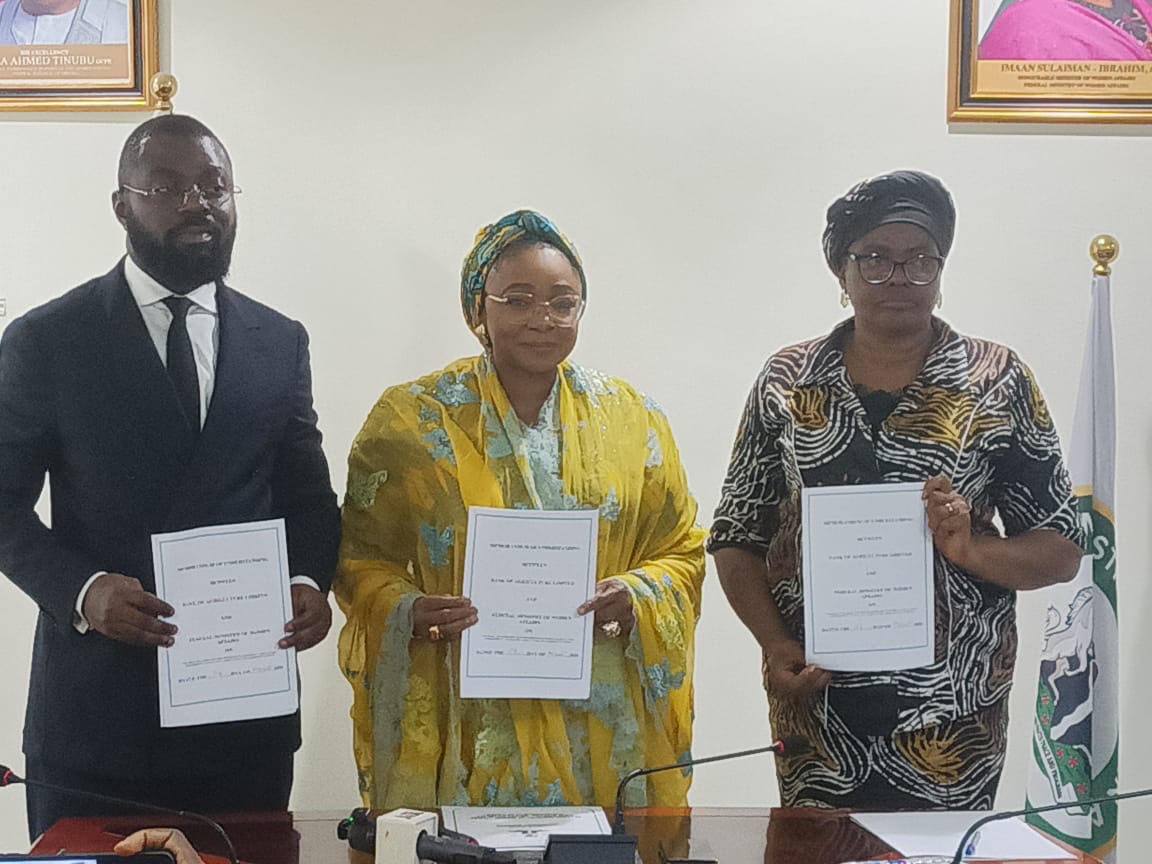
The Federal Government has signed a Memorandum of Understanding (MoU) with the Bank of Agriculture (BOA) to provide affordable financing, mechanisation and guaranteed markets for women farmers under the Renewed Hope Women Agro-Value Expansion (RH-WAVE) Programme, targeting at least three million beneficiaries over the next three to five years.
Speaking at the signing ceremony in Abuja, the Minister of Women Affairs and Social Development, Imaan Ibrahim-Suliaman, described the agreement as a major step towards addressing the long-standing exclusion of women from formal agricultural finance.
“Today is not a ceremony of paperwork. It is the moment two institutions decide to close, together, one of the most persistent gaps in our economy, the exclusion of women from formal agricultural finance,” the minister said while welcoming the Managing Director and Chief Executive Officer of the Bank of Agriculture, Ayodeji Sotinri, and his delegation.
The minister said women remain the backbone of Nigeria’s agricultural sector, accounting for the majority of smallholder farmers, yet continue to face significant barriers in accessing finance, infrastructure and markets.
She said the partnership aligns with President Bola Tinubu’s Renewed Hope Agenda by promoting inclusive economic growth that reaches women at the grassroots.
“This partnership is a direct expression of Mr. President’s Renewed Hope Agenda: inclusive growth that reaches the woman in the field, not just the boardroom,” she said.
According to the minister, pilot phases of the RH-WAVE programme in Nasarawa and Kaduna states demonstrated strong demand, with one implementing partner recording 33,000 expressions of interest from women farmers.
“What we need now is not more interest, it is the financing architecture and market discipline to convert that demand into lasting income. That is exactly what BOA brings,” she added.
The minister explained that RH-WAVE is the ministry’s flagship programme aimed at transforming women from subsistence farming into structured, bankable agribusinesses by supporting the entire agricultural value chain, including access to quality inputs, land, mechanisation, greenhouse farming, processing, packaging and market opportunities.
She said the collaboration would be implemented through three strategic pillars.
Under the first pillar, the partnership will provide concessional input financing to the first 10,000 women farmers through Farmer Aggregation Companies at interest rates below 10 per cent per annum. It will also establish a dedicated greenhouse financing window to support year-round, climate-smart agricultural production.
The second pillar will establish women-led agricultural hubs equipped with tractors, solar-powered dryers and processing facilities. The centres will be staffed predominantly by women and benefit from the Federal Government’s 40 per cent presidential subsidy on agricultural equipment.
The third pillar will create women’s aggregation channels that guarantee minimum purchase prices above prevailing market rates, ensuring stable incomes and direct access to produce buyers.
The minister said the initiative aims to reach at least three million women across Nigeria’s six geopolitical zones within three to five years.
Implementation will commence in Plateau, Kaduna, Katsina, Kano, Sokoto, Bauchi and Nasarawa states, selected based on existing beneficiary data before the programme expands nationwide.
She explained that the MoU establishes the governance framework for the partnership, including a Joint Steering Committee, a Programme Management Unit and State Coordination Nodes to oversee implementation.
“This is a framework of trust and intent. The specific financing and project terms will follow in the detailed agreements our teams will now develop,” she said.
The next phase, she added, will include joint mapping of Farmer Aggregation Companies, identification of AgriHub locations and programme design workshops.
Commending the Bank of Agriculture for joining the initiative, the minister said:
“You bring the finance; we bring the women, the reach and the mandate. Together, we make women-led agriculture bankable at scale.”
Addressing women farmers across the country, she added:
“This partnership is for you. Your work feeds this nation, and today this nation invests in you.”
On his part, Sotinri said the bank is targeting at least three million women farmers over the next few years through its partnership with the Federal Ministry of Women Affairs under the Renewed Hope Women Agro-Value Expansion (RH-WAVE) Programme.
He explained that the initiative is designed to close the financing gap facing women farmers and strengthen their participation across the agricultural value chain.
He said the programme aligns with President Bola Tinubu’s priorities of food security, agricultural development and women’s economic empowerment.
“We’re all clear on the priority the President has placed on the agricultural sector and food security, and we all know the role that women play when it comes to food systems in Nigeria,” Sotinri said.
He noted that while women already dominate farming activities across the country, access to finance remains their biggest challenge.
“This partnership between the Ministry of Women Affairs and the Bank of Agriculture is to fill the gap when it comes to access to finance because that’s where women need critical intervention,” he said.
According to him, the RH-WAVE programme allows women to participate in whichever segment of the agricultural value chain best suits their interests and capabilities, while also improving access to finance, education and digital tools needed to grow sustainable agribusinesses.
Sotinri disclosed that more than 33,000 women had already expressed interest in the programme during its pilot phase last year.
“In the next few years, we are targeting a minimum of three million women or more. We look forward to creating the right kind of excitement and momentum,” he said.
Responding to questions on the bank’s commitment to the initiative, Sotinri said BOA considers the programme both a development priority and a sound business proposition because women constitute the majority of Nigeria’s farming population.
“Our commitment stems from the need and necessity to lend to the sector. If you look at the demographics of farmers, most are women, and we must empower them within the agricultural space,” he said.
He explained that the bank would initially support about 200,000 women under the first phase by providing financing alongside productivity-enhancing tools that would enable beneficiaries to increase their incomes and improve their economic status.
Sotinri said the financing would be offered at single-digit interest rates to make credit affordable for women farmers, while beneficiaries would also receive improved seedlings and extension support to boost yields.
He stressed that increasing agricultural productivity remains critical to addressing Nigeria’s food security challenges.
“The most important thing in Nigeria’s agricultural sector now is increasing productivity. Many farmers still cultivate with poor-quality seeds, but with improved seeds they can significantly increase their yields,” he said.
The BOA chief also highlighted the programme’s mechanisation component, which will enable women farmers to acquire agricultural equipment under the Federal Government’s 40 per cent subsidy scheme.
Under the arrangement, beneficiaries will provide only about 25 per cent of the equipment cost, while the balance will be financed over three to five years, allowing them to generate income from hiring out the equipment and repaying the loans.
He said the bank would work through Farmer Aggregation Companies and women’s cooperatives to ensure loans reach genuine beneficiaries and achieve high repayment rates.
“There is always someone at the head of every cluster or cooperative. That person is responsible for ensuring the money gets to the right women farmers and that it comes back to the bank,” he said.
Sotinri added that the sustainability of the programme depends on strong loan recovery, noting that successful implementation would enable the bank to extend financing to millions more women and attract additional support from development partners.
“If the money comes back, we can give it to other women. The success of this programme will attract ministries, departments and agencies, as well as international development partners, because everyone wants to support a programme that works,” he said.